Money Left, Meaning Stayed, and the Clock Was Never Reset
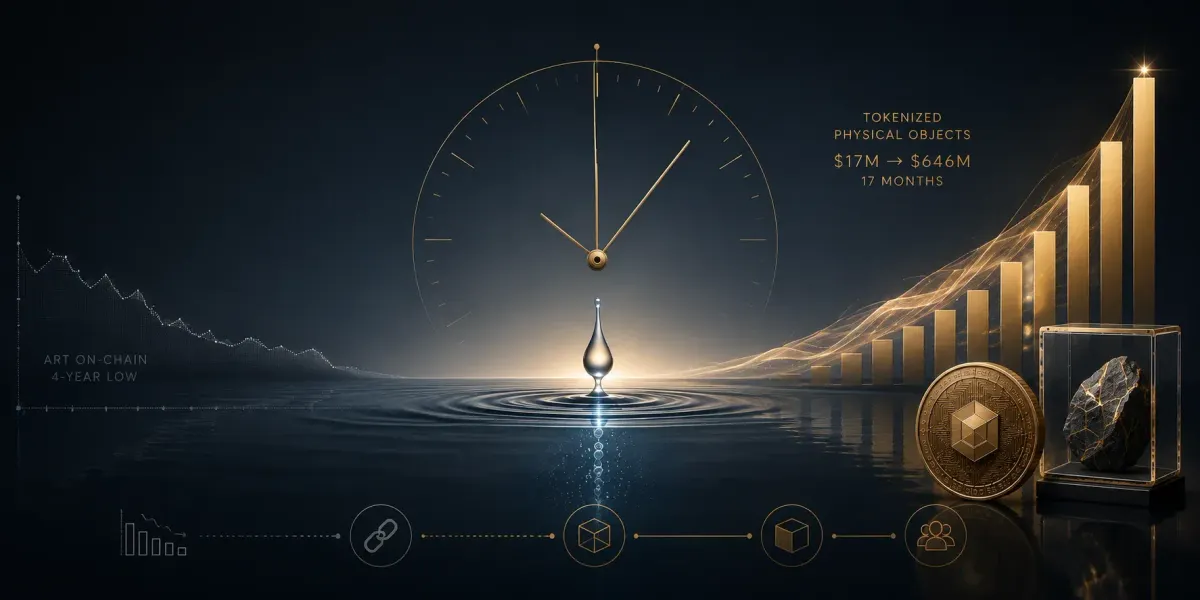
Monthly volume in tokenized physical objects went from $17M to $646M in seventeen months while art on-chain sat at a four-year low. The money didn't leave the category — it changed form. A measured reading of the digital-art record before NFT.NYC 2026.

A dual-lens reading of the 2026 record so far: digital art, NFTs, RWAs, and the art market that contains them
Numeric Humanism · Exoteric Verified Data + Declared Esoteric Instruments · August 26, 2026 · New York City · Directing Intelligence
Opening: Eight Turns, One Question, Three Days in Times Square...
This report is the eighth turn of an argument that began on July 15, 2026, and it is timed to land before NFT.NYC opens at the Edison Ballroom on September 1st.
The argument began with a number that did not fit. The H1 2026 Art+Tech Report, published by The Phygital Times on July 15, found the global art market back to growth near $59.6 billion while online art sales hit their lowest level since 2019 — and digital art entered the top three media by collecting spend among high-net-worth buyers. The channel contracted while the medium advanced. Those two lines do not belong to the same story, and everything since has been an attempt to find the story they do belong to.
The H1 2026 Art+Tech Report was developed independently, without knowledge of Christie’s Leads Resurgent Market 2026 First Half Report or its data. The two were published on the same day by coincidence.
What changed the picture came the day after.
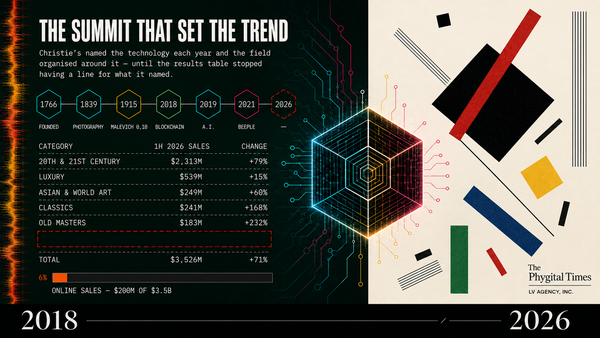
At the Christie’s Art+Tech Summit in New York on July 16, the framing question gradually became harder to ignore. By about 2:15 PM, it had become concrete enough to prompt a search, mid-Summit, for what the term “Art+Tech” was actually supposed to mean.
Digital art may have entered the conversation earlier in institutional or market terms, including through discussion of Christie’s former digital-art department, but a sustained discussion of digital art as an artistic medium did not emerge until later in the afternoon, around the 3:00 PM session.
Benedict Evans’s keynote, AI Eats the World, focused on AI as a technological and economic platform shift rather than on technology as an artistic medium. Across the day, the imbalance was difficult to miss: for a summit carrying Art+Tech in its title, relatively little of the programme was devoted to technology functioning as art itself.
“The Third Category” (29 July) made the case that the Summit had largely stopped arguing its own title—not out of malice, but because Christie’s had already folded digital art into its broader 20th- and 21st-century category and no longer maintained a dedicated digital-art department representing it as a separate field.
What followed was a sequence rather than a series. Edition 109 of "The Future of Collectibles" (30 July) took the argument to the collector side. "The Ledger and the Wave" (6 August) set the four patterns underneath it. "What a Collection Carries" turned the question toward stewardship — what a collection transmits across generations when the meaning and the record are two different layers. "The Wreckage Was Never Where the Word Puts It" answered the post-NFT narrative directly. The live-article hub gathered the whole run into one document kept current over time, with narrated editions. This report is the eighth, and it is the one the previous seven were building toward: not an argument about what the market means, but a measurement of what the market is.
Under Edition 109 of "The Future of Collectibles," the collector Sylvain Levy asked the question that reframed the whole sequence: whether phygital is the destination or merely a transition, and whether the next evolution is collections that function as intelligence systems rather than inventories. The answer filed in reply — that phygital is not the destination but the substrate, the ground the intelligence layer gets built on — was, until this report, a position held on conviction.
It is no longer. The measurement below supplies the evidence, and it arrived from an unexpected direction. Monthly volume in tokenized physical collectibles went from about $17 million in January 2025 to $646 million in June 2026 — a thirty-eight-fold increase over seventeen months, in the one segment that binds a token to a physical object — while art on-chain sat at a four-year low. The market did not choose the file. It chose the thing, with the record attached. That is the substrate thesis, arrived at by capital rather than by argument.
And it explains the title. Grail Capital’s July market letter called the contraction Money Out, Meaning In - a formulation this report gratefully borrows and then extends, because the accounting is not finished at that line.
Trading volume left digital art, but it did not leave blockchain-based collecting; much of the growth reappeared around physical objects on the same broader rails.
Meaning stayed, while institutional recognition continued to accumulate: MoMA had already brought CryptoPunks and Chromie Squiggles into its permanent collection; DATALAND opened in June; and the Whitney announced its artport: A History of Internet Art survey for November.
What nobody reset was the denominator. Many of the instruments still used to read this market translate ETH-denominated artworks into dollars through a currency that moved nearly sixty percent in eight weeks — even when no corresponding transaction in the artwork occurred. The industry has spent the summer watching the measuring instrument move and treating the movement as if it belonged entirely to the thing being measured.
Why publish now, and why here. Because the alternative is what is already circulating. A syndicated outlook reached this desk in late August projecting the NFT platforms market at an 8.5% CAGR through 2033, built entirely on 2021 revenue figures and forecasting an $80 billion market "by 2025" — a date already eighteen months in the past. A report that forecasts a year which has already happened is not a forecast. It is a template with a new cover date, and the industry keeps citing this class of document because nothing better is offered against it.
So this report offers something better, and offers it on terms anyone can check. Every exoteric figure below is sourced to a named publication with a date attached. Every conversion between dollars and ether is arithmetic shown in full. Where the analysis uses declared esoteric instruments — Khlebnikov's law of temporal shifts, the Di Tian Sui's vocabulary for composition, Nakamoto's proof of sequence — they are labelled as instruments, not evidence, which is the whole discipline of the dual-lens method: the verifiable and the interpretive kept in separate columns, and the reader told which is which.
Where it lands. The Phygital Times Podcast carries the argument in parallel through the sub-series Art+Tech: The Summit That Set the Trend, operating as a Web3 news and education channel before, during, and after the conference. Reporting from NFT.NYC—including dated observations and post-event log entries—will be produced after the event, turning what happens in the rooms into part of the record rather than attempting to narrate it in real time.
On Thursday, September 3, at 10:30 AM in the Edison Ballroom, the scheduled panel is “Artists and Why They Create” - which, read in the context of everything below, is not as soft a question as its title might suggest. It is the one question the measurement below cannot answer—and the one that survives a drawdown of this depth.
The SurR.Ai practice has also submitted SurR: SurRaiya V8T1 to the NFT.NYC Community Artists Showcase, with final selection for the Times Square billboards or gallery still pending. Whatever the curatorial outcome, the work stands as the practice’s own answer to the same question: human-authored, AI-amplified, and made to exist in both worlds.
The week also marks four years of SurR.Ai — an archive begun over the July 4th weekend of 2022 and now past 2,500 works. The activation around it is called The Grand Alignment, and this report is its opening document.
The market entering NFT.NYC 2026 is smaller, more concentrated, and better understood than the one that entered NFT.NYC 2025. Those three facts are not in tension. What follows is the measurement that shows why.
I. The exoteric lens
The recovery is a currency event. Here is the arithmetic.
At the time of writing on 25 August, total NFT market capitalisation stood at approximately $2.11 billion, compared with $1.30 billion at the end of June and $1.54 billion at the end of July. On its face, that amounts to a 62% recovery in less than eight weeks.
Ether over the same window went from a June 30 close near $1,570 to a August 24 close near $2,480—up 58.0% in less than eight weeks.
Price the market in the unit it actually trades in:
| Date | NFT market cap (USD) | ETH | NFT market cap (in ETH) |
|---|---|---|---|
| 30 Jun 2026 | $1.30bn | $1,558 | ~834,000 ETH |
| 25 Aug 2026 | $2.13bn | $2,506 (24 Aug close) | ~850,000 ETH |
| Change | +63.8% | +60.8% | +1.9% |
The market grew 64% in dollars and 1.9% in ether. Sixty-two of those sixty-four points are the denominator. July alone was worse: +18.5% in USD, −1.8% in ETH. Daily volume across art and PFP collections ran near $2 million through July, and total NFT sales volume printed $2.85 million in the last 24 hours — against a $2.13 billion capitalisation. That is a stock with almost no flow.
Any headline this autumn announcing an NFT or digital-art recovery, and any USD-denominated index reporting a strong quarter, should be checked against this table before it is repeated.
The Canon 8, marked to today
The Canon 8 closed Q2 2026 at 38.3 on a base of 100 at 1 January 2022 — down 12.6% on the quarter, down 40.0% year to date. Its constituent floors softened across the set in late June; CryptoPunks closed the quarter at a $50,719 floor and roughly $507 million in market value, a quarter of the index by weight. In July the ETH-denominated floors were flat to positive.
Mark that 38.3 forward on a single assumption — constituent ETH floors unchanged since 30 June, which July's prints roughly support — and the index would read about 61.6 today. A 61% gain. Not one artwork would have changed.
To Grail's credit, the index maker states the problem himself: quarterly return correlation to Ethereum near 0.90, described in their own letter as crypto beta with cultural validation rather than a decorrelated asset. That is an honest disclosure. But the disclosure sits in the prose while the number sits in the chart, and readers keep numbers. An index that concedes 0.90 correlation to its denominator should publish in both units. Index in ETH, index in USD, spread named as currency. Nobody in this category currently does that, which is exactly why doing it would matter.
Two further observations, offered as maintenance rather than objection:
The published rebalancing rule has drifted. The June methodology describes an index reconstructed quarterly from base 100. The Q2 letter states that weights are held at inception, capped at 25%, and rebalanced once a year, with the first annual rebalance on 30 June 2027. Those are different instruments. One of the two documents needs a correction note.
The data spine broke mid-series. Constituent floors ran on NFT Price Floor through its closure on 30 June 2026, with OpenSea as the source thereafter — a seam inside a four-and-a-half-year backtest, landing in the same fortnight as the ETH trough. It belongs on the chart, not only in a sources line.
Where the volume actually went
It did not evaporate. It changed asset class and it changed chain.
Monthly volume in tokenized physical collectibles went from about $17 million in January 2025 to $646 million in June 2026. The leader, Collector Crypt — professionally graded trading cards sealed, vaulted, and each token redeemable for the physical object — did $406 million in June alone, 62.8% of the segment, mostly on Solana blockchain. In the same month OpenSea, the marketplace synonymous with the 2021 art boom, logged $32.7 million.
This is the single most important number in the record, and it is not usually reported alongside digital art at all. The use case that found product-market fit was putting a real object on-chain, not making the file the artwork. Every phygital thesis argued on aesthetic or philosophical grounds since 2022 now has an arithmetic version: a 38x increase in monthly volume over seventeen months, in the one segment that binds a token to a thing.
The bifurcation inside the canon
July drew a clean line through the blue chips, in ETH-to-ETH terms:
- Held or rose: Chromie Squiggle +18%, XCOPY's Grifters +13%, CryptoPunks +4%, Fidenza +2%, Autoglyphs flat at 69 ETH.
- Fell: Mutant Ape −18%, Pudgy Penguins −14%, Bored Ape Yacht Club −8%.
The brands were not underperforming for lack of execution. Pudgy Penguins has moved over a million toys through mass retail, shipped a token, a game, and a metaverse, and has a proposed spot ETF. It did not hold the floor. Meanwhile Yuga Labs spent the year contracting — selling the CryptoPunks IP to the nonprofit Infinite Node Foundation, offloading Meebits and Moonbirds, installing a new CEO.
Q2's dispersion made the same point louder: CryptoPunks −44%, Bored Apes −4%, The Captainz −75%. A single-name bet landed anywhere across that spread.
And concentration is rising as the market shrinks: CryptoPunks now accounts for 37.4% of total NFT market capitalisation (40% at the end of July). One 2017 collection is more than a third of the category.
The gatekeepers swapped places
Commercial venues are leaving. Christie's closed its dedicated digital art department in September 2025 — founded 2022, wound down after its Christie's 3.0 sales failed to clear $400,000 — folding digital work back into 20th- and 21st-century art. Sotheby's had already cut its NFT and Metaverse staff back to a skeleton team before that. The marketplace layer keeps going: Foundation shut in April 2026 after a rescue sale collapsed, Binance closed its centralised NFT service on 3 July, Exchange Art wound down on 1 August, joining Nifty Gateway, MakersPlace, KnownOrigin, RTFKT, X2Y2, Rodeo and Kraken NFT. NFT Price Floor, the reference data source, closed 30 June. The Block put annualised NFT volume near $5.5 billion in 2025 against more than $50 billion at the 2022 peak.
Institutions are arriving. MoMA has taken CryptoPunks and Chromie Squiggles into the permanent collection. DATALAND, billed as the first museum of AI art, opened at The Grand LA on 20 June 2026. In November the Whitney opens artport: A History of Internet Art, a 25th-anniversary survey of more than 100 net-art commissions, with the world premiere of Operator's Human Unreadable Act III — an on-chain generative choreography whose scores were sold as NFTs — performed live on 19, 21 and 22 November.
Note the asymmetry, because it is where the editorial argument lives: Christie's closed the department but kept running the Art+Tech Summit. The commerce left; the conference stayed. Institutions did the reverse — they arrived with permanence and no transaction at all.
🎧 Audio podcast: Art+Tech: The Summit That Set the Trend
Also available on [Apple Podcasts] · [Spotify] · [YouTube] via Libsyn
Art+Tech: The Summit That Set the Trend — Special Edition: What the Numbers Say Before NFT.NYC 2026
II. The esoteric lens
Three declared instruments. They are analytical, not evidentiary.
Khlebnikov: the two shifts
Stated in his own hand, in a letter to Miturich dated 14 March 1922: over time, a negative shift occurs after 3ⁿ days and a positive shift after 2ⁿ days—events reverse their character on the threes and amplify their magnitude on the twos.
Applied to this market's anchor dates, recomputed:
| Anchor | Interval | Lands on | Character |
|---|---|---|---|
| Bitcoin white paper, 31 Oct 2008 | 3⁸ = 6,561 days | 18 Oct 2026 | reversal |
| Beeple Everydays, Christie's, 11 Mar 2021 | 2¹¹ = 2,048 days | 19 Oct 2026 | amplification |
| Genesis block, 3 Jan 2009 | 3⁸ = 6,561 days | 21 Dec 2026 | reversal |
| Everydays sale | 3⁷ = 2,187 days | 7 Mar 2027 | reversal |
| Canon 8 base, 1 Jan 2022 | 2¹¹ = 2,048 days | 11 Aug 2027 | amplification |
Mid-October 2026 carries a reversal on the protocol's founding document and an amplification on the sale that created the category, one day apart. The genesis-block reversal falls on the winter solstice. Read at its most conservative, this is a set of dates worth publishing before they arrive rather than after — which is the whole difference between a method and a retrofit.
Di Tian Sui: the vocabulary for composition
Where Khlebnikov gives timing, the Di Tian Sui gives quality. Four chapters read as if they had been written against this quarter’s data.
Clarity and turbidity. A chart clear to the bottom has spirit; one filled with turbid energy brings difficulty; the hardest condition is the half-clear, half-turbid. A market capitalization that rose 64% in one unit and 1.9% in another is a textbook case of turbidity—not false, but mixed. Separating the two readings is the act the classic describes as settling the turbidity to seek the clear.
Hidden and manifest; the many and the few. When the strong are many and the opposition few, momentum completes itself through the many. With 37.4% of the entire category concentrated in a single 2017 collection, this market has resolved toward the few: one object carrying disproportionate weight. The classic treats that condition as something to be read carefully rather than celebrated or feared.
Decline and prosperity. Know the true mechanism of decline and prosperity and you have understood more than half. What has reached extreme prosperity must not be further augmented; what has reached extreme decline must not be further depleted. Applied to a category at a four-year low while concentration is rising, the classical instruction is to resist acting at the extremes—the opposite of the instinct provoked by either a 40% drawdown or a 64% headline recovery.
Bridging the gate. Inside the pass stands the Weaver Girl; outside stands the Cowherd. Where two elements cannot meet directly, a third must open the gate. This is the precise shape of the record above: the canon sits inside the pass on Ethereum, carrying meaning but little volume; the collectibles economy sits outside it on Solana, carrying $646 million a month but no corresponding art-historical claim. The phygital object is the bridge through the gate—the connecting term. That is not a metaphor imposed on the data; it is the topology the data itself describes.
And then there is the image of the substrate: Wu Earth is solid and heavy, centered and upright, governing the fate of all things; moistened by water, things live; scorched by fire, they suffer. It is a description of ground, not of an asset.
Nakamoto: the design worked, and nobody noticed
The strongest esoteric-to-exoteric link this month is not philosophical, it is engineering. Every venue named above closed, and not one artwork was lost. Foundation shut down and the works stayed on-chain and non-custodial. NFT Price Floor closed and the floors remained readable elsewhere. Christie's closed a department; the objects it sold are unaffected.
The white paper’s claim was that the network requires minimal structure, and that nodes can leave and rejoin at will, accepting the longest chain as proof of what happened while they were absent. Every venue exit of 2025–26 became a live test of that proposition—and the proposition held. The venue layer is mortal. The registry is not.
This also explains why source and flow is the strongest bridge between the Di Tian Sui and the technical record. On-chain provenance offers a uniquely legible source-and-flow structure for collecting: origin, transfer, and continuity remain visible in the record even when the institutions built around them disappear. In that sense, the chain preserved what the venue layer could not.
Nakamoto's section 11 supplies the last piece: the answer to uncertainty is not conviction but depth — wait a specified number of confirmations. An index reconstructed on a contested cadence and reported in a currency that moved 61% in eight weeks is not a clock. The chain is the clock.
III. Where the lenses cross
One defect, two traditions. Exoterically, the category is being read through a denominator that moved 61% while the art stood still. Esoterically, Khlebnikov's whole objection to his century was that it read weather and called it law, and the Di Tian Sui devotes a chapter to the difficulty of the half-clear, half-turbid board.
Both say the same thing: separate the instrument from the medium it is suspended in.
One thesis, confirmed from the outside. The bridging term the classical text names abstractly — bridging the gate — is the same object the market has been quietly voting for with $646 million a month. Money moved out of digital art and into tokenized physical objects.
The phygital position is no longer merely a preference; it is where the volume has concentrated.
The dates to hold: 18–19 October 2026 as a paired reversal-and-amplification window, and 21 December 2026 as the second reversal. The Whitney’s artport survey opens in November, between them.
Vladi Lepi’s personal fold, for the notebook: 2026 is a Fire Horse year—the same sexagenary designation as 1966, completing a full sixty-year return as SurR.Ai reaches its fourth anniversary. Three dates share the same day pillar, Yang Earth Horse: Christie’s Everydays sale on 11 March 2021; the 4 July 2022 weekend, when the first hundred works were made; and 11 October 2026.
IV. Positions this supports
1. Publish everything twice
The standard. Every price, index level, and market-size figure in this category should appear in two units — the native unit the asset trades in, and the reporting currency — with the difference between them named as a currency effect rather than left to imply cultural momentum.
Why the evidence forces it. Three findings above make the case without argument. Total NFT market capitalisation rose 63.8% between 30 June and 25 August and 1.9% over the same weeks when priced in Ether. July was not merely weaker in the native unit; it was negative — up 18.5% in dollars, down 1.8% in ETH. And the most disciplined instrument in the category, the Canon 8, closed Q2 at 38.3 and would print near 61.6 today on unchanged constituent floors, a 61% move with no artwork touched. Its publisher already concedes quarterly correlation to ether near 0.90. The concession is real; the presentation has not caught up with it.
How to implement it. Three columns, not one: the figure in its native unit, the figure in USD, and the portion of the change attributable to the exchange rate. For period comparisons, state the denominator's start and end values in the same table so the reader can do the division themselves. The rule extends past on-chain data — a hammer price reported in dollars for a work bid in ether is the same error wearing a better suit.
The objection, and the answer. Collectors realise in dollars, so the dollar figure is the one that pays for anything. True on any single day. False across a series: a time series denominated in a floating unit measures two variables and reports one number. Both readings are legitimate; publishing only one is not.
Why it is worth claiming now. This costs one extra column and nobody in the category does it. It is the rare editorial standard that is simultaneously cheap, checkable, and unoccupied — and it is more valuable given away as a public standard than held as a proprietary edge, because a standard only works if others adopt it.
2. The phygital argument is now quantitative
The claim. The bridge between digital assets and physical objects is no longer a thesis awaiting evidence. It is the only line in the record that grew, and it grew by an order of magnitude.
The numbers, in order. Monthly volume in tokenized physical collectibles moved from roughly $17 million in January 2025 to $646 million in June 2026 — thirty-eight-fold across seventeen months. A single platform, Collector Crypt, accounted for $406 million of that June figure, or 62.8% of the segment. For scale, OpenSea — the marketplace synonymous with the 2021 art boom — logged $32.7 million in the same month. One vaulted-card operation did roughly twelve times the volume of the venue that defined the category's peak. This happened while art on-chain sat at a four-year low.
State the gap before a critic does. These are professionally graded trading cards, largely on Solana, and much of the volume is trading against redemption rather than collecting in any art-historical sense. The number does not prove that phygital art is ascendant. It proves something narrower and more useful: that the mechanism works. What buyers accepted at scale is a token bound to a specific physical object, held in verified custody, redeemable on demand. That is an infrastructure result, not an aesthetic one.
What follows for practice. The transferable component is the custody architecture — grading, vaulting, redemption, and a chain of title that survives the platform. Phygital art currently has no equivalent standard, which is precisely why the volume went to cards instead. The opening is not to argue that art deserves the same attention; it is to build the same guarantees for objects that cannot be graded by a third-party service.
Argument order. Number first, philosophy second. The substrate case has been made on conviction for three years and has persuaded the people it was going to persuade. The 38x persuades a different room.
3. Read concentration as a condition, not a verdict
The fact. CryptoPunks now accounts for 37.4% of total NFT market capitalisation, down from roughly 40% at the end of July. One collection minted in 2017 is more than a third of the category.
Both readings are correct. As strength: in a four-year drawdown, the market has resolved onto the object it intends to keep, and institutional custody has followed — MoMA holds the work, and the IP now sits with a nonprofit foundation rather than an operating company. As fragility: a category where one asset's floor moves the aggregate has no midfield. The Canon 8's 25% cap is itself an admission that the natural weighting is unusable for an art mandate.
The dispersion underneath. Q2 spread its constituents across a 70-point range — CryptoPunks down 44%, Bored Apes down 4%, The Captainz down 75%. July then split the set by kind rather than by quality of execution: generative and artist-authored works held or rose, brand-led profile collections fell, and the best-executed brand in the sector could not hold its floor despite retail distribution, a token, a game, and a proposed ETF.
What follows. Concentration at the top with nothing beneath it describes a category with a canon and no living body of work. That absence is the placement opportunity, and it is not at the top — competing with a 37.4% incumbent is not a strategy. It is the layer that does not currently exist: contemporary, authored, institutionally legible work that a collector can hold alongside the canon rather than instead of it.
The counter worth holding. Rising concentration in a shrinking market is, historically, as often terminal as it is foundational. Nothing in this record settles which one this is.
4. The frontier slot is occupied, not vacant
The situation. Seven of the Canon 8 constituents date from 2017 to 2021 and are settled history. The eighth, Winds of Yawanawá, sits at the bottom of the weighting and is the only post-2021 argument in the index — and its artist opened a museum in Los Angeles in June 2026. The frontier position is not empty and waiting. It is held, and held by someone building institutional infrastructure rather than merely making work.
What that means for anyone arguing for inclusion. This is a displacement argument, and it should be written as one: name the constituent that moves, identify which of the index's five published criteria it fails, and supply the evidence. The criteria are art qualification, top-tier standing, institutional validation, cycle resilience, and bucket coverage — one canonical collection per artist, chosen so the set spans the medium.
The trap inside the criteria. Cycle resilience requires a demonstrated ability to hold relevance across a full cycle, which no post-2022 work can satisfy by definition. A rule that admits only what has already survived a cycle will always describe the past. That is not a flaw to complain about; it is the specific criterion a new entrant must either satisfy by other means or argue is self-sealing. The bucket-coverage rule is the more practical route: it asks what the eight together fail to span, and human-authored, AI-amplified work with a physical manifestation is a bucket the current set does not cover at all.
The honest position. An index built for institutional consumption should be slow, and it is right that entry is hard. The argument is not that the door should open. It is that the eighth slot is where the medium's present tense lives, and a benchmark with only one live slot is measuring a museum, not a market.
5. Adopt confirmation discipline
Where it comes from. Two of this report's lenses converge on a single instruction. The protocol layer answers uncertainty with depth rather than conviction: at an attacker share of 10%, six confirmations put the probability of reversal below 0.03%, and that probability falls exponentially with each additional block. The framework's classical layer arrives at the same posture from the opposite direction, holding that what stands at extreme prosperity must not be added to and what stands at extreme decline must not be drained. Neither says predict. Both say wait for depth.
Why this market needs it. A category printing 64% headlines on 1.9% substance is generating exactly the signal that punishes conviction and rewards patience. Every venue exit of the past eighteen months was a confirmation event for the assets rather than against them: the marketplaces proved mortal, the registry did not.
The publishing version of the rule. Depth applies to claims as well as to blocks. No figure should enter this record on a single citation from an aggregator, however confidently phrased. A number is publishable when it can be traced to a primary source with a date, and it is durable when two independent primary sources agree across two reporting periods. Where only one source exists, the figure runs with its source and its date attached so the reader can weigh it. This standard is stated here because it has already caught errors in our own drafting, and a measurement discipline that exempts the measurer is not a discipline.
What it looks like in practice. Do not act on a single month. Do not treat a currency move as a market move. Do not repeat a market-size projection whose underlying figures are older than the forecast it supports. And publish the dates before the events they describe, not after — the difference between a method and a retrofit is entirely a matter of sequence.
Sources and Disclosures
Exoteric sources. CoinGecko live NFT market data (25 Aug 2026) and 2026 Q2 Crypto Industry Report · Grail Capital Research, The Canon 8 Methodology (first edition, June 2026) and Grail Capital newsletters, Q2 2026 and July 2026 · NFT Price Floor (constituent floors through 30 June 2026) · The Art Newspaper, Artnet, ARTnews (Sept 2025) · The Block · whitney.org · Fortune (ETH daily prints, Aug 2026).
Method. Exoteric figures are independently sourced to the publications named above, current as of 25 August 2026, and are re-checkable at source. All currency conversions and the marked-forward index figure are our own arithmetic, computed from published closes, with every assumption stated in the text. The esoteric layer is applied under the Numeric Humanism framework, a proprietary analytical method developed by LV Agency, Inc. Its instruments are declared in the text wherever they are used and are offered as interpretive tools only — never as evidence of market causation. Where the two lenses agree, the agreement is stated; where only one speaks, it is labelled as such. The framework's internal reference set and calculation procedures are not published.
Interests and independence. This report is published by The Phygital Times, an imprint of LV Agency, Inc. The author is a working artist and the founder of SurR.Ai, a studio that produces and sells human-authored, AI-amplified phygital works, and LV Agency, Inc. provides advisory services on phygital collecting. The firm is therefore an active participant in the market this report measures and has a commercial interest in the phygital thesis it advances. No compensation was received from any party named in this report, and no named party reviewed it prior to publication.
No advice. This document is editorial research and market commentary. It is not investment, financial, legal, tax, or accounting advice, and it is neither an offer to sell nor a solicitation of an offer to buy any asset, security, token, or artwork. Digital art and blockchain-based assets are volatile and illiquid. Floor prices reflect the lowest active listing rather than an executed trade. Past performance does not indicate future results. Readers should conduct their own research and consult qualified professionals before acting.
Forward-looking statements. Statements about future dates, conditions, or market direction are analytical projections, not predictions or guarantees, and are subject to change without notice.
Third-party material. Company, product, index, and publication names are the property of their respective owners and are used for identification and commentary only. Reference does not imply affiliation, sponsorship, or endorsement in either direction. Where this report characterises the published work of a third party, the characterisation is our reading of their public documents; corrections are welcomed and will be appended.
Accuracy. Figures are believed accurate as of the stated dates. Market data changes continuously. Corrections will be published at phygitaltimes.com and reflected in the live edition of this report.
© 2026 LV Agency, Inc. · The Phygital Times · SurR.Ai. All rights reserved. Reproduction in whole or in part requires written permission; short excerpts with attribution and a link are welcome.