Art+Tech: Can We Still Trust Christie’s?
Christie's built the market for digital art from 2018, then quietly took it apart: the department closed, the category left the reporting, and Art+Tech became "tech that supports people at Christie's." The ninth document in our investigation asks what, exactly, we are being asked to trust.


An Open Letter to Bonnie Brennan and the Leadership of Christie’s
The ninth document in The Phygital Times investigation prompted by Christie’s 2026 Art+Tech Summit
Dear Bonnie Brennan, François-Henri Pinault, Alexander Rotter, and the leadership of Christie's,
This is the ninth document in an investigation into the definition of Art+Tech, prompted by Christie's Art + Tech Summit, held on July 16, 2026, at 20 Rockefeller Plaza.
It has become a question about trust.
Not because Christie's has ceased to matter — the opposite is true. Institutions of this scale do more than sell art. They help determine which categories become legible, which technologies acquire cultural credibility, which objects enter the canon, which collectors enter the room, and which histories are remembered after markets turn.
The house did what no institution of its age was expected to do: sold a JPEG for $69.3 million secured by NFT technology, accepted payment in cryptocurrency, and gave digital art, AI art, and blockchain provenance standing in the established art market.
That is why Bonnie Brennan’s recent essay about “Tech That Supports People at Christie’s” deserves to be read carefully.
The article makes Christie's current position unusually clear. Technology should strengthen client relationships. It should empower employees. It should improve operations. It should help Christie's work smarter. It should support the people who make a nearly 260-year-old institution function.
All of that is reasonable.
But does that fully define what Art+Tech means?
Or does it describe something narrower: technology serving an art-market business?
The distinction matters because the definition of Art+Tech determines the boundaries of the field — what it includes, what it prioritizes, and what it leaves out. Art+Tech is broader than operational innovation. It also encompasses the ways technology changes artistic practice, authorship, provenance, ownership, collecting, and, ultimately, the artwork itself.
The Question Is Not Whether Christie’s Uses Technology
Christie’s clearly does.
Bonnie Brennan describes Christie’s Ventures, the Innovation Lab, internal Demo Days, portfolio companies, employee participation, client-experience tools, and technologies intended to improve the organization’s effectiveness.
Her argument is coherent: Christie’s is a relationship business, and technology should reinforce rather than displace human expertise, judgment, and trust.
But read the essay again and notice where the technology points.
Almost entirely toward Christie’s.
Toward its people.
Its clients.
Its workflows.
Its engagement.
Its operations.
Its competitive position.
The artwork itself is largely absent.
So are many of the questions that made Art+Tech consequential in the first place:
What happens when technology becomes part of the artwork?
What is authorship when AI becomes an instrument of production?
What happens when provenance can be written at creation rather than reconstructed decades later?
What is an artwork when its digital and physical states are both integral?
What survives when an NFT market collapses but the blockchain record does not?
How does tokenization alter ownership, inheritance, authentication, and collecting?
What does a digital-native collector expect an institution to prove?
Those are not primarily questions about productivity software.
They are questions about art.
Christie’s Once Defined Art+Tech More Broadly
This is not a definition being imposed on Christie’s from outside.
It comes from Christie’s own record.
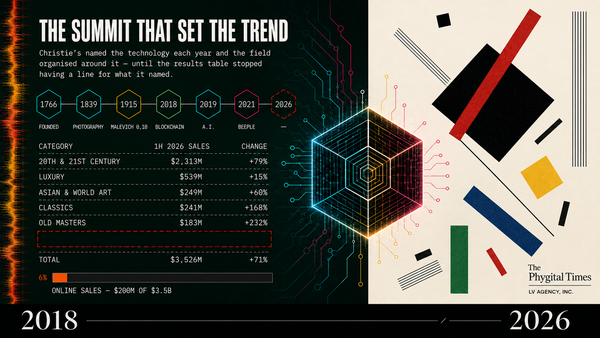
When the inaugural Art+Tech Summit launched in 2018, Christie’s described the event as an effort to examine a major technology trend and provide a broad view of its impact on the art world. That first Summit was dedicated specifically to blockchain, with sessions on distributed ledgers, legal implications, blockchain in the art world, and digital art. (Christie's)
The 2026 Summit was still publicly described in expansive terms: emerging technologies “reshaping creativity, value, intelligence, and the future of the global art ecosystem.” (Christie's)
Yet the actual 2026 program was dominated by AI, venture capital, business, markets, platform companies, Wall Street, client strategy, and institutional conversations. There were artists and art-market discussions, certainly, but digital art, blockchain provenance, NFTs, and on-chain collecting were no longer substantial named pillars of the program. (Christie's)
That difference is not trivial.
Because Christie’s had already helped write another version of this history.
Christie’s Did Not Merely Observe the NFT Moment
In 2021, Christie’s sold Beeple’s Everydays: The First 5000 Days for $69.3 million, calling it a watershed for digital art. Christie’s described NFTs and blockchain as mechanisms that had opened a path for digital artists into the art market. (Christie's)
That year, Christie’s reported more than $140 million in NFT sales and then-CEO Guillaume Cerutti said:
“The NFT market is here to stay.”
He specifically connected NFTs to new artists, new audiences, a new generation of collectors, and more inclusive markets. (Christie's)
Christie’s had gone further even before Beeple.
In 2018, it partnered with Artory to record auction transactions from the Barney A. Ebsworth Collection on a blockchain. By 2021, Christie’s was publicly highlighting its role in blockchain, AI art, augmented reality, NFTs, and digital-market experimentation. (Christie's)
And this history has not disappeared entirely from Christie’s own website.
Its current Digital Art and NFTs pages still describe NFTs as having transformed digital art by enabling verifiable digital ownership, and Christie’s still presents itself as a pioneer in bringing that market onto the global auction stage. (Christie's)
So the issue is not whether Christie’s ever believed these technologies mattered.
The record says that it did.
The question is how that record fits with the institution’s current Art+Tech language.
Eight Documents Later
Our investigation began on July 15, 2026.
Christie's is the point of departure because it went first. From 2018 it built the category — the department, the sales, the language, the $69.3 million headline that made digital art legible to the entire market. The 2026 Art + Tech Summit is where the same institution turns around and walks it back. The market moved forward anyway.
The Eight Documents
The sequence now contains eight documents, published between July 15 and August 26. Together, they move from market data to category definition, provenance, the "NFT" correction, institutional memory, and finally the question of where capital and meaning moved after the speculative cycle.
1. The Phygital Times H1 2026 Art+Tech Report — July 15
The first original report, published the same day as Christie’s H1 results. Nine pages of data examined against the Art Basel & UBS Global Art Market Report 2026: a global art market returning to growth at roughly $59.6 billion, online art sales at their lowest level since 2019, and digital art rising into the top three media by collector spending. The online channel contracted while the medium advanced — apparently contradictory, but not actually so.
2. Art+Tech: The Third Category — July 29
The central argument of the investigation. Physical art and digital art were no longer sufficient categories for describing what was happening. A third category — hybrid or phygital art — was becoming increasingly visible between them. The article also asked what Christie’s 2026 Art + Tech Summit might have addressed, given what the institution itself had already helped build.
3. Physical, Digital, or Phygital — July 30
Written from the collector’s perspective. New buyers are often presented with a false binary: physical art or digital art. The article argues that there are three choices, not two — and that the third may increasingly shape how contemporary collecting evolves.
4. Art+Tech: The Ledger and the Wave — August 6
Four patterns beneath the season’s numbers, including the historical comparison with photography and the distinction between a collapsing speculative market and the technological infrastructure operating beneath it. A 93% decline in trading volume did not necessarily mean what the headline number appeared to say.
5. Art+Tech: What a Collection Carries — August 12
Written for collectors, family offices, estate lawyers, and wealth advisers. The question shifts from acquisition to inheritance: what happens one generation later, when the person who assembled a collection is gone and its meaning, provenance, intent, and relationships must survive without them?
6. Art+Tech: The Wreckage Was Never Where the Word Puts It — August 17
A reconstruction of the 2021–22 NFT market collapse: how severe the speculative correction actually was, who carried the reputational cost, and why the underlying technology became conflated with the behavior of the market built around it. It also examines what museums and institutions were doing while much of the broader market declared the category finished.
7. Art+Tech: The Record and the Reading — August 20
A different kind of document. Rather than advancing a single new argument, it assembles ten named voices, separates the verifiable record from the interpretive reading, sets out five propositions to be revisited publicly in December, and introduces the accompanying podcast investigation, Art+Tech: The Summit That Set the Trend.
8. Money Left, Meaning Stayed, and the Clock Was Never Reset — August 26
The second original report. It asks what the market actually did during the summer, measured in the currency it trades in, and where capital moved while art on-chain remained near a four-year low. The conclusion is not that money abandoned the broader category, but that value began appearing in different forms — particularly where physical objects, digital records, provenance, and tokenization converged.
The Ninth Document
This open letter is the ninth document in the sequence.
It turns from the market to the institution itself.
After eight pieces examining what Christie’s Art + Tech Summit revealed, omitted, or left unresolved, Bonnie Brennan’s subsequent essay clarifies something the earlier documents could only infer: the narrowing of Art+Tech may not have been an accidental feature of a single Summit.
It may reflect a more durable institutional position.
That makes the question larger than one conference, one executive statement, or one season in the market. It asks what Christie’s current definition of Art+Tech tells us about the institution itself — and about the basis on which the next generation of collectors, artists, advisers, technologists, and cultural stakeholders is being asked to trust it.
Technology at Christie’s Is Not the Same as Art+Tech
There are at least three different categories hiding underneath the phrase.
Technology for the art business.
Analytics, CRM, workflow systems, AI productivity, digital engagement, logistics, personalization, operational tools.
Technology for art-market infrastructure.
Authentication, blockchain provenance, digital identity, tokenization, ownership records, smart contracts, archives, interoperable records.
Technology within artistic practice.
Digital art, generative art, AI-amplified art, computational systems, audiovisual work, interactive media, on-chain work, immersive environments, and hybrid physical-digital forms.
Bonnie Brennan’s essay is overwhelmingly about the first.
Christie’s historical Art+Tech record includes all three.
That is the tension.
Technology helping Christie’s become a more efficient Christie’s is useful.
But Art+Tech cannot be reduced to enterprise technology merely because the enterprise happens to sell art.
And Then There Is Trust
This is where Bonnie Brennan’s article becomes more consequential.
She writes that Christie’s is fundamentally a relationship business and that trust with collectors, consignors, museums, artists, and advisers lies at its center.
Agreed.
But whose definition of trust?
Christie’s says it is preparing for the next generation of collectors. Its own 2025 results reported that 46% of new bidders and buyers were Millennials or younger. (Christie's)
That next collector class does not consist only of younger versions of the traditional collector.
It includes technology entrepreneurs.
AI founders.
Crypto-created wealth.
Digital-native creators.
Gaming and platform executives.
Millennial and Gen Z HNWIs.
People accustomed to distributed systems, searchable records, data trails, public ledgers, version histories, and software in which an assertion can often be checked against the underlying system.
Traditional collectors, dealers, advisers, museums, family offices, and estate professionals remain essential.
But another constituency has entered the room.
And its relationship to trust may be different.
For a 260-year-old auction house, reputation itself carries enormous weight.
For a technologically native collector, the response may increasingly be:
Show me the record.
Show me the provenance.
Show me when it was created.
Show me when it entered the market.
Show me what changed.
Show me which edition is authoritative.
Show me the ownership history.
Show me which statement was made in 2018, which was made in 2021, and which is being made in 2026.
That does not eliminate relationships.
It changes the evidentiary foundation beneath them.
So: Can We Still Trust Christie’s?
This article cannot responsibly answer that question with a categorical yes or no.
There is no evidence here establishing that Christie’s is institutionally untrustworthy.
But there is ample evidence for asking a more precise question:
What should trust in Christie’s mean in 2026 and beyond?
Should collectors trust an institution because it has survived for almost 260 years?
Certainly, history matters.
Should they trust its specialists?
Expertise matters.
Should they trust relationships built over decades?
Of course.
But should the technologically sophisticated collector also be able to compare Christie’s current claims against Christie’s own record?
Yes.
And that record contains an unresolved discontinuity.
In 2018, blockchain was important enough to anchor the inaugural Art+Tech Summit.
In 2021, Christie's stated that the introduction of non-fungible tokens and blockchain technology "has enabled collectors and artists alike to verify the rightful owner and authenticity of digital artworks." The house reported that 91 percent of the sale's active bidders were new to Christie's, the majority of them millennial and Gen X.
In 2026, Christie’s continues to maintain Digital Art and NFT pages that describe blockchain-enabled ownership positively.
Yet at the 2026 Art+Tech Summit — and now in Bonnie Brennan’s substantial explanation of Christie’s technology philosophy — blockchain provenance, NFT infrastructure, digital ownership, and digital art occupy remarkably little conceptual space.
That deserves an explanation.
Not because Christie’s is forbidden to change its position.
Institutions should change.
Markets change.
Evidence changes.
Strategies change.
But trust requires the change itself to become part of the record.
An Open Question to Bonnie Brennan
Ms. Brennan, you write that technology should preserve “the expertise, judgment, and relationships that define Christie’s.”
I would ask whether the inverse deserves equal attention:
How will technology change the standards by which the next generation judges Christie’s expertise, relationships, and institutional claims?
Because technology is not only something Christie’s can deploy toward its clients.
Clients can deploy it toward Christie’s.
The collector can verify.
The artist can timestamp.
The adviser can trace.
The family office can preserve.
The estate can inherit a record rather than reconstruct one.
The public can compare what an institution says now with what it said before.
That may be one of the most important Art+Tech developments of all.
Questions for Christie’s Leadership
So I would respectfully put the following questions to CEO Bonnie Brennan, Chairman of the Board François-Henri Pinault, Global President Alexander Rotter, and the broader Christie's leadership team.
1. What does “Art+Tech” mean to Christie’s now?
Is it principally technology that improves the operation of the art business?
Or does it still include technology that changes the artwork, ownership, provenance, collecting, and the definition of the object itself?
2. Does Christie’s still stand behind the principles it articulated around blockchain and digital art in 2018 and 2021?
If yes, where do those principles sit within the 2026/2027 strategy?
If no, what changed?
3. Why were blockchain provenance, NFT technology, and digital art so limited within the 2026 Summit's formal program, after Christie's had done so much to give them standing?
A market correction explains lower transaction volume.
It does not, by itself, explain a conceptual disappearance.
4. What does Christie's now believe an NFT actually is?
A failed collectible category?
A speculative market instrument?
A provenance mechanism?
A technological container?
A historical term that has become commercially inconvenient?
The answer matters, because the market collapse and the technology were never identical things.
An NFT is a record: a line in a ledger stating who made a thing, when, and who holds it now. It can carry a smart contract that pays an artist a percentage every time the work resells — which the trade has failed to do for its artists for two centuries, and which no relationship, however long, has ever managed to deliver.
None of that stopped working in 2022. The provenance chains written in 2021 still resolve. The royalty clauses still execute wherever a marketplace honours them — and the ones that don't made a choice, not a discovery.
Which returns the question to the first list, and to the last item on it.
5. How should younger and technologically native collectors evaluate Christie’s changing language?
Should they rely on institutional reputation alone?
Or should Christie’s make its own evolution more transparent and auditable?
6. What role does Christie’s see for blockchain-secured provenance in physical art?
This may ultimately prove more important than the NFT image market that produced the headlines.
7. If Christie’s believes technology should strengthen trust, will it also accept that technology makes institutional trust more verifiable?
That is the other side of the equation.
Christie’s Does Not Need Less Technology
It needs a larger definition of what technology is doing to art.
That is the point of this open letter.
The problem with “Tech That Supports People at Christie’s” is not that the philosophy is wrong.
The problem is that it is too small for the banner under which it is being presented.
Art+Tech is bigger than Christie’s Ventures. Art+Tech is bigger than Christie’s.
Bigger than workflow.
Bigger than client engagement.
Bigger than operational efficiency.
It includes the systems artists are using to make work.
The systems collectors are using to acquire it.
The mechanisms by which provenance can be secured.
The infrastructure through which digital and physical objects increasingly become connected.
The consequences of AI for human authorship.
The problem of preserving time-based culture.
And the changing expectations of a generation that may still value expertise enormously but increasingly wants expertise accompanied by evidence.
The Ninth Document
Our eight previous pieces asked what the Summit missed, what the market was actually doing, why physical and digital collecting were beginning to converge, what survived the NFT crash, what a collection must carry forward, and where the capital moved.
The ninth asks something more institutional.
When Christie’s says trust is at the heart of its business, what exactly are we being asked to trust?
The people?
The expertise?
The brand?
The market judgment?
The historical narrative?
The technological strategy?
The record?
Probably some combination of all of them.
But in 2026, one addition is unavoidable:
trust should increasingly be capable of verification.
That does not weaken a relationship business.
It may be what allows a relationship business to survive the next generation.
So, Bonnie Brennan, François-Henri Pinault, Alexander Rotter, and Christie’s:
The question is not whether technology can support your people.
It clearly can.
The question is whether Christie’s is prepared for what happens when technology also supports the people evaluating Christie’s.
That is where the next Art+Tech Summit may need to begin.
The Registry
At SurR.Ai the question has produced a practical response rather than a position.
Four years of making has produced an archive of more than 2,500 works. Roughly 900 are published to marketplaces; some 42 are written to Ethereum and two inscribed on Bitcoin. Most of the rest are lazy-minted — the artwork and its metadata exist on a platform, and no token is written to any chain until a sale occurs. That gap between what has been made, what has been published, and what has actually been recorded is not unusual. It is the ordinary condition of this field, and almost nobody states it.
The Registry begins there: a permanent public catalogue, published through NFT SurR Post, with an entry for every work. What it is. When it was made. Which of those three states it occupies, and where to verify it. How many physical manifestations will ever exist. And the entry is never removed — not when the work sells, not when it changes hands again after that. Inaugural listings publish between September 7 and 10.
The premise is simple. Provenance should not begin when somebody eventually needs to reconstruct it. It should begin while the artist, the source files, the decisions, the timestamps, the editions and the context are all still present. That reverses the traditional sequence: instead of relationship, then trust, then a record assembled later, the order becomes record, verification, trust, relationship.
Neither model replaces the other. A verifiable record does not diminish the relationship an institution builds over two centuries — it gives that relationship something to stand on.
The Phygital Times is published by LV Agency, Inc., New York.
LV Agency, Inc. and its studio SurR.Ai participate in the market discussed and have a commercial interest in it.
This letter is commentary and analysis. It is not investment, legal, or tax advice, and no representation is made regarding the future value of any work, token, or asset mentioned.
Statements about Christie's are based on the company's own published materials, public statements, and press reporting, cited throughout and accurate as of the date of publication. Characterisations of the significance of those facts are the author's opinion. Corrections are welcome and will be published additively, with the date of the amendment noted.
Christie's, its executives, and any other named parties are invited to respond. Any response received will be published in full.