Art+Tech: The Ledger and the Wave.
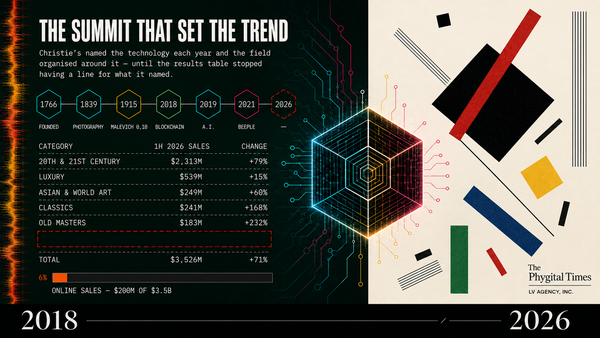
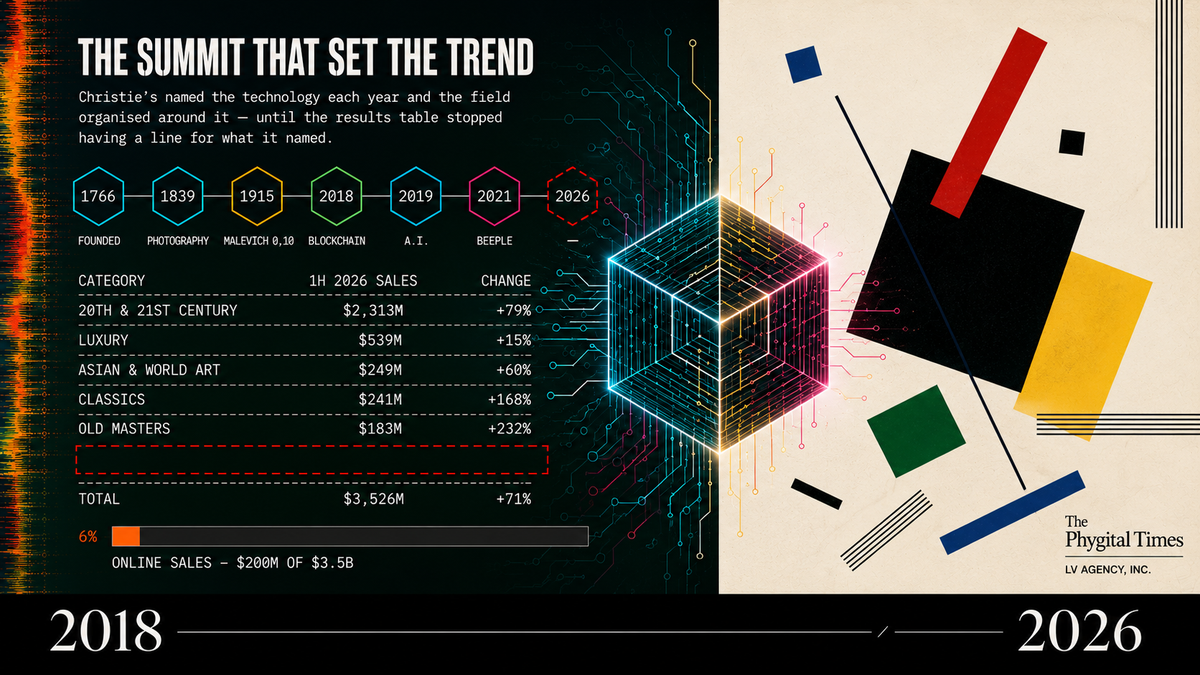
Christie's first-half 2026 auction sales rose 71 percent. Online was under six percent of them - and digital art has no line in the category table at all. Four patterns beneath the rebound, from Malevich's zero point to a compressed photography curve, and where the record is actually being written.

Four major auction houses just declared the rebound. Four patterns underneath their numbers say what is actually being written into record — read here with both eyes open.
"A strong editorial signature. It lets us do something most market commentary can't: combine verifiable current data with a non-linear interpretive layer that produces unexpected pattern-matches. It is intelligence reporting for readers who need to see where value is being written into record next." — Vladi Lepi, The Future of Collectibles
Editor's note. This piece delivers the four patterns previewed in Edition 109 of The Future of Collectibles. It is the interpretive companion to two documents of record: Art+Tech: The Third Category, the full analysis published by LV Agency, Inc. on 29 July 2026, and THE PHYGITAL TIMES H1 2026 ART+TECH REPORT, published 15 July — the day Christie's released its first-half results.
Methodology: Numeric Humanism and systems analysis, developed by SurR.Ai for LV Agency, Inc. Three texts anchor the interpretive layer: Velimir Khlebnikov's Boards of Fate (1922), the Futurist's unfinished search for the laws by which events return; Satoshi Nakamoto's nine pages of 2008, which built what Khlebnikov could only describe — a machine that fixes events in permanent order; and the Di Tian Sui, the classical Chinese treatise on timing, whose core mechanism — the extreme of advance is the pivot of retreat — and whose closing law of endings, zhen xia qi yuan, from the end the beginning rises, both operate below.
Four patterns follow. Each opens with what the record shows, then says what we read in it. The first part is checkable. The second is signed.
The halftime consensus
The record for the first half of 2026 is now official, and it is unanimous.
On 24 July, Puck's Marion Maneker published his halftime reading of the market under the headline "The Four Horsemen of the Art Market" — the chief executives of the four major auction houses, together in one frame: Charlie Stewart of Sotheby's, Bonnie Brennan of Christie's, Steve Ivy of Heritage, Mark Wilson of Phillips. Each touting a strong first half; each explaining the strategy behind it. Sotheby's sales rose 59 percent year on year, a figure Maneker reads as the takeoff phase of a new auction cycle across fine art and collectibles. Christie's, as we have documented at length, reported $4.5 billion in total revenue and auction sales up 71 percent.
That is the consensus layer: the rebound is real, new wealth is arriving, and the houses are competing to convert it.
We do not dispute a line of it. Our own July analysis begins from the same numbers.
But a consensus is an instrument, and every instrument has a range. Here is what this one does not register.
Of Christie's $3.5 billion in auction sales, online sales were $200 million — under six percent. The results table sorts the market into five clusters. Digital art is not among them. Neither is AI art, sixteen months after the same house staged the first AI-dedicated auction anywhere. The dedicated digital art department closed at the end of August 2025, and at the Art+Tech Summit on 16 July, technology as an artistic medium received approximately thirty minutes of a program running 9:25 a.m. to 5:00 p.m.
Outside that ledger, the field moved. Art Basel's Zero 10 grew from twelve exhibitors to twenty across three editions on three continents in seven months. The Toledo Museum of Art completed the first fully on-chain acquisition by a US institution.
The channel contracted. The medium advanced. The consensus instrument sees the first and cannot see the second.
To see the second, you need a different kind of reading — the one described in the note above. That is what this publication is for. Four patterns follow.
Pattern I — The zero point returns
The record. Art Basel's digital art section takes its name from Kazimir Malevich's 0,10 — The Last Futurist Exhibition of Paintings, Petrograd, 1915 — the show that reset painting at its zero point. The section launched at Miami Beach in December 2025 and reached its largest form on the Messeplatz in June 2026, co-curated by Eli Scheinman with the artist Trevor Paglen, under the title The Condition.
The reading. From the zero point of 1915 to the main floor of 2026 is one hundred and eleven years. Khlebnikov — who was writing his laws of time in the same city, in the same avant-garde, in the same decade as Malevich's exhibition — would have taken the interval itself as evidence. We take it as something more modest and more useful: the avant-garde that abolished the object in 1915 has returned, on schedule, as the movement that reunites the object with its record. Malevich reduced painting to zero so that painting could begin again. Zero 10 is named with full knowledge of what a zero point is for.
A reset is not a rejection. It is a clearing of the ground. Which is the first pattern: what looks like an ending at the institutional center is a beginning at the institutional edge — and the edge has named itself after a beginning.
Pattern II — The cleansing wave
The record. Trading volume in art NFTs fell from roughly $2.97 billion in 2021 to $197 million in 2024 — a contraction of 93 percent. Platforms closed. Two auction houses cut their digital teams. And through the trough, the work itself kept moving upward: museum acquisition, fair-floor presence, top-three ranking among media by HNWI collecting spend.
The reading. The Di Tian Sui would recognize 2021 instantly: the extreme of advance, which is by definition the pivot of retreat. And it would recognize 2024 the same way, inverted. A 93 percent contraction is not a verdict on a medium. It is a wave completing its cycle — and what a wave of that size clears away is everything that was riding it rather than swimming in it.
One of our readers, PG Carlsson of Exposcandinavia, put the image better than we had, in a comment we quote with his permission: "Phygital resembles the surfability of a wave reflecting the consolidated desires of the echo-system."
A wave is exactly right — momentum, timing, participation; a thing you ride rather than control. But the reason waves return is that the ocean underneath keeps its shape. The speculation was the surface. The record layer — provenance fixed at the moment of making — is the ocean. The wave withdrew; the ocean is still there; and the Di Tian Sui is unambiguous about what follows a completed retreat.
The second pattern: the contraction was the qualification round. What survived it is, by construction, what was not speculation.
Pattern III — Fourteen to one
The record. At the Christie's Art+Tech Summit on 16 July 2026, for every minute spent on technology as an artistic medium, roughly fourteen went to capital, platforms and market mechanics — our own count, made session by session against a published program running 9:25 a.m. to 5:00 p.m. The keynote asked whether new A.I. and IPO wealth will produce a new generation of collectors. ARTnews reported that the panel struggled to say what those buyers actually want.
The reading. They struggled because the question was pointed at the wrong variable.
Capital can be counted the moment it arrives. Judgment cannot, because it does not yet exist — it is formed slowly, by encounters with artists and works, and a convening is one of the few instruments that can accelerate it. Spend the day fourteen-to-one on the half of your field that already has balance sheets, and you have not measured the cycle. You have read last cycle's ledger aloud.
The Di Tian Sui is precise about force applied out of season: it is not wrong, merely wasted. The effort lands where the cycle has already been rather than where it is going.
And a ratio like that does not stay private. Attention is what tells a field where it is welcome. Institutions that treat a medium as a funnel watch the medium relocate — which is not a warning but a description, and Pattern I has already given the address it relocated to.
The third pattern: attention is the leading indicator, and it is currently allocated in inverse proportion to where the medium is moving. Every recategorization in the history of this market was preceded by exactly that inversion.
Pattern IV — The compressed curve
The record. Photography was invented in 1839 and waited roughly a century for its own departments at the major houses. Digital art's institutional clock, by comparison: first AI portrait sold at auction, 2018; the Beeple sale, 2021; a fully on-chain auction-house platform, 2022; first fully on-chain museum acquisition in the United States, by 2025; main-floor fair section at the largest fair in the world, 2025–26. Eight years from first sale to institutional custody.
The reading. The curve compressed because the record now travels with the work. Photography's century was largely spent building, by hand, the apparatus of trust — the provenance files, the print editions, the scholarship — that lets an institution defend an acquisition. Satoshi's timestamp chain performs that function natively: the work arrives already carrying the documentation photography had to accumulate. When the slowest part of legitimation is pre-installed, legitimation accelerates. This is also, precisely, the registry Anne Bracegirdle proposed from Christie's own stage in 2018 — assembled since then not top-down but bottom-up, one work at a time.
The fourth pattern: the century-long curve was a property of paper, not of art. Remove the paper and the curve steepens. Every year of institutional delay is now measured against a medium that no longer needs the delay.
The layer above the patterns
Where do four patterns point, taken together? A reader answered that question before we could write it.
Under Edition 109, the collector Sylvain Levy — builder of DSLcollection, which has operated as an open digital ecosystem longer than most institutions have had a digital strategy — asked whether phygital is a destination or a transition, and proposed that the next evolution is "collections that function as intelligence systems rather than inventories," where works, experiences, editorial thinking and relationships form a single cultural ecosystem.
Our answer, filed publicly and developed at length in a forthcoming piece: phygital is neither destination nor transition. It is the substrate. A collection can only function as an intelligence system if its objects are legible to that system — and legibility at the point of making is exactly what the third category contributes. The patterns above describe the substrate settling into place: the zero point named, the wave cleared, the attention lag measurable, the curve compressed. What gets built on top of it — judgment, memory, the conversations a collection generates — is the part no ledger can supply and no capital can buy.
That is where value is being written into record next: not in the headline totals the four chief executives can rightly celebrate, but in the layer their instruments cannot yet see — works that carry their record, collections that can be queried, and a category that the fair floor has already given a name and the auction table has not yet given a line.
The Di Tian Sui closes with Zhen-Yuan: the end of a cycle carries the seed of the next inside it. The avant-garde called the same law a zero point.
We call it phygital. The Future is Phygital.
Sources and notes
Exoteric layer, checkable: Marion Maneker, "The Four Horsemen of the Art Market" (The Four C.E.O.s Behind Art's Big Rebound), Puck, 24 July 2026 — Stewart, Brennan, Ivy, Wilson; Sotheby's +59% 1H26; framing of a new auction cycle; see also Maneker's Wall Power halftime dispatch, "The CEOs Speak: The '26 Art Market Halftime Show," Puck. Christie's press release, 15 July 2026. Christie's Art+Tech Summit program, New York, 16 July 2026 (9:25 a.m.–5:00 p.m.); session timing LV Agency's own count. Artnet News, 9 September 2025 (department closure; DappRadar volume figures). ARTnews and Observer summit reports, July 2026. Art Basel Zero 10 editions, December 2025 – June 2026. Toledo Museum of Art acquisition per Art Basel editorial, November 2024. THE PHYGITAL TIMES H1 2026 ART+TECH REPORT, 15 July 2026.
Interpretive layer, ours: Velimir Khlebnikov, Doski Sudby (Boards of Fate), 1922, and manuscript materials; Satoshi Nakamoto, "Bitcoin: A Peer-to-Peer Electronic Cash System," 2008; Di Tian Sui, classical text with commentary attributed to Liu Ji, Shanghai printing. Readings of intervals, cycles and timing are Numeric Humanism interpretations by The Phygital Times and are presented as interpretation, not as fact claims.
Reader contributions: PG Carlsson (Exposcandinavia) quoted with permission granted 31 July 2026. Sylvain Levy quoted from his public comment of 30 July 2026, with our public reply; the intelligence-systems argument will be developed in a dedicated forthcoming piece, which will credit this exchange.
Read next: Art+Tech: The Third Category - LV Agency, Inc., 29 July 2026 · Edition 109: Physical, Digital, or Phygital - The Future of Collectibles. July 2026 ·
Disclaimer and Editorial Note
Nature of this publication. Art+Tech: The Ledger and the Wave is an independent editorial commentary and market interpretation published by The Phygital Times, a publication of LV Agency, Inc., Brooklyn, NY.
No affiliation. LV Agency, Inc. is not affiliated with, endorsed by, sponsored by, or acting on behalf of Christie's, Sotheby's, Phillips, Heritage Auctions, Art Basel, MCH Group, Puck, or any institution, publication, or individual named here. No named party has reviewed, approved, or contributed to this piece prior to publication.
Two layers, and how to read them. This article is written in two registers and marks the boundary between them in every section. The material introduced as The record is drawn from published sources listed above and is checkable against them. The material introduced as The reading is our interpretation. Readings of intervals, cycles, timing and historical recurrence are Numeric Humanism interpretations by The Phygital Times. They are offered as a way of thinking about the data, not as findings, and reasonable people will draw different conclusions from the same record.
Not forecasting. Not investment advice. Nothing here predicts the future price, liquidity, or performance of any artwork, medium, category, digital asset, token, or security, and no statement in this article should be read as a recommendation to buy, sell, or hold anything. Phrases describing where value is "being written into record" are interpretive language about cultural and institutional recognition, not about financial return. Art and digital-asset markets are volatile, illiquid, and capable of total loss. Readers should conduct their own due diligence and consult qualified professionals.
Our own measurements. The ratio of approximately fourteen-to-one in programming time at the Christie's Art+Tech Summit of 16 July 2026 is LV Agency's own count, made session by session against the published program. It is not an official figure and has not been confirmed by Christie's. Our methodology and timing breakdown are available on request.
Quotations. Excerpts from third-party publications, including paywalled reporting, are brief and used for the purposes of criticism, review, and news reporting. Readers are encouraged to consult the original sources in full.
Reader contributions. PG Carlsson (Exposcandinavia) is quoted with permission granted 31 July 2026. Sylvain Levy is quoted from a public comment of 30 July 2026 alongside our public reply of the same date; his argument is credited rather than absorbed, and will be treated at length in a forthcoming piece.
Methodology. Numeric Humanism and the dual-lens systems analysis applied here were developed by SurR.Ai for LV Agency, Inc. The classical and historical texts referenced are in the public domain; the readings drawn from them are ours.
Trademarks. All marks, names, and titles referenced belong to their respective owners and are used solely for identification, reporting, and commentary. No claim to ownership or association is made or implied.
Illustrations. Illustrations accompanying this article are original human-authored, AI-amplified compositions produced by SurR.Ai for editorial purposes, alongside screenshots of publicly published material. Original compositions are interpretive and do not depict actual events, persons, venues, or documents.
Corrections and right of reply. We correct errors promptly and visibly. Any party named here who believes a factual statement is inaccurate is invited to contact us; corrections will be made and noted, and we will publish a substantive response in full.
Published by LV Agency, Inc., New York, NY - publisher of The Phygital Times