Art+Tech: From Pokémon to Provenance — The Other Half of the Collectibles Story, Explained
From Pokémon to on-chain provenance, Part 10 of our Art+Tech investigation examines digital art’s visibility, NFT.NYC’s public role and how education, clear records and accountability can rebuild trust in NFTs.

Two markets crashed in 2022. Nobody blamed the paint. Everybody blamed the non-fungible token. Four years on, the collectibles boom has arrived — and the technology built for collectibles still can't say its own name in public.
The Phygital Times · By Vladi Lepi · September 2026 · Tenth document in the Art+Tech investigation.
On 10 September, Scott Reyburn's “From Poussin to Pokémon” described a collecting culture moving beyond the preferences that shaped the traditional art market. Familiarity, personal attachment and popular culture increasingly influence what buyers consider worth owning.
His examples are striking: a Pokémon card sold for $16.5 million in February, a sealed Super Mario game for $3 million in June, and Jensen Huang’s leather jacket for $960,000 at a charity auction in July. These objects belong to different markets, but they share something important. Their cultural meaning is immediately legible to the people who want them.
That helps explain why an improving auction market does not necessarily restore demand for everything it once rewarded. Reyburn reports Anders Petterson's attribution of the fine-art recovery to single-owner sales of Impressionist and Modern work. A rising total can conceal substantial differences beneath it.
Our investigation has followed those differences since July: between medium and sales channel, institutional announcements and measurable activity, ownership and the records that make ownership intelligible.
This tenth article brings our research together with ArtTactic’s September confidence assessment, NFT.NYC’s published programme and my experience participating in the event for three consecutive years — as an artist in 2024 and as an artist and speaker in 2025 and 2026. It asks how the knowledge and commitment within this community can reach a wider public—and who should take responsibility for explaining the technology, its uses and its limitations.
I. The other market for Pokémon
The Pokémon card in Reyburn’s account is a Pikachu Illustrator previously owned by Logan Paul. Its appeal is a useful starting point for a collecting story that also extends into blockchain markets.
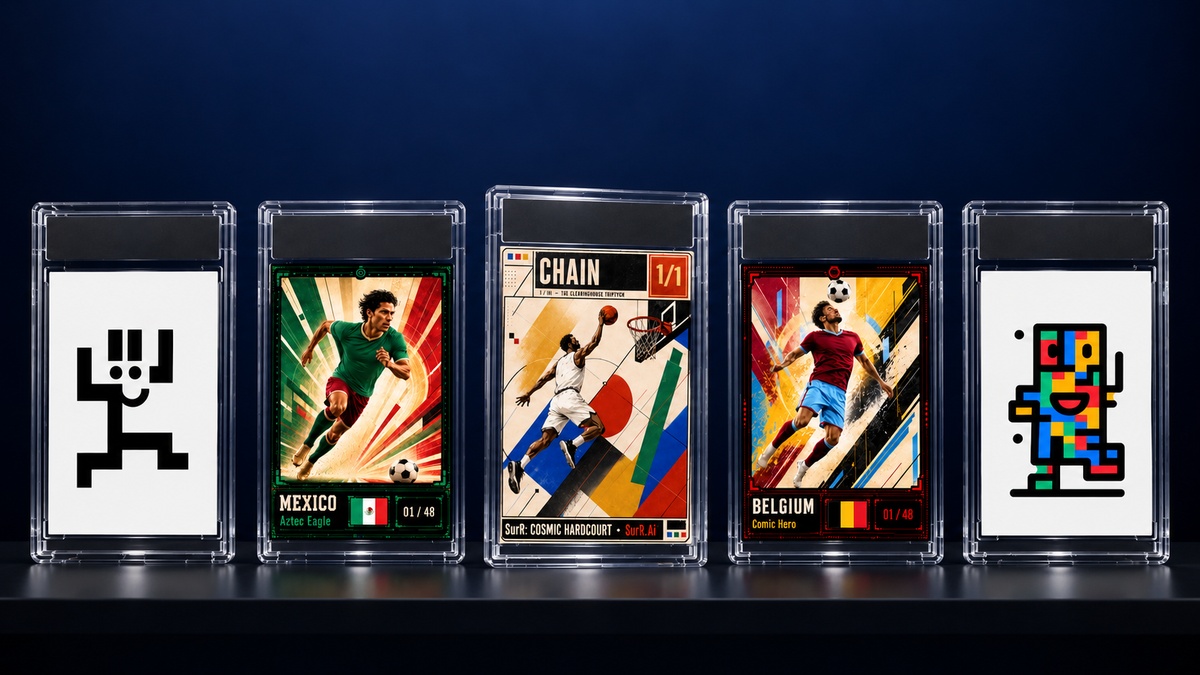
Collector Crypt, for example, links tokens to professionally graded trading cards held in custody. A holder can request the physical card under the platform’s redemption terms. Pokémon is part of that market too.
The arrangements introduce specific responsibilities: someone must safeguard the card, maintain the link between token and object, disclose charges and honour redemption. Tokenization changes how a collectible can be held and transferred. It does not remove the custodian or the need to assess that custodian.
Our August report, “Money Left, Meaning Stayed, and the Clock Was Never Reset,” examined this activity alongside the contraction in other NFT markets. CoinGecko’s figures show monthly tokenized-collectibles volume rising from approximately $17 million in January 2025 to $646 million in June 2026. Collector Crypt accounted for $406 million that June, or 62.8% of the segment. OpenSea recorded $32.7 million.
The qualification belongs beside the numbers: CoinGecko reports that, on average, more than 98% of volume on these platforms comes from randomized paid draws, commonly called gacha, rather than secondary sales. The growth demonstrates substantial activity around tokenized collectibles; it does not establish a mature resale market or an equivalent inflow of new collecting capital. OpenSea’s volume also covers more than fine art. These figures describe different forms of activity and should not be treated as interchangeable measures of cultural demand. CoinGecko, Q2 2026 report.
A separate CoinGecko sector overview reports that more than 30% of Collector Crypt users have redeemed a physical card. That is evidence that redemption is being used. We have not seen a corresponding failure-rate measure, and the percentage should not be read as a general guarantee of custody or service quality.
These distinctions matter because the market remains active, even as its scale, composition and mechanisms have changed. OpenSea’s $32.7 million in monthly volume warrants attention without being presented as evidence that the digital-art market has recovered. The much larger tokenized-collectibles figure deserves examination with its chance-based buying mechanism clearly explained.
Reyburn’s account leaves this part of the collecting story unexplored. It never mentions digital art, NFTs or on-chain work. His November 2021 column placed the young painters described as “red-chip artists” alongside NFTs. Five years later, that comparison remains worth revisiting: both experienced speculative excess, both underwent substantial corrections, and both still have active markets. Their trajectories now require separate examination.
That absence connects with the reporting question we raised in Part 9, “Art+Tech: Can We Still Trust Christie’s?”
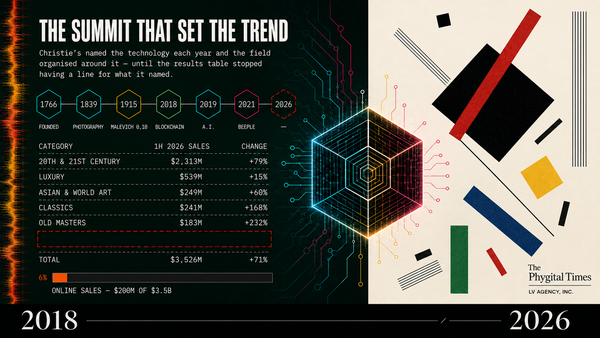
Reyburn cites Christie’s 71% year-on-year revenue growth in the first half of 2026 without a corresponding account of digital-art performance; Christie’s own results provide no separate digital-art line. Neither omission proves withdrawal or deliberate exclusion. Together, however, they leave readers with little basis for assessing where digital art stands within the reported recovery.
This is what our investigation means by statistical erasure: activity becomes difficult to evaluate when it is no longer separately visible. It is our reading of the reporting gap, not a conclusion Reyburn advances.
A fuller account would connect the physical collectibles attracting new buyers with the digital records and markets developing around them. Pokémon already belongs to both stories.
II. The safe, the can and the receipt
ArtTactic’s September 2026 Contemporary Art Market Confidence Report describes improving sentiment across auction and primary markets. Confidence has moved back into positive territory, while experts remain cautious about the sustainability of the recovery amid economic and geopolitical uncertainty.
That is evidence of improving sentiment. It is not proof that every artist, price segment or medium has recovered. Nor can selected painting prices be compared directly with aggregate NFT transaction volumes to claim that two markets fell by identical amounts.
The more useful comparison concerns interpretation. A fall in painting prices is readily understood as a change in demand, taste or speculative appetite. With NFTs, a market decline became entangled with judgments about the underlying technology.
Our reply to Gary Vaynerchuk approached that confusion through two analogies.
The safe. If the value of an object inside a safe falls, the price movement does not tell us whether the lock worked. The same distinction matters when assessing a token record. A falling price does not, by itself, invalidate the record of issuance and transfers.
But a functioning ledger does not make the surrounding system safe. Wallets can be compromised, contracts can contain defects, platforms can fail and people can be deceived. Public education must explain those failures as clearly as it explains what continued working.
The can. A can and its contents perform different jobs. The container helps identify and handle what is inside; the contents are what somebody wants. An NFT can play a comparable role in a collecting arrangement, connecting an identifiable token with a work, an object or specified rights.
The analogy has limits. A token does not preserve a linked image merely by existing. It does not authenticate an artistic attribution, confer every right in a work or keep a physical object in good condition. Someone must maintain the files, safeguard the object and honour the commitments attached to it.
The term NFT is used for both the token and the collectible associated with it. That compression makes everyday conversation easy inside the industry and difficult outside it. Buyers need to know which part they are acquiring and what accompanies it.
The receipt is the practical place to begin: who issued the token, what it refers to, which rights are included, where the work is stored and what happens if the platform closes. Blockchain records can make certain transactions independently inspectable. Connecting a wallet to a real person, an object to its authentic maker, or a token to enforceable rights requires additional evidence. The ERC-721 standard establishes token functions; it does not settle those surrounding questions.
For an audience whose first encounter with NFTs was a spectacular price or a reported scam, this explanation is overdue. Suspicion deserves a substantive answer.
III. What Christie's makes visible
Our Christie’s investigation has followed a related problem: how outsiders can evaluate a category when its institutional presentation changes.
The digital-art department's closure was reported in September 2025. Christie's said digital art would continue within its 20th- and 21st-century business. Its first-half 2026 results subsequently reported strong overall growth without a separate digital-art line. Our ninth article, “Art+Tech: Can We Still Trust Christie's?”, brought those developments together.
Integration can be a reasonable institutional choice. Not every medium needs a dedicated department or a row in a results table. But when a previously identifiable activity becomes harder to measure, an outside reader cannot easily assess what integration has accomplished.
In July, our H1 2026 Art+Tech Report considered normalization as one possible interpretation. The condition is evaluability: what evidence would allow a collector to distinguish successful integration from declining activity?
The same report separated digital art as a medium from online selling as a channel. A collector can acquire a digital work through a live auction, just as a physical painting can sell online. Growth or decline in one category does not establish the condition of the other.
We also read the summit's emphasis on technology used within the business as a shift in how “Art+Tech” was being presented. That is our interpretation of institutional emphasis, not evidence of an intention to exclude artists or discredit NFTs.
Traditional art institutions already depend on records: certificates, provenance research, catalogues raisonnés, condition reports and transaction histories. A token can support part of that system. It does not replace the expertise or obligations surrounding it.
Our reading is that the function remains useful while the terminology has receded. The question for Christie's is how it will make the continuing activity—and its standards—visible enough to assess.
IV. Inside the Edison Ballroom
NFT.NYC's published programme for 2 September and 3 September offers another view of the field's priorities.
Our tabulation of NFT.NYC’s published programme covers 65 sessions across 2 and 3 September, excluding registration and breaks. We examined session titles, descriptions, audience-level tags and tracks to assess the programme’s priorities and its emphasis on public education.
Of the 49 sessions carrying an audience-level tag, 11 were introductory and 38 were intermediate, advanced or expert. Sixteen sessions had no audience-level tag. Those proportions describe the tagged programme, not the knowledge or experience of the people who attended.
Twenty-eight titles contained “NFT.” Other titles included “Beyond the Token,” “Beyond the Mint,” “NFTs Are Not Products” and “What Survived the NFT Crash? The Real Value Was Never the Token.”
These titles can signal a useful effort to distinguish technology from the experience it supports. They also suggest how much explanatory work the word still requires. A title alone cannot establish what a speaker argued, and we have not reviewed recordings for this analysis.
Seven sessions were assigned to RWA Tokenization and seven to AI Agent Tokenization, with one additional session under Game Tokenization. Track labels show how the programme organized its subjects; they do not establish that all those applications use NFTs or the same token standards.
Within the published titles and descriptions, we identified no session expressly devoted to rehabilitating public perception of the term NFT. Two descriptions mentioned education, but neither set out a broad public-education campaign.
There was a relevant opening. “Collectibles and Phygital” addressed bringing people unfamiliar with crypto into wallets through things they already care about. That approach connects directly with the collecting behaviour Reyburn describes.
The event brought committed artists, builders and collectors together, and introductory material was present. Our argument is that this gathering could support a larger public role. The programme's balance suggests an industry conversation; the next step is a sustained invitation to people outside it.
Renaming alone will not provide that invitation. “On-chain art,” “crypto art” and “digital art secured by blockchain” can be useful descriptions. Public explanation should also connect those terms to the history and functions of NFTs, so that changing vocabulary does not obscure continuity.
V. Seven proposals for reputation recovery
Crisis communication remains necessary when a specific incident occurs. A security breach, failed redemption or misleading claim requires a prompt response. But emergency damage control cannot, on its own, repair years of public distrust.
The wider task is reputation recovery through public education, demonstrable protections and accountability. Some skepticism follows real losses and misconduct. A credible campaign must acknowledge that experience.
1. Separate price performance from recordkeeping. Falling prices did not invalidate the idea of recording issuance and transfers on a blockchain. Particular implementations did fail. Explain what failed, what continued working and which protections would have changed the outcome.
2. Explain the receipt in ordinary language. State what the token represents, what rights accompany it, where the work is kept and who remains responsible. Make these answers available before purchase. A buyer should not need specialist vocabulary to understand the arrangement.
3. Keep the word and explain its history. Use the clearest description for each application while making its connection to NFTs explicit where that connection exists. The public should be able to follow the development of the technology through changing names.
4. Open a public day in Times Square. NFT.NYC could add a free introductory public programme, accessible without a conference badge or crypto wallet. Demonstrations should cover collecting, credentials, access and other relevant uses alongside their limitations. No token promotion, price predictions or purchase requirement should be attached to the educational sessions.
5. Give independent scrutiny a place. Invite conservators, museum professionals, security researchers, consumer representatives and experienced collectors to examine concrete cases. Institutional involvement is most useful when it produces an explanation people can check. A familiar logo alone cannot establish safety, authenticity or lasting value.
6. Measure it. Commission a baseline survey of public perception of the word before the campaign’s public launch, and repeat it afterwards with the same questions and a comparable sampling method. Measure awareness, understanding and trust separately, including whether respondents can identify what a token does, what it does not guarantee and who remains responsible. A campaign on behalf of a record-keeping technology should keep a record of its own results.
7. Create one body to carry the work. The industry needs an entity with a continuing mandate for public education and reputation recovery: jointly funded, independent in its educational judgments and accountable for its claims.
The organizational precedent is “Got Milk?” The California Milk Processor Board and Goodby Silverstein & Partners launched the campaign in 1993. A shared category had a shared communications problem, and competing businesses supported a common response. Its advertising made the product's role tangible by showing the frustration of needing milk and finding none. ANA Educational Foundation campaign history.
The lesson for NFTs begins with that shared responsibility. Marketplaces, chains, platforms and events all have an interest in public understanding, but no single company's promotion can credibly speak for the whole field.
Four provisions should be written into the proposed body's founding rules: published funding; meaningful representation for collectors and consumers outside the membership; independent authority to reject misleading claims, including those preferred by funders; and a complaints process with published outcomes.
Its demonstrations should make consequences understandable. What happens to a token record if a marketplace disappears? What happens to the image? Who maintains the physical counterpart? Which elements remain accessible, and which depend on a service agreement?
Those questions offer a stronger foundation than promises that everything becomes permanent or secure. An ownership record may survive a platform while associated files become inaccessible. An authentic token may still point to a falsely attributed object.
“Got Milk?” also reminds us to distinguish cultural recognition from changed behaviour. An NFT campaign should be judged by what people understand, what protections improve and whether complaints are resolved—not simply by how widely its slogan travels.
VI. Two sources of wealth, one test of relevance
Reyburn’s account challenges a proposition running through our investigation: that wealth created by AI and technology listings could become a source of demand for digital and phygital art. His examples show why that possibility cannot be treated as an expectation. New wealth does not arrive with a predetermined collecting preference.
Inheritance presents a related question. What happens when a collection passes to someone who does not share its maker’s attachments? Cultural value, financial value and personal relevance may separate sharply at that moment. An heir can appreciate a collection’s importance without wanting to live with it.
New technology wealth introduces different circumstances, but no automatic answer. A company valuation is not money available to spend on art. Liquidity, taxes, restrictions and personal preferences intervene. Familiarity with software does not establish a desire to collect digital work, just as working in AI does not establish an interest in AI-amplified art.
Huang’s jacket sharpens the distinction. In the single-lot charity auction described by Reyburn, 45 bidders competed for the garment, which sold for $960,000. Reyburn does not identify the successful buyer, so the result tells us nothing reliable about that buyer’s source of wealth. The charity context also limits what we can infer about ordinary collecting demand. The sale demonstrates interest in an object associated with a prominent technology figure; that interest cannot be assumed to extend to art made with the technology. Reyburn, “From Poussin to Pokémon.”
Sylvain Lévy’s observation supplies the more useful test: does the prospective collector feel that the work belongs in their life?
Phygital art can address that question through physical presence, digital experience and a documented relationship between the two. A print lived with, a moving image returned to, or an object connected to an unfolding artistic practice can offer several points of attachment. Accessible, maintained records can help that relationship endure. They cannot manufacture the attachment itself.
Our proposition is therefore conditional. AI and technology wealth may expand the pool of potential collectors. Artists still have to make work those people care about and provide convincing reasons to live with it. The opportunity depends on cultural relevance, artistic judgment and the experience of the work.
For inherited collections and newly assembled ones alike, documentation then becomes a practical concern. What is the work? Why was it acquired? What belongs with it? Which rights transfer? Which services or files does it depend on? Who can answer when the artist, gallery or original collector is no longer available?
Phygital—hybrid—art connects physical and digital aspects of a work. Keeping their records together helps preserve that relationship, provided those records remain accessible and the responsibilities surrounding them are clear.
The SurR.Ai Registry is our attempt to address this at studio scale. Our September studio inventory distinguishes more than 2,500 works made since 2022, approximately 900 marketplace publications, about 42 works with tokens written to Ethereum and two works inscribed on Bitcoin.
These figures describe different statuses. Many marketplace publications use lazy minting: listing a work does not necessarily mean a token has already been created. The minting event depends on the platform’s process, often occurring with a purchase.
Publishing those distinctions prevents the size of a studio archive from being mistaken for the size of its on-chain record. The registry is being developed one work at a time; its figures are studio-reported, not an independent market census.
SurR.Ai’s practice is human-authored, AI-amplified hybrid art, connecting digital works with material counterparts. The registry makes those connections—and the work still needed to document them—more visible.
The collecting decision begins with the work’s relevance to someone’s life. The record helps carry that relationship forward, preserving the information a future owner will need to understand what they have received.
VII. Beyond the inventory
The Sylvain Lévy quoted by Reyburn is also the collector who challenged our thinking under Edition 109 of The Future of Collectibles. His two contributions belong in the same conversation.
In Reyburn’s article, the question is personal relevance: why would someone acquire something they do not feel connected to? In his comment on our earlier essay, Lévy asked whether phygital was a destination or a transition. He proposed a further development: collections functioning as intelligence systems, bringing together physical works, digital experiences, editorial thinking, machine-readable knowledge and long-term relationships. This is our paraphrase; his comment remains under the original post.
We promised to develop that idea. The connection is now clearer: a collection becomes part of someone’s life through encounters, questions, judgments and conversations that continue over time. Its records can preserve those connections alongside the inventory.
An inventory identifies what a collection holds. A richer record explains why a work was acquired, what it connects to, how interpretations have changed and where disagreement remains. An heir could encounter the collector’s reasons for choosing a work. A curator could follow its exhibition history and the arguments surrounding it. A researcher could distinguish the artist’s account from later interpretations.
This is what we understand a collection functioning as an intelligence system to mean: a body of knowledge that people can read, question and develop. Its value depends on the quality of its sources, judgments and relationships.
Our response to Lévy was that phygital provides a foundation for this development. Connecting the physical and digital aspects of a work creates opportunities to carry its history, context and interpretation with it. Those connections still require maintenance. A token can anchor part of the record; the broader cultural account requires people to document, interpret and preserve it.
The requirement is disclosed uncertainty. A disputed attribution can be valuable knowledge when its sources and competing judgments are recorded. Trouble begins when a system presents a contested claim as settled, hides a gap in provenance or silently overwrites an earlier interpretation.
A useful record therefore distinguishes what is established, what is attributed to a particular source, what remains disputed and what has changed. Corrections should add to that history so a later reader can understand how the account developed.
The machine-readable layer can help make this material searchable and connect information across a collection. AI may assist with finding inconsistencies, identifying missing documentation and preparing questions for further research. Its usefulness depends on preserving the distinction between evidence and inference—and making its sources available for inspection.
For our registry, the governance choice is explicit: an agent may read records, prepare draft entries, reconcile holdings and flag missing information. It may not publish, assign an official registry number or turn an inference into an authorized fact. The agent proposes; the artist authorizes. Human authorization carries responsibility; it does not remove the need for evidence or subsequent correction.
Other studios and institutions may allocate authority differently. They should disclose who can amend a record, who approves publication and how earlier versions remain accessible.
Lévy’s two observations thus lead to one continuing task. A work must first earn a place in someone’s life. A collection’s records can then preserve and deepen that relationship, carrying forward the reasons for caring as well as the evidence of ownership.
VIII. Where this could begin
NFT.NYC could convene an initial meeting of platforms, artists, collectors, researchers and consumer representatives to establish the proposed education body. This is a proposal to the organizers and the wider field, not an announced initiative.
Its first public research output should be an independently commissioned baseline of what people understand by NFT. The questionnaire, sampling method and anonymized aggregate tables should accompany the findings.
A pilot could begin with the US general public, followed by locally designed work in other markets. The first pilot could pair that research with the introductory public programme proposed for NFT.NYC, using the baseline findings to decide which questions the sessions should address. Language, trust and consumer experience differ; an American campaign should not be treated as a worldwide answer.
Funding and oversight arrangements should be published before the campaign's public launch. The baseline should precede that launch, with a comparable follow-up a year later. Results should include misunderstanding that persists and trust that fails to improve.
Meanwhile, individual studios, galleries and platforms can publish clearer records now. They can explain rights, disclose dependencies, maintain accessible files and show how corrections are made. Public relations becomes more persuasive when there is something specific for the public to inspect.
The safe analogy takes us only so far: where the lock held, say what it protected. The can still needs someone to keep it on the shelf. Explain both the record and the responsibility that remains with people.
That is the work of Web3 public education and technology awareness: giving people enough understanding to make a considered choice, and enough evidence to hold the industry to its promises.
The investigation so far
| No. | Article | Published | Where | The question carried forward |
|---|---|---|---|---|
| 1 | The Phygital Times H1 2026 Art+Tech Report | 15 Jul 2026 | The Phygital Times | Why distinguish sales channel from artistic medium? |
| 2 | Art+Tech: The Third Category | 29 Jul 2026 | LinkedIn · LV Agency, Inc. | What does the physical/digital binary leave out? |
| 3 | Physical, Digital, or Phygital: The Third Category of Art Collecting | 30 Jul 2026 | The Future of Collectibles, Ed. 109 | How should collectors understand hybrid works? |
| 4 | Art+Tech: The Ledger and the Wave | 6 Aug 2026 | The Phygital Times | What lies beneath a headline recovery or collapse? |
| 5 | Art+Tech: What a Collection Carries | 12 Aug 2026 | LinkedIn · SurR.Ai | What must survive the person who assembled a collection? |
| 6 | Art+Tech: The Wreckage Was Never Where the Word Puts It | 17 Aug 2026 | NFT SurR Post | Why was speculation confused with its infrastructure? |
| 7 | Art+Tech: The Record and the Reading | 20 Aug 2026 | The Phygital Times · article and podcast | How do evidence and interpretation stay distinct? |
| 8 | Money Left, Meaning Stayed, and the Clock Was Never Reset | 26 Aug 2026 | The Phygital Times | What do currency effects and divergent volumes reveal? |
| 9 | Art+Tech: Can We Still Trust Christie's? | 8 Sep 2026 | The Phygital Times · open letter | How should institutional trust become verifiable? |
| 10 | This article | 16 Sep 2026 | The Phygital Times | Who takes responsibility for public understanding? |
Disclosures and source notes
Interests. The Phygital Times is an imprint of LV Agency, Inc. The author is the founder of SurR.Ai, a studio producing and selling human-authored, AI-amplified work. LV Agency, Inc. provides advisory services on phygital collecting. The author and firm participate in the market discussed and have a commercial interest in it.
Participation. The author attended Christie's Art+Tech Summit in July 2026 and participated in NFT.NYC's “Artists and Why They Create” panel on 3 September. The programme analysis uses published schedule data, not a review of session recordings. Counts are the publication’s own tabulation of NFT.NYC’s published programme.
Sources and limits. Auction examples and the jacket-buyer qualification are attributed to Reyburn. Confidence findings refer to ArtTactic's public report summary. Tokenized-collectibles volume and randomized-draw findings come from CoinGecko's Q2 report; the Collector Crypt redemption percentage comes from its separate sector overview. The latter does not provide a failure-rate measure used in this article. Studio inventory figures are studio-reported. Institutional interpretations and the proposed education body are the publication's judgments and recommendations.
Drafting. AI tools, including Claude and ChatGPT, assisted with drafting and revision. Their use does not constitute independent verification or third-party endorsement.
Scope. This article is editorial commentary, not investment advice or an offer to buy or sell an asset. References to people, institutions and companies do not imply affiliation or endorsement.
Corrections. Corrections will be dated and appended so that the original record and subsequent amendments remain distinguishable. Named parties are invited to respond.
© 2026 LV Agency, Inc. · The Phygital Times · SurR.Ai