ART+TECH: THE RECORD AND THE READING · Podcast: The Summit That Set the Trend — Part 1 · Summer/Fall 2026
A live article: six pieces this summer on one missing category — for art collectors, family offices, and the market itself. This seventh gathers what ten named voices said, our reading of where it goes, five predictions we'll score in December, and a podcast through NFT.NYC 2026 and beyond.

In July, the world's biggest auction house had a very good six months and held a summit about art and technology. Neither event answered the question underneath both. Six articles later, here is what was said, what we think it means, and what we expect to happen next — with a note on how you'll know if we're wrong.
The Phygital Times · Seventh Article in the Art+Tech Sequence · Opened August 20, 2026 · Stays open until the end of December.
🎧 Audio Podcast Trailer:
If you've arrived here first
You don't need to have read anything else. Here is the whole situation from the beginning.
Christie's is one of the two largest auction houses in the world, founded in 1766. When a major painting sells for tens of millions, it usually sells at Christie's or at its rival, Sotheby's. Twice a year Christie's publishes its results, and those numbers are read across the art world as a temperature check on the entire market.
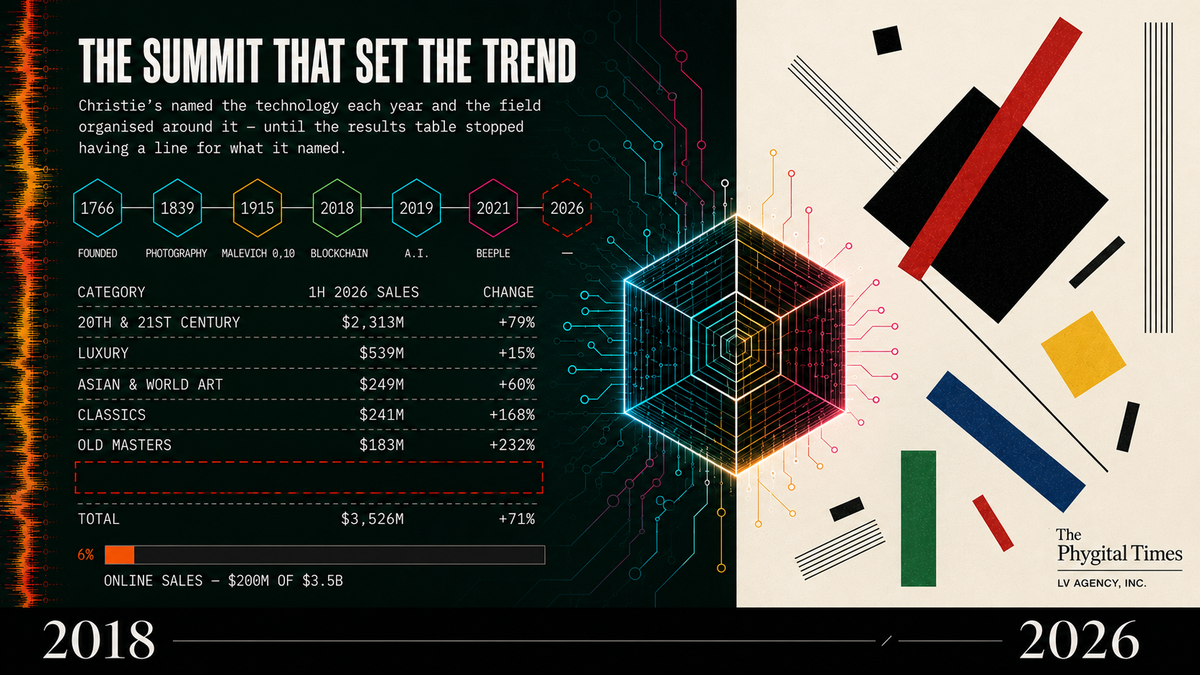
On July 15, 2026, Christie's published results for the first half of the year, and they were strong — the best in five years. $4.5 billion in total revenue. Auction sales up 71 percent. Notably, nearly half of the house's new clients were Millennials or Gen Z, and 63 percent of all new bidders arrived online. A younger generation is entering this market in numbers.
On July 16 — the very next day — Christie's hosted its annual Art+Tech Summit at its own New York headquarters. This is a one-day conference the house has run since 2018, taking one technology theme each year and examining it through talks and panels. The 2026 edition ran from 9:25 in the morning to 5:00 in the afternoon.
So: results one day, conference about art and technology the next. Two events, twenty-four hours apart, at the same institution.
The question sitting between them
Here is what makes those two days worth writing six articles about.
There is a kind of artwork that is now firmly established but does not fit the art world's existing filing system. A physical object — a sculpture, a print, a crown — made together with a digital record of itself that is stored on a blockchain. The object hangs on your wall. The record proves who made it, when, and everyone who has owned it since, and that record cannot be lost in a filing cabinet or destroyed when a company shuts down.
We call this phygital, or hybrid art: work in which the physical object and its blockchain-secured record are made as one collectible.
This is not a proposal or a prediction. It exists. A US museum — the Toledo Museum of Art — bought a work this way, entirely on-chain. Art Basel, the world's largest art fair, gave the category a section on its main floor and grew it from twelve exhibitors to twenty across three continents in seven months. In survey data, digital art now ranks in the top three media by spending among wealthy collectors.
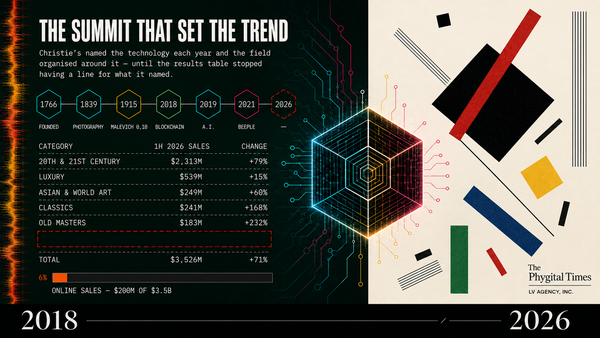
But when Christie's published its results on July 15, it broke sales into five categories — 20th & 21st Century, Luxury, Asian & World Art, Classics, Old Masters. Digital art was not among them. Neither was AI art, sixteen months after Christie's itself staged the first auction dedicated to AI art anywhere in the world.
And at the summit the next day, roughly thirty minutes of the seven-and-a-half-hour program went to technology as an artistic medium. About six percent of the day. That count is ours, made session by session against the published program.
A market rebounded. A medium advanced. And the system that reports on the market has no line for the medium.
That is the question. Everything else follows from it.
Why it isn't a small question
Categories are not labels. They are the mechanism by which a kind of art becomes a market.
If a medium has no separate line in the results, its sales cannot accumulate into a track record. Without a track record, no trend can be measured. Without a measurable trend, no one can demonstrate demand. And without demonstrated demand, there is no case for giving the medium its own department, specialists, or attention.
Photography went through exactly this. It waited roughly a century from its invention until it had its own auction department. It got one because somebody kept counting it.
🎧 Audio podcast: Art+Tech: The Summit That Set the Trend
Also available on [Apple Podcasts] · [Spotify] · [YouTube] via Libsyn
Art+Tech: The Summit That Set the Trend — Pt. 1: Overture — The whole story from the beginning.
Art+Tech: The Summit That Set the Trend, Pt. 2: The Numbers — Christie's had its best six months in five years. The medium it's built on has no line.
Art+Tech: The Summit That Set the Trend, Pt. 3: The Four Patterns — 1915, a 93% collapse, fourteen minutes to one, and a century photography spent waiting.
Art+Tech: The Summit That Set the Trend — Special Edition: What the Numbers Say Before NFT.NYC 2026
The six documents
Between July 15 and August 17, we published six pieces working through this. In order:
THE PHYGITAL TIMES H1 2026 ART+TECH REPORT (July 15) — Published the same day as Christie's results. Nine pages of data checked against the Art Basel & UBS Global Art Market Report 2026: a global art market back to growth at roughly $59.6 billion, online art sales at their lowest level since 2019, and digital art rising into the top three media by collector spending. The online sales channel shrank while the medium itself grew — which sounds contradictory and isn't.
Art+Tech: The Third Category (July 29) — The full argument. What the summit could have done, what Christie's had already built before it stepped back, and why the category question matters before December.
Physical, Digital, or Phygital (July 30) — Written for collectors. New buyers arrive believing they must choose between traditional physical art and digital art. There are three options, not two, and the third one is where the interesting work is being made.
Art+Tech: The Ledger and the Wave (August 6) — Four patterns underneath the season's numbers, including the photography comparison and the reasons a 93-percent collapse in trading volume did not mean what most people took it to mean.
Art+Tech: What a Collection Carries (August 12) — For family offices, estate lawyers and wealth advisers. What happens to a collection one generation later, when the person who assembled it is gone and the meaning has to survive without them.
Art+Tech: The Wreckage Was Never Where the Word Puts It (August 17) — The record of the 2021–22 crash: how severe it actually was, who ended up carrying the reputational cost, and what museums were quietly doing while the market declared the whole thing over.
This article is the seventh. It does something different from the other six. Rather than making a new argument, it collects what other people said, sets out what we think it means, and states what we expect next.
How this article is organized
We separate two things, always, and label them.
The record is what was actually said and by whom, with sources you can check. Quotes, dates, links. If we get something wrong here, you can catch us.
The reading is our interpretation — where we think this goes, and why. It is opinion. Nobody quoted in the first section has endorsed any of it.
Keeping those apart is the method this publication has used across 109 editions of our newsletter "The Future of Collectibles" on LinkedIn and every issue since. Verifiable data first, interpretation second, never blended.
PART ONE: THE RECORD
Ten people said something on the public record that bears directly on the category question — from a 2021 press release to remarks made this summer. Here they are together, with sources, for the first time.
From the summit stage
Marcus Fox, Christie's Global Managing Director of 20th and 21st Century Art, introducing a panel called "Navigating the Market," told the room the market is post-NFT and that he did not really want to sift through the wreckage. Introducing the advisor Benjamin "Redbeard" Gross and the digital artist Kiya Tadele, he added that although they use the technology, this conversation was not about NFTs. (ARTnews)
The same executive, five years earlier. In October 2021, announcing Beeple's HUMAN ONE — a physical sculpture accompanied by an NFT, both drawing imagery from the Ethereum blockchain — Christie's own press release quoted Fox: "Presenting this physical object, and the associated NFT, as a highlight of the 21st Century Evening sale, alongside the best artists in recent decades, provides context for the best of physical and digital works. Christie's is proud to continue to be in the center of the NFT conversation." Interviewed the following year for Christie's International Real Estate, he defined the term: "An NFT (non-fungible token) is a publicly viewable, permanent record that is unique." Both statements are his. Both are on Christie's own record. We are not going to characterize the distance between them.
Max Carter, Christie's Global Chairman of 20th and 21st Century Art — the same department — spoke about the digital art department the house closed in 2025: "I'm actually very proud of what we did in that space, and that is probably surprising coming from someone with my background. We took a fairly advanced position on something that was still quite niche at the time. It then became much more mainstream, and we served a different group of clients. It was a very interesting learning experience." He rejected outright the idea that digital art is dead, comparing it to specialist categories that grow quieter under external conditions — the comparison he reached for was the house's Russian art department. (Observer)
From the house
Bonnie Brennan, Christie's CEO, in an interview published in December 2025: the market requires the house to be nimble and responsive; a digital art specialist has been retained; the category now sits inside 20th and 21st Century Art; artists including Beeple and Refik Anadol continue to generate interest. Resources have to follow demand. Christie's, ultimately, is a small business. (The Value)
From the press
Louis Jebb, managing editor of Right Click Save and previously of The Art Newspaper, offered the most generous reading of the closure: the positive angle is that it was an admission digital art is contemporary art and has been for a long time — no need to separate them anymore, and therefore the removal of an unnecessary silo.
Alex Estorick, founding editor of Right Click Save, on who actually left when the market crashed: the people who had driven the speculation disappeared, and what remained were the individuals and platforms committed to supporting artists, collectors and curators. He also noted that the ten-percent resale royalty — one of the main things this technology was supposed to give artists — is no longer honored by many marketplaces. (Both: ART & TECH, Q2 2026)
From the museums
Philippe Bettinelli, curator at the Centre Pompidou in Paris, described the same period as a gold rush in which many people positioned themselves around digital art without any artistic consideration at all — followed by a rationalisation, a resizing to a realistic scale. What remains, he says, is the work, the structures supporting it, and artists more able to live from their practice than before.
Marcella Lista, his co-curator, on the Pompidou's February 2023 acquisition of eighteen blockchain-related works by thirteen artists — a decision taken deliberately after the crash, framed around the range of artistic positions the technology has produced.
Diane Drubay, curator and founder of We Are Museums, on the Museum of Modern Art's December 2025 acquisition of sixteen digital works: MoMA acquired more than digital art — it supported digital cultures beyond the technology and the market, following the path the Centre Pompidou had already taken. (ARTnews)
From the collectors
Sylvain Levy, of the family DSLcollection, on a digital music platform being absorbed by a larger company: not death but absorption — the thing didn't fail, it changed owners. And, separately: the next step is collections that work as intelligence systems rather than inventories, where the value is in the judgment and conversation a collection generates.
PG Carlsson, owner of Exposcandinavia, commenting publicly on our fifth article: the generational transition of a collection has mostly been a stumbling, undefined challenge, where obscure reasons come into play by chance rather than by robust vision. And: the collector is the artist of the combination — a collection is a composition, and its dispersal begins the next creative act rather than ending one.
What the record shows
Read together, these ten do not disagree about the facts.
Everyone accepts that the department closed, that the contraction was real and severe, that the medium kept going anyway, and that museums kept buying throughout. What they disagree about is a single word.
Jebb and Carter read the closure as integration — a category grown up enough not to need its own box. Bettinelli and Drubay describe continuity proceeding regardless of what the market said. Estorick and Levy describe absorption — of artists' royalties in one case, of a whole platform in the other.
Is folding a medium into a bigger category recognizing it, or removing it from view?
That is the real argument, and it is narrower than it looks. Nobody in this record disputes that the work continued. What broke was not the technology and not the market's interest in it. What broke was the word.
PART TWO: THE READING
Everything below is our opinion. No person, company or institution named above has said any of it or endorsed it. We are working out likely positions from public statements, business models and how each house is structured — the same way we read auction data. Argue with it.
Where each auction house sits
Christie's has the deepest record here and the hardest position. It ran the first blockchain summit in 2018, sold the first AI portrait at auction, conducted the record $69.3 million digital sale, built a fully on-chain platform, and staged the first AI-only auction. It also closed the department, and its Global Chairman describes what followed as expertise preserved, ready for a revival.
Our reading: that is standby, not continuity — and standby has a trap built into it. A category folded into a bigger cluster produces no separately reported sales. No separately reported sales means no evidence of demand. No evidence of demand means no case for reopening the department. The house isn't blocked by lack of belief. It's blocked by its own reporting structure — and by a contradiction underneath it.
Christie's is courting two audiences with opposite requirements: conservative capital that wanted the vocabulary scrubbed, and tech capital that arrived understanding the mechanism better than the room describing it. The first can be reassured with a change of language. The second cannot. A summit convened to ask whether A.I. wealth will produce collectors, held in a building that spent the day treating the medium closest to how that wealth already thinks about ownership as something the conversation was not about, is not a marketing problem. It is a legibility problem with the exact people it was built to reach.
There is a simpler way to state the trap, and it comes entirely from Christie's own July 15 release. Millennials and Gen Z were 47 percent of new clients. Sixty-three percent of new bidders arrived online. The same document breaks sales into five clusters, none of which is the medium those clients are most likely to arrive through — because the department that would have counted it had closed ten months earlier.
A business cannot scale for a demographic whose preferences it has stopped counting. That is not an argument about digital art. It is an argument about measurement.
Sotheby's has the cleanest reason to name the category first. No closed department to explain, a visibly hesitant competitor, and a track record of moving early on new formats.
Our reading: if any house draws the line before the end of 2027, this is the likeliest, and it will be framed as leadership rather than catching up.
Heritage Auctions is the only major house whose instincts are already hybrid. Comics, trading cards, sneakers and pop-culture material taught this market about boom-bust cycles, price ladders and survivability decades before fine art met them.
Our reading: Heritage doesn't need convincing that provenance works best when it's public and built in. It only needs to decide that fine-art phygital work is in its lane.
Phillips has the demographic fit and the least legacy structure to defend — youngest collector base, contemporary focus, no centuries of category architecture to renegotiate.
Our reading: the most natural home for this, and the least likely to be reported as a dramatic shift when it happens.
Where the counting moved
While Christie's stopped reporting the category, Art Basel started. Zero 10's multi-year partnership with OpenSea integrates on-chain metadata directly into the Art Basel app — making the work reportable at exactly the moment the auction results table stopped reporting it. One institution folded the medium into a cluster where its sales cannot be counted. The other is building the infrastructure to count them in public.
Our reading: a fair section is commercial, annual and reversible, and it is not a category line. But price discovery has to happen somewhere, and right now it is happening at Art Basel.
Where the capital went
One further piece of the record belongs here. In September 2025 — weeks after the digital art department closed — Christie's Ventures announced an investment in Artsignal, described as the first agentic AI platform for art and collectibles. Artsignal's founders have said publicly that they met the Christie's team at a Christie's Art+Tech event in Paris. In October 2025 the venture arm named Web3, fintech, AI and hardware as its investment pillars.
Our reading: the summit moved from Christie's Education to Christie's Ventures, and within the same year the house closed the department that sold this work and put capital into the platform that analyzes the market for it. The public category went quiet. The private position did not.
PART THREE: WHAT WE EXPECT — AND HOW YOU'LL KNOW IF WE'RE WRONG
Five predictions. For each one we say what it rests on, when it should happen, and what would show we got it wrong. In December we'll come back and mark each one: right, wrong, or still open.
We include the "how you'll know we're wrong" line because a prediction vague enough that it can never be judged isn't a prediction. It's decoration.
1. A major auction house names a digital, phygital or systems category by the end of 2027.
Based on: digital art in the top three media by collector spending; Art Basel's digital section growing from 12 to 20 exhibitors in seven months; museums continuing to buy right through the downturn; and the measurement problem above — a house cannot build a client strategy around a cohort it has stopped counting.
We're wrong if: no top-four house has a separately reported line by December 31, 2027.
2. Art Basel's Zero 10 section — not an auction house — becomes the place the field looks to for validation.
Based on: main-floor placement at the world's largest fair; an established price range across three continents; curation treating this work as contemporary art rather than novelty; and the OpenSea integration making the data public.
We're wrong if: Miami Beach in December 2026 shows fewer exhibitors or lower prices than Basel did in June 2026.
3. Wealth managers start formally handling the transfer of a collection's meaning, not just its value.
Based on: the Deloitte and ArtTactic estimate of roughly $992 billion in art and collectibles changing hands over the next decade; wealth managers offering art services rising from about a quarter in 2011 to over half today.
We're wrong if: the next Deloitte and ArtTactic report shows no movement toward documenting collector intent as a named service.
4. The next phase gets selective — institutional attention narrows to a small group of artists rather than spreading.
Based on: the filtering pattern identified in our H1 Report; how mediums have historically matured after a boom.
We're wrong if: museum and institutional acquisitions in 2027–28 broaden out rather than concentrating.
5. At least one collection is publicly built as an intelligence system rather than an inventory.
Based on: Sylvain Levy's stated position; the two-layer argument in our fifth article; younger collectors wanting to verify rather than take intermediaries' word for things.We're wrong if: nothing of the kind is publicly announced by the end of 2027.
Why this article is built this way
Our central criticism of the summit was that it removed the argument. A full day at the house's own headquarters. One panel touching the medium. No audience questions. And the technology underneath the featured artist's own work described from the stage as something the conversation was not about.
An article making that criticism ought to be answerable itself.
So this one publishes a critical review of its own argument, argues the strongest version of the case against itself, says plainly what would show its predictions were wrong, records every change publicly, and invites anyone named to reply in full.
The record makes it checkable. The reading makes it useful. Both stay open.
Listen
Audio is being added through December, as a series called Art+Tech: The Summit That Set the Trend on The Phygital Times Podcast is Live now — available on Apple Podcasts, Spotify, YouTube and everywhere else.
About the audio: episodes are AI-generated from the sources listed below. In the debate episode, one voice argues our position and the other argues the strongest counter-argument we could construct. Neither voice represents any real company or person, and nothing said in any episode should be attributed to anyone named in this article.
Names and terms are sometimes mispronounced by the generated voices — an artist's name, a foreign phrase, an institution we cite. When that happens, we publish a corrected transcript shortly after the episode airs, rather than editing the audio itself. The corrected transcript is the accurate record; the audio may occasionally lag behind it.
Update log
August 20, 2026 — Opened. Published with the record of ten named voices, our reading of the four houses plus Zero 10 and Christie's Ventures, and five predictions. Episode 1 (Overture) live.
Sources
Shanti Escalante-De Mattei, "Christie's Art + Tech Summit 2026," ARTnews · Elisa Carollo, "Christie's Art + Tech Summit 2026," Observer, July 2026 · Christie's press release, HUMAN ONE, October 2021, quoting Marcus Fox · "Brave New Art World: The Rise and Rise of the NFT," Christie's International Real Estate, 2022 · Bonnie Brennan interview, The Value, December 19, 2025 · ART & TECH No 001 (Q2 2026) and No 002 (Q3 2026), Right Click Save · Centre Pompidou on its 2023 acquisition · ARTnews on MoMA's December 2025 acquisition · The Art Newspaper on Artsignal and Christie's Ventures, November 20, 2025 · Art Media Agency, September 19, 2025 · Art Basel on Zero 10 and the OpenSea partnership · Deloitte Private and ArtTactic Art & Finance Report 2025 · Art Basel & UBS Global Art Market Report 2026 · Christie's H1 2026 results release, July 15, 2026.
Disclaimer
Independent editorial commentary published by The Phygital Times, a publication of LV Agency, Inc., New York. LV Agency is not affiliated with, endorsed by, or acting on behalf of Christie's, Sotheby's, Heritage Auctions, Phillips, Art Basel, OpenSea, Right Click Save, Observer, ARTnews, the Centre Pompidou, the Museum of Modern Art, or any institution or individual named here. Statements attributed to named individuals are quoted or paraphrased from the published sources cited. Everything in "The Reading" and "What We Expect" is the opinion of LV Agency, Inc., offered as fair comment; no named party has stated or endorsed any of it. The count of programming time at the July 16, 2026 summit is LV Agency's own, made session by session against the published program; it is not an official figure and has not been confirmed by Christie's. Audio episodes are AI-generated from listed sources and represent no real company or individual. Nothing here is financial, investment, legal or estate-planning advice. All marks belong to their owners. Corrections will be published promptly in the update log, and any party named is invited to reply in full. Inquiries through LV Agency, Inc.
The Future is Phygital!
#PhygitalArt #ArtTech #ArtCollecting #Provenance #TotalArtTech #ArtMarket #DigitalArt