The Hinge of November: Forecasting the 2026 Midterms
In May, Episode 3 of The Phygital Times Podcast called it the 729-Day Wall. Five months on, the data has caught up with the clock: Democrats are strong favorites for the House (88%) and narrow favorites for the Senate (60%). The wall still stands. It falls on the count, not the vote.

A Numeric Humanism Special Report · October 7, 2026 · By Vladi Lepi
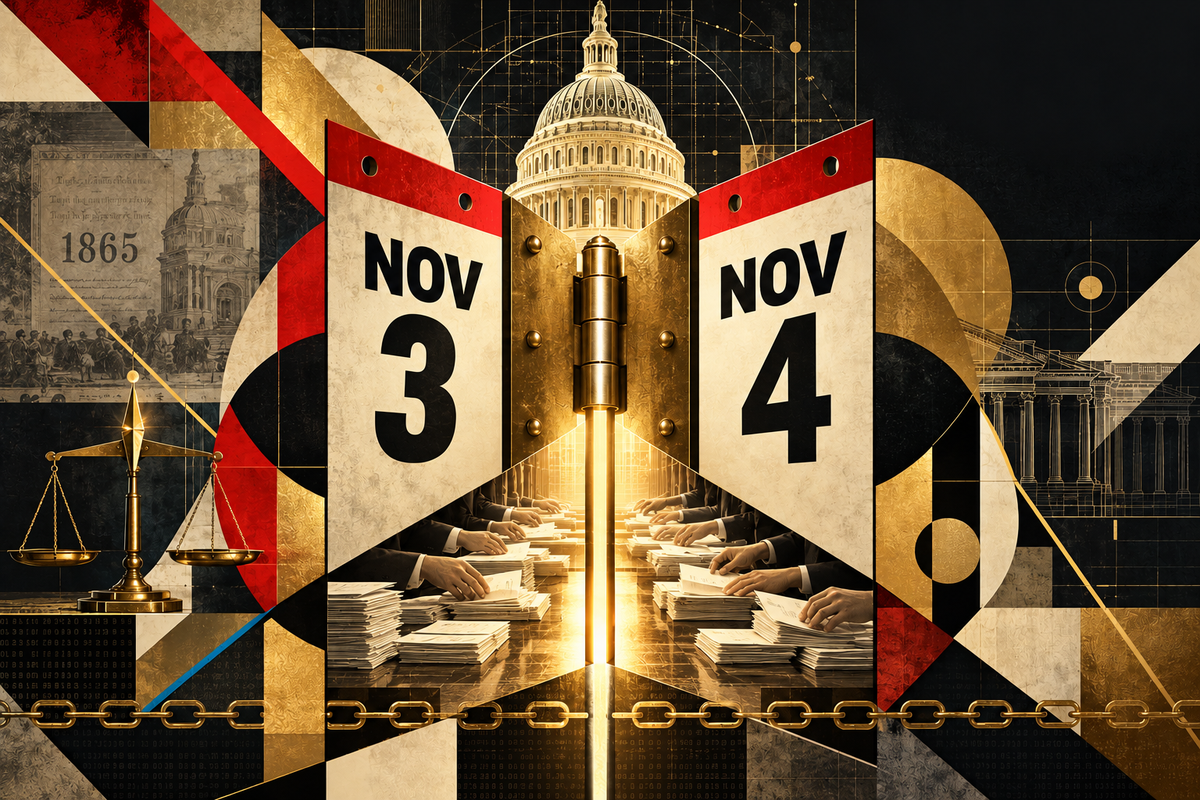
From the Wall to the Hinge: The wall still stands. It lands on November 4, the morning of the count, not on election day.
On May 2, The Phygital Times Podcast premiered its third episode on YouTube: The 729-Day Wall | Decoding the "Reconstruction" Signal of the 2026 U.S. Midterm Elections. Directed by Vladi Lepi as a SurR.Ai Lab production, the episode was the pilot of a strategic-intelligence case-study format. It read the 2026 midterms as a temporal threshold where the momentum of 2024 would meet resistance. Its thesis fit in one sentence: the system is not choosing a side; it is correcting its imbalance.
Five months later, the thesis holds, and the data has caught up with it. In the spring the case rested mostly on the clock, and the prediction markets treated the Senate as a coin flip, with Republicans slight favorites in late March. Since then, the Iran war has flared again at the Strait of Hormuz. Gasoline has set a September record, the Federal Reserve has raised rates for the first time since 2023, and the president's approval has fallen to a second-term low. On October 7, the markets priced a Democratic House at 91% and a Democratic Senate at 64%.
The October update, researched on October 7 and published on October 8, does four things the episode could not. It puts numbers on the call: Democrats are strong favorites for the House at 88% and narrow favorites for the Senate at 60%. It pins down the wall: counted day by day, the 729th day after the 2024 vote is Wednesday, November 4, so the wall falls on the count, not the vote. It widens the Reconstruction signal. The vote mirrors the Freedmen's Bureau Act of March 3, 1865, and the count mirrors Lincoln's Second Inaugural the next day, with its charge to "bind up the nation's wounds." And it fingerprints the forecast, so that after November 3 anyone can check what was said before it.
The method has not changed. Numeric Humanism reads the data and the clock together and lets each do its own job: the data names the winner, and the clock names the moment. Both still say what the episode said in May: 2026 is a correction, not a collapse.
The Call
Our call: Democrats are strong favorites for the House (88%) and narrow favorites for the Senate (60%) on November 3, against market prices of 91% and 64%. The shape of the result is a check, not a revolution. The majority breaks; the core holds.
If you read elections as a daily collision of polls, outrage and personalities, this cycle looks like noise. Step back from the 24-hour churn and it looks like architecture. Numeric Humanism reads that architecture through two lenses at once. The exoteric lens is what can be measured: prices, polls, maps and money. The esoteric lens is the framework's temporal model, which marks when complex human systems expand and when they are forced to correct.
The two lenses do different jobs. The first names the winner. The second names the moment, and the moment is not election night. It is the morning after, when the count is read.
Since our May edition The 729-Day Wall | Decoding the “Reconstruction” Signal of the 2026 U.S. Midterm Elections, the surface has moved hard. The Iran war flared again at the Strait of Hormuz, gasoline set a September record, and the Federal Reserve raised rates for the first time since 2023. The president's approval fell to a second-term low, and the betting markets turned the Senate from a Republican hold into a Democratic lean. This report reads all of it, then makes the call.
I. The Surface: Prices, War and the President's Numbers
Every gauge a household actually feels is pressing on the party that holds the executive. Fuel, credit and real wages are all under strain at once, four weeks before the vote.
| Gauge | Reading | Reference point | Source |
|---|---|---|---|
| Gasoline, national average | $4.37/gal (Oct 7) | $3.16 on Oct 1, 2025; September averaged $4.33, the highest September on record | AAA |
| Crude oil (WTI) | about $90/bbl | Renewed US–Iran strikes at the Strait of Hormuz since Aug 30 | AAA, AP |
| Consumer prices (CPI, year on year) | 3.4% (August) | September print due Oct 14 | BabyPips |
| Federal funds target | 3.75–4.00% | Raised Sept 16, the first hike since July 2023 | Newser |
| Payrolls / unemployment | +29,000 / 4.2% (September) | 4.1% in August; wages +3.0% a year, below inflation | BabyPips |
| Presidential approval | 39% approve / 60% disapprove (end of September) | Low of 38% on Sept 29; second-term high 54% | Ballotpedia |
| Direction of the country | 32% right / 61% wrong | Second-term low of 24% right on Sept 2 | Ballotpedia |
| Congressional approval | 24% | Low of 12% on May 26 | Ballotpedia |
| Generic congressional ballot | D 50.4 / R 42.2 (D+8.2) | Every poll in the Sept 16–Oct 5 average shows Democrats ahead | RealClearPolitics via El Cronista |
The squeeze. September wages rose 3.0% a year against the latest CPI reading of 3.4% for August, so the average household is losing ground in real terms in the last quarter before the vote. September payrolls grew by just 29,000, and the two prior months were revised down by 60,000. The Fed answered persistent inflation with a quarter-point hike on September 16, and sixteen of its eighteen officials projected at least one more by December. Mortgage and card costs are moving the same way as the pump.
The war. The new variable since spring is the intermittent US–Iran war, which began with US–Israeli strikes on February 28 and flared again at the Strait of Hormuz on August 30 after a month-long lull. It connects a decision in the Situation Room to the price board at the corner station. In Emerson's September national poll, voters ranked the Iran war highest in importance (3.87 on a five-point scale), ahead of jobs (3.80) and tariffs (3.72). The economy remains the top single issue at 41%, and 60% say the president's economic policies are making things worse.
The exposure. On November 3, 470 of 535 voting seats are on the ballot: all 435 House seats and 35 Senate seats, including specials in Ohio and Florida. That is 87.9% of the voting legislature. A volatile public mood is meeting almost total exposure at the federal level, and the mood is not the governing party's friend.
II. The Map: A Thin Wall of New Districts
The House is the Democrats' to lose; the Senate is the real contest. Democrats need a net gain of three House seats and four Senate seats.
The redistricting war. Mid-decade redistricting was meant to raise the bar for the opposition. After the Supreme Court's April 29 ruling in Louisiana v. Callais narrowed Section 2 of the Voting Rights Act, Alabama, Louisiana and Tennessee joined Texas, Florida, Ohio, Missouri and North Carolina in redrawing. California and Utah answered for Democrats. Virginia's voters approved a new map in April, and the state Supreme Court voided it in May (Reuters via Investing.com; Votebeat).
Exhibit 1. Republicans drew the bigger map edge, but expect to keep less of it
| State | Redrawn seats leaning | Status |
|---|---|---|
| Texas | Up to +5 Republican | Map in effect |
| Florida | Up to +4 Republican | Passed late April 2026 |
| Ohio | Up to +2 Republican | Compromise map |
| Missouri | +1 Republican | Signed September 2025 |
| North Carolina | +1 Republican | Approved October 2025 |
| Louisiana | +1 Republican | Approved May 29, after Callais |
| Alabama | +1 Republican | Allowed by the Supreme Court June 2 |
| Tennessee | +1 Republican | Approved May 7 |
| California | Up to +5 Democratic | Voter-approved map |
| Utah | +1 Democratic | Court-implemented map |
| Net, on paper | Republicans +10 (16 against 6) | Cook expects about Republicans +4 in practice |
Struck down or abandoned: Virginia (voter-approved map voided by the state Supreme Court, May 8), South Carolina, Indiana, Kansas and Maryland. Seats are each map's maximum projected gain. Sources: Reuters state-by-state tally (June 11, 2026) via Investing.com; Cook projection via Axios (Oct 6, 2026).
The wall is thinner than it looks. The 16 and 6 are gross, on-paper counts; Cook now projects Republicans to net about four seats from redistricting, not the double digits once hoped for. House Majority Whip Tom Emmer told donors, "We're not gonna win all 13 of those redistricted seats" (Axios). In September, Cook moved 15 House races toward Democrats and Sabato's Crystal Ball moved 11, many of them in districts Trump carried in 2024.
The Senate battleground. Republicans hold 53 seats. Democrats need 51; at 50–50, Vice President JD Vance breaks the tie. Democrats must also hold Georgia, Michigan and New Hampshire, where polling averages show them ahead by 7.8, 3.6 and 5.6 points. In those averages they lead in six Republican-held races, but only North Carolina (49.8 to 40.8) is comfortable (El Cronista, RealClearPolitics averages).
| State | Seat now | Democrat or independent | Republican |
|---|---|---|---|
| North Carolina | R, open | Roy Cooper | Michael Whatley |
| Maine | R | Troy Jackson | Susan Collins |
| Ohio (special) | R | Sherrod Brown | Jon Husted |
| Texas | R | James Talarico | Ken Paxton |
| Alaska | R | Mary Peltola | Dan Sullivan |
| Iowa | R, open | Josh Turek | Ashley Hinson |
| Nebraska | R | Dan Osborn (independent) | Pete Ricketts |
| Michigan | D, open | Abdul El-Sayed | Mike Rogers |
| Georgia | D | Jon Ossoff | Mike Collins |
| New Hampshire | D, open | Chris Pappas | John E. Sununu |
Texas is the race that tells you how far the mood has traveled. A state Trump carried comfortably now has Democrat James Talarico favored over Attorney General Ken Paxton, who unseated Senator John Cornyn in the primary. Nebraska is the anomaly: Democrats fielded no candidate, and independent Dan Osborn says he will caucus with neither party. An August Impact Research poll released by his campaign had him tied with Senator Pete Ricketts at 47–47, while Cook and Sabato rate the race Likely Republican (Newsweek).
III. The Money: What the Markets Price
Money agrees with the polls on the House and is moving toward them on the Senate. On October 7, prediction markets priced a Democratic House at 91% and a Democratic Senate at 64%; full Republican control traded at about 9%, the average of Kalshi and Polymarket (DeFi Rate, observed Oct 7, 2:27 p.m. ET).
The direction matters as much as the level. In late March the same markets made Republicans slight favorites to keep the Senate, at 51% on Kalshi and 53% on Polymarket, and gave Democrats 84–85% for the House (DeFi Rate, March 24). Six months of war, fuel and rate shocks moved the Senate price by about fifteen points.
Exhibit 2. Markets price five Republican-held Senate seats to flip, one more than Democrats need
| State | Seat held by | Price of a Democratic win (Kalshi) |
|---|---|---|
| North Carolina | Republican | 97% |
| Georgia | Democrat | 96% |
| New Hampshire | Democrat | 89% |
| Minnesota | Democrat | 87% |
| Alaska | Republican | 77% |
| Michigan | Democrat | 71% |
| Texas | Republican | 67% |
| Ohio (special) | Republican | 63% |
| Maine | Republican | 58% |
| Iowa | Republican | 45% |
| Kansas | Republican | 37% |
| South Carolina | Republican | 14% |
| Florida (special) | Republican | 10% |
Bold marks a Republican-held seat priced as a Democratic gain. Nebraska is left off: no Democrat is running, and markets gave Senator Ricketts about 70% against independent Dan Osborn in late August. Sources: Kalshi midpoints via DeFi Rate, observed Oct 7, 2026, 2:27 p.m. ET; Newsweek (Aug 26, 2026).
Added across all 35 Kalshi race contracts, these prices imply about 51.4 Democratic seats; DeFi Rate's race-by-race calculation gives a 71% chance of a majority if every race were independent. They are not. A polling miss in one state usually runs through all of them, which is why the single chamber contract trades lower, at 64%.
The models published in August pointed the same way with less conviction. FiftyPlusOne's model gave Democrats an 85% chance in the House, with a median of 230 seats, and 55% in the Senate, with a median of 51. Silver Bulletin moved Texas to Lean Democratic at 60%. For collectors who think in order books, the lesson is familiar: the market is most informative about direction, and least reliable at the tails.
IV. The Hinge: What the Clock Sees
The esoteric lens does not name the winner. It names the hinge, and Numeric Humanism's temporal model registers five signals closing at once on Tuesday, November 3, and Wednesday, November 4.
The House was built to be answered. Every two years the whole chamber returns to the voters, and Numeric Humanism treats that rhythm as structural rather than procedural: a majority is elected, then it meets its answer. Read through the temporal model, the 2024 mandate meets its answer on schedule, but not on the day most people expect.
Exhibit 3. Five signals close on the vote and the count
| Anchor event | Date | Lands on | Signal |
|---|---|---|---|
| Freedmen's Bureau Act | Mar 3, 1865 | Tue, Nov 3 (mirror) | Repair after rupture |
| The 2020 race is called | Nov 7, 2020 | Tue, Nov 3 | Reversal |
| Iowa caucuses | Jan 15, 2024 | Wed, Nov 4 | Amplification |
| The 2024 vote | Nov 5, 2024 | Wed, Nov 4 | Reversal |
| Tariffs struck down by the Supreme Court | Feb 20, 2026 | Tue, Nov 3 | Amplification |
| Iran war begins | Feb 28, 2026 | Thu, Oct 29 | Reversal: the war's turning date |
Reversal: the event meets its answer. Amplification: the same sign, stronger. The window of November 3–4, 2026 (the vote and the count) mirrors March 3–4, 1865. Source: Numeric Humanism temporal model.
The count, not the vote. The model's primary signal from the 2024 election lands on Wednesday, November 4. That is the morning the result is read, not the day it is cast. In a year when Alaska and Maine rank their ballots and Georgia can send a close race to a runoff, the hinge sitting on the count is not a poetic detail. It is a practical warning.
Two hands on one clock. Read with signs, the clock has two hands. Three signals point toward a check on the governing coalition: the reversal of the 2024 mandate; the amplification of February 20, when the Supreme Court ruled 6–3 that the International Emergency Economic Powers Act does not authorize tariffs (Ropes & Gray); and the deep-time mirror of 1865, read in the next section. Two signals point the other way. The day the 2020 race was called for the Democrats returns as a reversal of that victory, and Trump's January 2024 Iowa win returns as an amplification of his base.
The reconciliation is structural. The majority breaks; the core holds. That is the shape of a midterm in which the House turns while the deep-red Senate seats stand. The clock says when. The data says who.
The signpost. The sixth signal does not land on the vote. The Iran war opened with US–Israeli strikes on February 28 (An-Nahar), and the model marks Thursday, October 29 as its turning date. That is one day after the Fed's October 28 decision and five days before the vote. The same morning brings the advance estimate of third-quarter GDP and September PCE inflation, so the week is crowded on both calendars: watch oil, the Strait of Hormuz and the data.
V. Mirrors in Deep Time
Three mirrors frame the vote: Reconstruction, the fatigue election of 1978, and the Republic's 250th year. All three describe a correction, not a collapse.
1865: the bureau and the address. Numeric Humanism's deep-time mirror sets the vote against March 3, 1865, when Congress created the Bureau of Refugees, Freedmen and Abandoned Lands. It sets the count against the next day, March 4, 1865, and Lincoln's Second Inaugural: "With malice toward none, with charity for all … to bind up the nation's wounds." The mirror pairs a federal agency built to repair a rupture with the most famous call for repair in American speech.
Its questions return in modern dress. How far should federal power reach into states and cities? What is labor owed when prices outrun wages? Who pays for a war? In 1865 the answer was an institution of repair. In 2026 the electorate is shopping for the same thing.
1978: the fatigue election, 48 years on. The second mirror is closer. Forty-eight years ago, a president with majorities in both chambers ran into inflation, a tax revolt and an Iran coming apart. California passed Proposition 13 in June. In November the president's party lost 15 House seats, 3 Senate seats and six governorships, and twelve of sixteen tax-and-spending limits passed on state ballots. Newsweek called it "the ratification of a new and no longer partisan agenda," with inflation as "the primary villain" (Ashbrook Center).
The rhyme is in the mechanics, not the magnitudes: 1978 inflation ran roughly twice today's 3.4%. Today the first rate hike since 2023 and a war with Iran holding crude near $90 play the same role, and the September 16 hike landed exactly 48 days before the vote, a numerical echo rather than a law. The party in power pays for prices and for Iran.
The measure is relative. In 1978 a 15-seat loss dented a majority of more than 280 seats, and the larger realignment arrived two years later. In 2026 a loss a fifth that size ends a three-seat majority. Read forward, 2026 opens a correction, and 2028 is where it is completed or reversed.
The 250th year. The Republic turned 250 on July 4. Numeric Humanism reads each body on the ballot through its own age in this cycle, and the readings agree with the clock.
| Subject | Founded | Reading for 2026 |
|---|---|---|
| The Republic | 1776 | Hope and renewal: a star, not a storm |
| Congress | 1789 | Change and reaction: the institution turns |
| Democratic Party | 1828 | The turning wheel: periodicity comes round |
| Republican Party | 1854 | Activity and work: the base renews itself |
| Election day | Nov 3, 2026 | Two ways in counterpoise: a choice, weighed |
Read together: the institution turns, the challenger's wheel comes round, the incumbent party's base renews itself, and the Republic keeps its star. These readings are interpretive; none of them sets a probability.
VI. The Third Node: The Swing Voter, Nebraska and the Count
When two forces lock, the system reaches for a third term. In 2026 that third term can be measured: independent voters, one independent candidate, and a count that will not finish on election night.
The tongue of the balance. Every balance has two pans and a tongue between them, and the tongue decides. Numeric Humanism treats the swing voter as that tongue, not as a third party. Independents broke for Trump in 2024. In Emerson's September poll they favored Democrats 60–31, and Hispanic voters, who also moved right in 2024, favored them 64–31 (Emerson). The tongue has moved.
Proof over trust. A proof-of-work blockchain runs on a simple consensus logic: one unit of work, one vote, and the longest chain of work is the majority's record. A trailing chain with less than half the work sees its chance of catching up shrink exponentially with every block. A trailing chain with more than half catches up from any deficit with probability one.
Apply that logic to the vote. Nationally, the opposition now holds the majority of the work: 54–46 in two-party terms on the generic-ballot average. Its House deficit is three seats, or about seven counting Cook's redistricting estimate. A shallow deficit against a majority of the work is not much of a race.
Depth of witness. The Senate is a deeper chain. Two-thirds of it is not on the ballot, and most of the third that is was last confirmed in 2020, in a different climate. In any ledger, a record becomes harder to revise the more confirmations sit on top of it. The House, re-witnessed every two years, is the most revisable layer the Founders built; the Senate, confirmed across three staggered elections, is the least. So the House follows the national mood, and the Senate fights it state by state. In Iowa, Kansas, South Carolina and Florida, the governing coalition still holds the local majority.
Nebraska, literally. In one state the third node is a person. Dan Osborn, an independent with Democratic backing but no Democratic label, says he will caucus with neither party. If the Senate lands at 50–49 around him, he becomes the tongue of the balance in the most literal sense American politics allows.
The count as third node. Alaska ranks its general-election ballots, and its 2026 ballot also carries a measure to repeal ranked-choice voting (Ballotpedia). Maine ranks its federal ballots as well, and Georgia sends any race without a majority to a December runoff. The blockchain rule applies: wait for confirmations. Senate control may not settle until weeks after November 4.
The repairman. The third node is also a posture. The candidates gaining ground in 2026 talk less about defeating the other side and more about fixing what is broken: prices, rates, wages, a war without an exit. The electorate is not asking for a new ideology. It is asking for a debugger.
VII. The Forecast
Our call: Democrats take the House as strong favorites and the Senate narrowly, in a check on the executive rather than a revolution.
| Chamber | Call | Probability | Central estimate | 80% range |
|---|---|---|---|---|
| House | Democratic majority | 88% | 233 Democratic seats | 216–250 |
| Senate | Democratic majority, narrowly | 60% | 51 Democratic seats | 49–53 |
| Outcome | The Phygital Times | Kalshi, Oct 7, 2:27 p.m. ET |
|---|---|---|
| Democratic sweep | 58% | 63.5% |
| Democratic House, Republican Senate | 30% | about 26% (derived) |
| Republicans keep both chambers | 10% | 9.65% |
| Republican House, Democratic Senate | 2% | 0.75% |
The House call rests on the exoteric lens, and it is not close. An eight-point generic-ballot lead, 39% approval, falling real wages and a three-seat deficit leave Republicans needing a large, uniform polling miss. The redistricting wall, about four seats in Cook's estimate, buys them less than a point.
The Senate call shades below the market. Markets say 64%, summed race prices say 71%, and the August models said 55%. One structural reading pulls the number down: the depth of witness, which says the Senate resists national waves, as the August models' 55% also suggests. The 51st seat runs through Ohio (63%) and Maine (58%). Iowa (45%) is the reach; Michigan (71%) is the main Democratic defense. The 58% sweep is a judgment, not a product: if the chambers moved independently, 88% × 60% would give 52.8%. The extra five points reflect one national wave lifting both.
The esoteric lens does not move these numbers; it reads them. Every reading gives the same shape: the majority breaks, the core holds, the Republic keeps its star. That is a check, not a revolution.
The fingerprint. Blockchain's first gift to publishing is the timestamp: proof that a record existed at a given time. This forecast is fingerprinted that way, and anchored on chain before November 3.
The SHA-256 hash of the line below is 1508dbdf178a2af6d0d9f4c99ab927a641ceae6265af6197f9fea0617d27a5d7.
Inscribed on chain, the call becomes a phygital object that cannot be edited after November 3.
THE PHYGITAL TIMES | MIDTERM FORECAST | STAMPED 2026-10-07 | HOUSE: DEM 88% | HOUSE SEATS: DEM 233 (80% RANGE 216-250) | SENATE: DEM 60% | SENATE SEATS: DEM 51 (80% RANGE 49-53) | DEM SWEEP 58% | DEM HOUSE + GOP SENATE 30% | GOP BOTH 10% | GOP HOUSE + DEM SENATE 2%
VIII. Strategic Protocols
In a breaking field, every side wins by repairing, not attacking. Accord with the cycle brings fortune; defiance of it brings misfortune.
| Actor | Winning posture | The trap |
|---|---|---|
| Governing party (Republicans) | Consolidate: defend the new map seats and the Senate firewall, and lower the temperature on war and prices | Expansion: new fronts, new fights, new tariffs. Strength at its peak already carries its loss. |
| Opposition (Democrats) | Repair: run as the agent of household security on fuel, rates and wages | Outrage: a weak blow only rouses a strong opponent. The wheel is turning; it does not need to be pushed. |
| Independents and reformers | Fix the operating system and stay outside the machine | Becoming a spoiler rather than a balance |
| Capital and markets | Price the settlement window, not election night | Treating November 4 as final |
For the governing party, the only levers big enough to move the national number in four weeks are a de-escalation in the Gulf and a lower price at the pump. Everything else is expansion, and expansion is the trap in a correcting year.
For the opposition, the risk is mistaking the mood for a mandate. Voters who rate the economy their top issue back Democrats 55–41 in Emerson's poll; they are buying repair, not revenge.
For independents, the posture writes itself: "We are not here to join the partisan machine; we are here to fix the operating system."
What HNWIs and collectors should watch. This is analysis for your own judgment, not investment advice.
- Rates. The Fed raised its target to 3.75–4.00% on September 16, and 16 of 18 officials projected at least one more hike by December (BabyPips). The 10-year Treasury yield closed at 5.28% on October 2 and 5.31% on October 5 (FRED). A Democratic House changes oversight and appropriations, not monetary policy.
- Oil. Fuel has eased from its September record, with WTI near $90. The war, not the election, sets this price.
- The power of the purse. A new House majority gains subpoenas, hearings and the budget. It cannot reverse executive action alone, so expect leverage through spending deadlines rather than new statutes.
- Crypto. Bitcoin was $85,686 on September 23, about $40,500 below its record of $126,198 set on October 6, 2025 (KuCoin). Numeric Humanism marks December 21, the winter solstice, as Bitcoin's own turning date. The 120th Congress is due to convene on January 3, 2027, the eighteenth anniversary of Bitcoin's genesis block.
- The phygital collector. Physical works conceived as digital art travel through the same tariff, rate and currency weather as everything else. A divided government is a slower government, and slow policy is the friend of long holding periods.
IX. The Calendar
Nine dates carry the cycle from here to the new Congress. The September CPI on October 14, the Fed on October 28, and third-quarter GDP with September PCE inflation on the morning of October 29 are the last economic shocks before the vote (BEA). October 29 is also the model's signpost for the war, so the two calendars meet in the same week.
Exhibit 4. Nine dates to watch, from the CPI print to the new Congress
| Date | Event |
|---|---|
| Wed, Oct 14, 2026 | September CPI release |
| Wed, Oct 28, 2026 | Fed rate decision |
| Thu, Oct 29, 2026 | Q3 GDP (advance estimate) and September PCE, 8:30 a.m. ET |
| Thu, Oct 29, 2026 | Signpost: the war's turning date |
| Tue, Nov 3, 2026 | Election day |
| Wed, Nov 4, 2026 | The count: the model's hinge |
| Tue, Dec 1, 2026 | Georgia runoff, if needed |
| Mon, Dec 21, 2026 | Signpost: Bitcoin's turning date |
| Sun, Jan 3, 2027 | 120th Congress due to convene |
Sources: release dates via BabyPips and BEA; the runoff date assumes Georgia's four-week rule; signposts from the Numeric Humanism model.
After November 4, watch the slow counts. California counts for weeks, Alaska and Maine may need ranked-choice tabulation, and Georgia can push a Senate seat into December. If control of the Senate hangs on any of them, the answer arrives with the confirmations, not with the first headline.
Coda: The Architect of Repair
2026 is not just another midterm. It is the first re-confirmation of the 2024 mandate, on a clock the House has kept since 1789: a majority is elected, then it is answered.
The answer arrives on Wednesday, November 4, when the count is read. On that same morning the deep-time mirror shows March 4, 1865, when a wartime president asked a divided country to bind up its wounds. The data says the House turns and the Senate is close. The clock says the turn is a correction, not a collapse. Both say the same thing about the winners of 2026: they will be the repairmen, not the disruptors.
When the count is read, the question for every reader is the same. Will you be caught in the partisan noise, or will you read the architecture well enough to become an architect of repair?
Method and Sources
Method. Numeric Humanism pairs verified exoteric data with a proprietary esoteric framework of temporal and structural analysis. The framework sets timing and shape; it never sets the probabilities. The 88%, 60% and 58% are judgments shaded from polls, race ratings, prediction markets and published models as of October 7, 2026; the temporal reading is not one of the inputs.
Sources.
- AAA: national average dips after record-setting September
- Ballotpedia: approval averages, September 2026
- Emerson College Polling: September 2026 national poll
- El Cronista: RealClearPolitics generic ballot and Senate averages
- BabyPips: September 2026 jobs report and Fed outlook
- Newser: the Fed's first hike since 2023
- AP via Messenger-Inquirer: US strikes in Iran, August 30
- An-Nahar: Iran war timeline, February–June 2026
- Ropes & Gray: Supreme Court strikes down IEEPA tariffs
- Reuters via Investing.com: how the redistricting war played out, state by state
- Votebeat: redistricting after Callais
- Axios: House GOP leaders admit redistricting fell short
- DeFi Rate: 2026 midterm prediction markets, observed Oct 7, 2026, 2:27 p.m. ET
- DeFi Rate: market odds, March 24, 2026
- FiftyPlusOne: midterm forecast, August 3, 2026
- Silver Bulletin: 2026 midterm model
- Newsweek: Osborn vs. Ricketts in Nebraska
- Ballotpedia: Alaska's ranked-choice federal elections
- Ashbrook Center: the 1978 midterm
- FRED: 10-year Treasury constant maturity, daily
- BEA: release schedule, Q3 GDP and September personal income and outlays on October 29
- KuCoin: Bitcoin price, September 23, 2026
Disclaimer
This report is editorial analysis published by The Phygital Times for information and discussion. It is not investment, financial, legal or political advice. It is not a recommendation to buy, sell or trade any security, digital asset or prediction-market contract. Readers should make their own decisions and consult qualified advisers.
The forecast reflects the author's judgment, drawn from public polls, race ratings, prediction-market prices, economic data and published models as of October 7, 2026, as cited. These sources are third-party, their accuracy is not guaranteed, and conditions can change quickly. Elections are uncertain: an 88% call misses about one time in eight, and a 60% call four times in ten.
Numeric Humanism pairs this data with an esoteric framework used to read timing and shape. That reading is interpretive and symbolic. It is not a scientific predictive model, and it sets none of the probabilities in this report.
The Phygital Times does not endorse any party or candidate. This report was not paid for by, or coordinated with, any campaign, party or committee. Prediction markets are cited as data only; their availability and legality vary by jurisdiction.
The SHA-256 hash is a fingerprint of the exact forecast text; it proves what was written, not when. Once the hash is anchored on chain, the block time records when the forecast existed. The hash does not certify accuracy, and any on-chain inscription of it is an archival record, not a digital asset offered for sale or investment. Corrections, if any, will be published separately, leaving the fingerprinted forecast unchanged.
© 2026 The Phygital Times.