2026 FIFA World Cup™ Prediction: From Chaos to Clock
The 2026 FIFA World Cup is not only a tournament. It is a 48-team system converting global noise into historical permanence - and the most visible form of Total Popular Art on Earth, capable of gathering billions of viewers into one synchronized cultural clock.

Argentina, Spain, France, England, Prediction Markets, and the New 48-Team Matrix.
A systems analysis of the 2026 FIFA World Cup format, prediction markets, and the shift from chaos to clock.
By: "The Phygital Times" Strategic Systems Desk
Published: May 24, 2026
Methodology: Numeric Humanism and systems analysis developed by SurR.Ai for LV Agency, Inc.
Editorial Direction: Vladi Lepi / SurR.Ai, under the Directing Intelligence protocol.
🚀 Sponsored: The chaos. The clock. The collectible record. 🚀
◆ Annotation — July 15, 2026: This Forecast Was Falsified
This article's central claim did not survive. On July 14, 2026, Spain beat France 2–0 in the semifinal at Dallas Stadium. France did not score. The final is Spain vs Argentina on July 19.
Nothing below has been altered. "The forecast is France" stands. So does the reasoning that produced it — including the passage arguing that Spain "may be the best team when the page is clean" and that "the World Cup rarely offers a clean page." Spain conceded one goal in seven matches across three countries. Spain did not need a clean page; Spain cleaned it.
This page is kept as published because that is what a record is: not the archive of what we got right, but the proof of what we claimed, when we claimed it, and what the tournament did to it.
→ The full accounting: The Countdown to Clock: Live Readings
◆ Editor's Note — A Living Work
This piece did not end where it was first published. It opened a door — and the tournament came back through it.
Originally published May 24, 2026, this systems analysis was the pre-tournament forecast: the reading that named France, not for leading the odds, but for being built to survive a 48-team tournament stretched across three countries. It is the editorial framework beneath everything that followed.
On July 14, 2026, Spain beat France 2–0 in the semifinal at Dallas Stadium. France did not score. The forecast below is falsified.
Nothing below has been altered. "The forecast is France" stands, and so does the reasoning that produced it — including the argument that Spain "may be the best team when the page is clean," and that "the World Cup rarely offers a clean page." Spain conceded one goal in seven matches across three countries. Spain did not need a clean page. Spain cleaned it. The page stays as published because that is what a record is: not the archive of what we got right, but the proof of what we claimed, when we claimed it, and what the tournament did to it.
The weekly record it set in motion now lives on its own page: The Countdown to Clock: Live Readings — a running, dated log through the final on July 19, pairing each entry's prediction-market snapshot (now Spain, Argentina, and the field) with a short four-lens reading and that day's video overview and audio podcast, generated via NotebookLM under the Directing Intelligence protocol. The full accounting of how the reasoning failed is there.
The thesis here is that the 2026 FIFA World Cup is a 48-team system converting global noise into historical permanence. The live log is that thesis made literal: instead of describing the move from cloud to chain to clock, it performs it — one day at a time, from the pre-tournament dead heat to the final whistle on July 19.
The thesis survived. The forecast did not — and the thesis is why. This article argued that the tournament converts belief into permanent record. It did. It converted ours. The forecast was the noise; this page is the permanence; the semifinal was the clock.
The collector's question runs underneath every entry: not who wins, but what survives.
→ Follow the live log to its home: The Countdown to Clock: Live Readings
"The dual-lens framing - exoteric and esoteric, surface data and temporal blueprint - is a strong editorial signature. It lets us do something most market commentary can't: combine verifiable current data with a non-linear interpretive layer that produces unexpected pattern-matches. It is intelligence reporting for readers who need to see where value is being written into record next." - Vladi Lepi
The 2026 FIFA World Cup is not only a tournament. It is a 48-team system converting global noise into historical permanence.
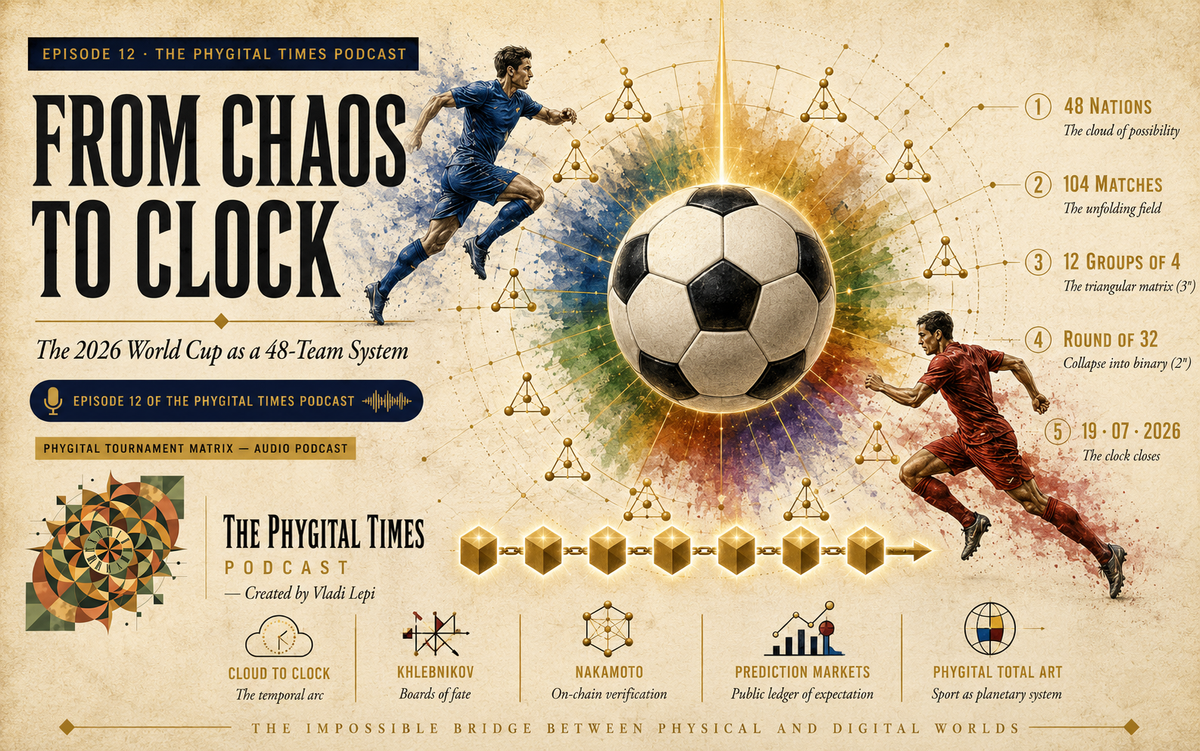
On June 11, 2026, the expanded FIFA World Cup 2026™ begins in Mexico City. By July 19, 2026, the event closes at New York New Jersey Stadium, where one national team will be removed from probability and written into record. Between those two dates sits the largest World Cup structure ever staged: 48 teams, 104 matches, 16 host cities, three countries, and a new knockout architecture designed to absorb volatility before forcing it into binary elimination.
This is where sport becomes system.
For The Phygital Times, the question is not simply who will win. The deeper question is how a planetary event moves from fluid potential to fixed time. In the language of SurR.Ai’s Numeric Humanism, the 2026 World Cup becomes a macro-temporal object: a public machine in which numbers, bodies, travel, media, markets, and memory converge.
The spectacle begins as cloud. It ends as clock.
🚀 Sponsored: The chaos. The clock. The collectible record. 🚀
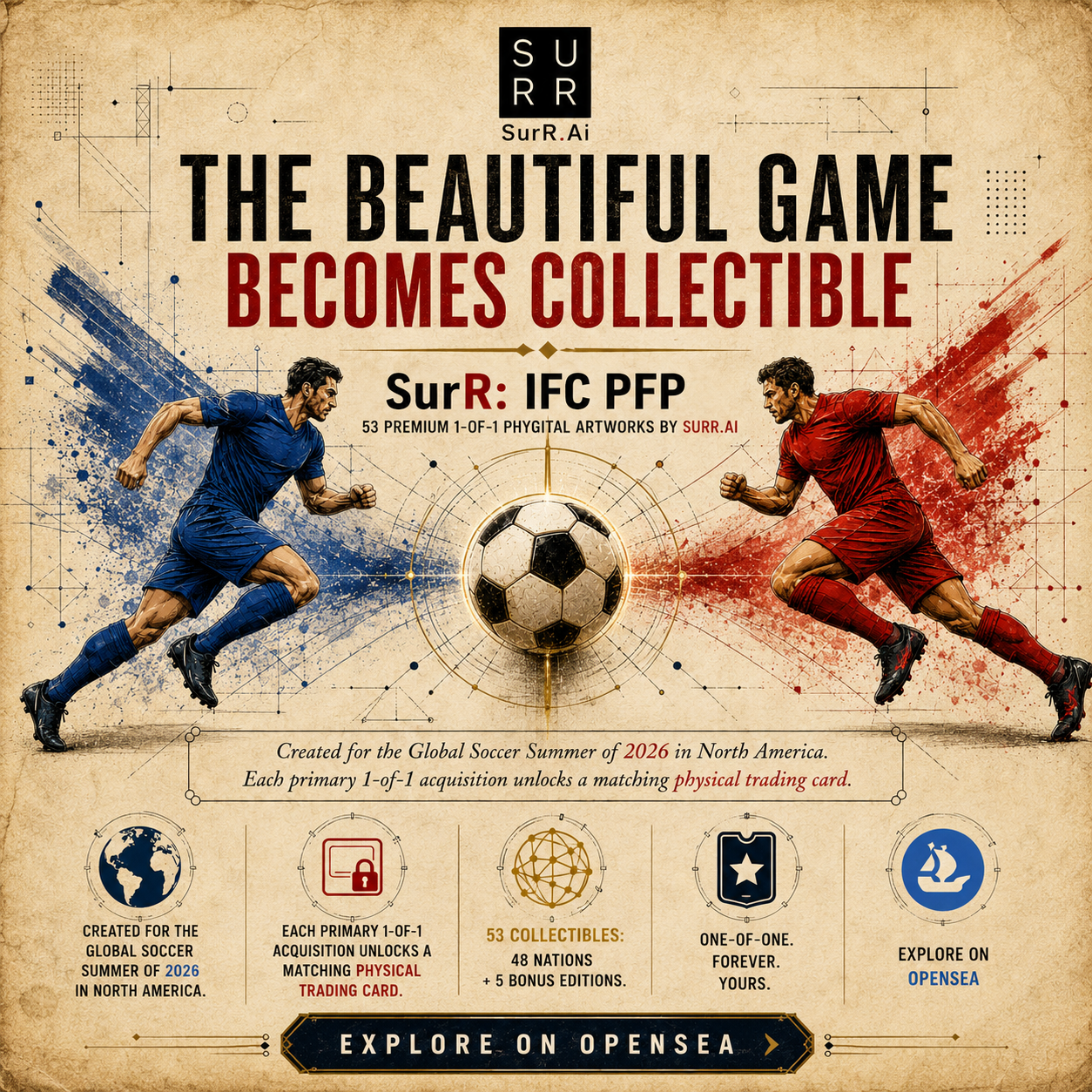
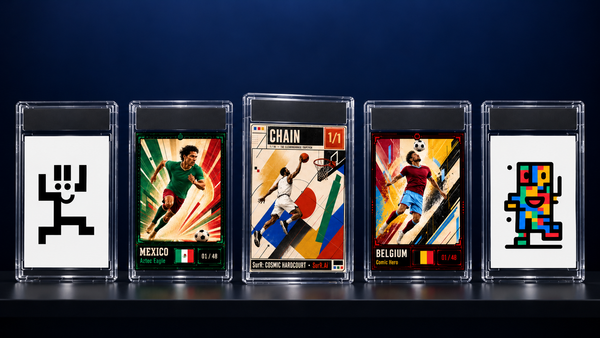
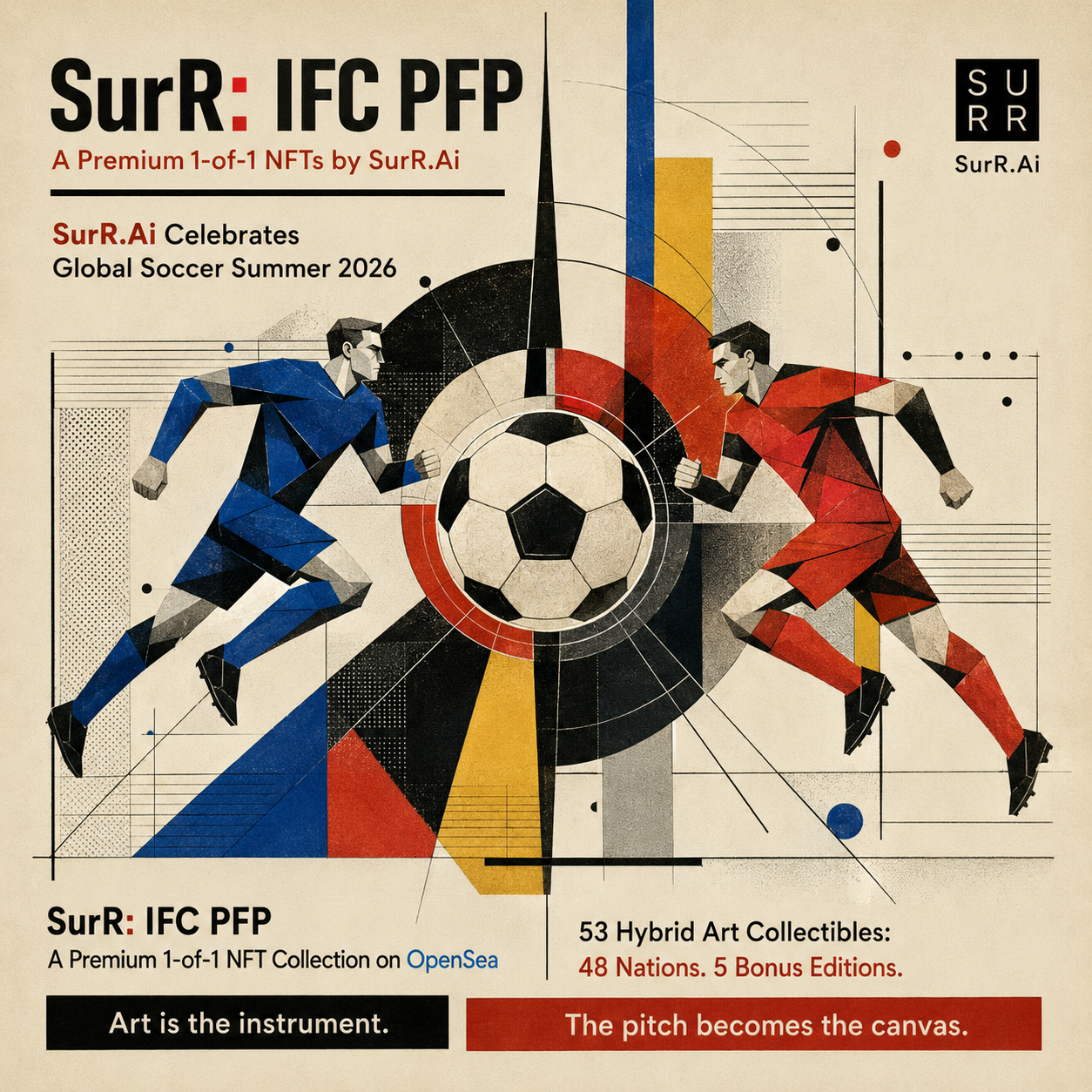
SurR.Ai's SurR: IFC PFP — A Premium 1-of-1 NFT Collection is the phygital record of the Global Soccer Summer of 2026: a 53-piece series rooted in Constructivist visual principles, pairing on-chain authorship with a matching premium physical trading card. On-chain provenance, tangible artifact, collectible memory - the phygital loop. Art is the instrument. The pitch becomes the canvas. The collectible becomes the record.
→ Explore the collection portal on OpenSea
The 48-Team Expansion: A Tournament Built as a Data Engine
The 2026 World Cup marks a structural rupture in football history. FIFA’s expanded format places 48 qualified nations into 12 groups of four, with the top two teams in each group and the eight best third-placed teams advancing into a new Round of 32.
This matters because the expanded tournament does not merely add more teams. It changes the tournament’s mathematical psychology.
A 32-team World Cup had a familiar rhythm: group-stage sorting, then a Round of 16. The 2026 edition inserts a larger filtration mechanism. More teams survive the first stage. More third-place scenarios remain alive. More national audiences remain emotionally attached for longer. More media surfaces, prediction markets, fan tokens, broadcast packages, and cultural narratives remain active before elimination begins.
In plain language: the tournament expands the cloud before it activates the clock.
The group stage becomes a field of unresolved possibility. Every team enters with a symbolic claim on the future. Every early goal produces a temporary reality. Every draw, upset, injury, tactical shift, and travel condition changes the shape of the bracket before the bracket has even fully hardened.
Then the Round of 32 arrives.
At that point, the architecture changes. The tournament stops behaving like a field of probability and begins behaving like a ledger. One team advances. One team disappears. Meaning is no longer negotiated through points, tie-breakers, or group permutations. It is confirmed by elimination.
Football calls this the knockout stage. Systems theory calls it collapse.
From the Cloud to the Clock
The 2026 World Cup can be read through three symbolic states:
The Cloud is the group stage: 48 teams, 12 groups, overlapping narratives, unstable rankings, national hopes, media noise, and probabilistic abundance.
The Chain is the Round of 32: the first hard conversion of distributed possibility into confirmed sequence.
The Clock is the final: July 19, 2026, New York New Jersey Stadium, the terminal timestamp where the system closes.
This is not a metaphor imposed from outside the event. It is the logic of the format itself. The expanded World Cup generates a larger field of potential, then forces that field through increasingly narrow gates until only one record remains.
The same structure appears in blockchain culture. A transaction begins as intention. It passes through a distributed network. It becomes durable only when confirmation transforms proposed action into recorded fact.
The same structure appears in serious digital art. A generative field may contain thousands of possible outputs. Authorship begins when the human artist imposes structure, selection, sequence, and intent. The final work is not valuable because a machine produced variation. It is valuable because human Directing Intelligence converted variation into form.
The 2026 World Cup performs this drama at planetary scale.
Khlebnikov, Nakamoto, and the Mathematics of Collision
The draft’s strongest conceptual move is its pairing of football structure with exponential number logic. That frame should remain central.
Velimir Khlebnikov’s Boards of Fate treated history as a numerical field. His project was not conventional prediction in the sports-betting sense. It was an attempt to find rhythmic laws beneath historical collision: war, revolution, cultural recurrence, and temporal pattern.
Satoshi Nakamoto’s 2008 Bitcoin white paper approached time differently, but with a related structural ambition. It turned sequence, confirmation, proof, and irreversible ordering into a working protocol. The question was no longer what people believed happened. The question was what the network could verify.
The 2026 World Cup sits between these two traditions.
The group stage belongs to the power of three: multiplicity, turbulence, and unstable relation. Wins, draws, and losses create triangular point systems. Twelve groups generate local micro-histories. Every national team is temporarily inside a system that permits surprise.
The knockout stage belongs to the power of two: binary survival. Thirty-two becomes sixteen. Sixteen becomes eight. Eight becomes four. Four becomes two. Two becomes one.
This is the passage from 3ⁿ to 2ⁿ.
The group stage rewards adaptability inside noise. The knockout stage rewards execution under irreversible pressure. Teams built only for beauty may not survive compression. Teams built only for force may not survive the early complexity. The champion must do both: absorb chaos, then master convergence.
Prediction Markets as a Public Ledger of Expectation
The 2026 World Cup will also be remembered as a prediction-market tournament.
Polymarket's 2026 FIFA World Cup winner market has held France and Spain in the high-teens throughout the pre-tournament window — co-leaders separated by a point or less, trading places repeatedly as new information arrives; the same page explains that prices operate as crowd-sourced implied probabilities and shift continuously as traders react. For the current daily reading, see the Countdown to Clock log at the foot of this article.
Kalshi also lists World Cup winner contracts, while recent betting-market coverage describes France and Spain as co-favorites, with England in the next tier.
This does not make the markets prophetic. It makes them culturally revealing.
Prediction markets are not truth. They are timestamped consensus. They show where financial conviction, public information, tactical analysis, national sentiment, and speculative appetite converge at a given moment. In that sense, they function as a visible social instrument: a live diagram of collective expectation.
FIFA itself has moved into this terrain. In April 2026, FIFA announced ADI Predictstreet as the Official Prediction Market Partner of the FIFA World Cup 2026™, describing the platform as a new interactive forecasting experience with safeguards for transparency, fairness, and participant protection.
This matters beyond football. The World Cup is becoming a programmable media environment. Tickets, broadcast rights, data feeds, prediction markets, digital collectibles, fantasy games, fan identity, and national attention are no longer separate categories. They are layers of one phygital event system.
The stadium remains physical. The tournament record becomes digital. The emotional economy becomes tradable, trackable, and continuously refreshed.
That is the real cultural shift.
Spain: The Vector of Pure Form
Spain enters the 2026 tournament as the most elegant systems candidate.
Its current symbolic force comes from structure: positional intelligence, youth, rhythm, geometry, and the capacity to control the field through spatial discipline. Spain’s recent European Championship success and the emergence of Lamine Yamal have strengthened the sense that this is not merely a talented side, but a generational design.
Spain is the team of form.
Its ideal match is not chaos but choreography. The ball moves as a regulating device. Possession becomes a method of reducing uncertainty. Width, timing, and coordinated pressure turn the pitch into a diagram. When Spain controls tempo, the opponent is forced to live inside Spain’s geometry.
This makes Spain the purest representative of convergence. It wants the game to become legible. It wants patterns to repeat. It wants the opponent’s emotional surges to dissolve into passing lanes, half-spaces, and positional patience.
In the language of the 2026 matrix, Spain is a 2ⁿ team pretending to survive a 3ⁿ world.
That is both its strength and its risk.
A team built on form can dominate when the environment is stable. But the 2026 tournament will not be stable. It will be stretched across three countries, multiple climates, long travel corridors, unfamiliar recovery rhythms, intense media pressure, and a larger elimination field. Spain may be the best team when the page is clean. The World Cup rarely offers a clean page.
France: The Vector of Structural Reversal
France is the opposite kind of system.
France does not require a perfect field. France does not need the match to become elegant. France is built to remain dangerous when the match breaks.
That is why France remains the stronger championship forecast.
With Kylian Mbappé as the central force, France carries a structural advantage that is difficult to model through possession metrics alone: the ability to reverse a match instantly. One vertical acceleration can invalidate twenty minutes of territorial control. One transition can turn an opponent’s geometry into exposure. One moment of athletic torque can collapse an entire tactical plan.
France is not anti-system. France is a different kind of system.
It is a pressure-resistant architecture. It can absorb disorder without losing identity. It can allow the opponent to hold the ball without surrendering the future of the match. It can survive ugly phases. It can win games that do not resemble its preferred aesthetic.
This is decisive in an expanded World Cup.
The champion of 2026 will need more than talent. It will need tolerance for friction. It will need squad depth, recovery discipline, tactical elasticity, emotional coldness, and the capacity to execute under compression. France has the deeper match between structure and violence, patience and acceleration, form and rupture.
Spain seeks to perfect the field.
France can survive the field when perfection fails.
England, Brazil, Argentina, Portugal, and the Second Ring of Probability
A serious forecast cannot reduce the tournament to France versus Spain.
England sits close enough to the top tier to matter. Its player pool, Premier League conditioning, and tactical flexibility give it a credible claim on the final four. But England’s historical burden is not talent. It is conversion under symbolic pressure. A tournament held largely in North America will bring a different media atmosphere, but not a smaller one.
Brazil remains dangerous because Brazil always carries excess meaning. Its problem is not cultural force. It is continuity of system under tournament stress. If Brazil finds rhythm, the ceiling is high. If the structure fragments, the team can become dependent on individual rescue.
Argentina, as defending champion, enters with memory on its side. But memory can stabilize or weigh down. The 2026 tournament will test whether Argentina can transform the aura of 2022 into a new operational identity.
Portugal has enough elite quality to damage any bracket. The question is whether it can become a team rather than an archive of extraordinary players.
These teams remain live variables. They are not decorative. But in the current matrix, they sit behind the central clash between Spain’s form and France’s resilience.
Travel, Climate, and the North American Friction Layer
The 2026 World Cup is the first edition hosted across three countries. FIFA lists Canada, Mexico, and the United States as host countries, with 16 host cities across the continent.
This geography is not neutral.
North America adds scale. Scale adds fatigue. Fatigue changes tactics. Tactical change alters probability.
A team’s ability to recover between matches may become as important as its preferred formation. A nation’s medical staff, sleep management, travel planning, and bench depth will become part of its competitive identity. The public will watch football. Behind the public spectacle, logistical systems will decide who remains fresh enough to execute.
This is where France gains another structural advantage.
A delicate possession system must preserve timing. A transition-dominant power system can tolerate more discontinuity. Spain may produce the more beautiful football. France may be better built for the tournament as a physical machine.
The 2026 champion must not only defeat opponents. It must defeat the calendar.
The MetLife Horizon: Why the Final Matters Symbolically
The final will be held at New York New Jersey Stadium, which FIFA describes as the site of the last of the tournament’s 104 matches.
This is symbolically precise.
The 2026 World Cup begins in Mexico City, one of football’s great historical stages, and ends on the New York New Jersey horizon, inside the commercial, media, financial, and cultural gravity field of the United States. The tournament’s movement from Mexico City to New York/New Jersey becomes a continental arc: heritage to infrastructure, ceremony to ledger, emotion to record.
For The Phygital Times, this matters because the 2026 World Cup is not only a football event. It is a phygital cultural system operating at global scale. It exists simultaneously as stadium ritual, broadcast spectacle, data architecture, prediction market, social-media engine, national myth, and collectible future archive.
Every goal will become a clip. Every clip will become metadata. Every national emotion will become searchable memory. Every decisive moment will be replayed, tokenized, remixed, archived, ranked, and cited.
The match happens once. The digital afterlife begins immediately.
Forecast: France Wins the Clock
The forecast is France.
Not because France is guaranteed. No serious system claims certainty before the event closes. Prediction markets are implied probabilities, not fate. Football remains too embodied, too fragile, too exposed to injury, weather, refereeing, psychology, and chance.
But the structural reading points to France.
Spain may be the most coherent form. France is the more resilient tournament machine. In a 48-team World Cup stretched across North America, the champion must survive both disorder and compression. France is better designed for that passage: from group-stage turbulence, through binary elimination, into the final timestamp.
France can win when the game is beautiful.
More importantly, France can win when it is not.
On July 19, 2026, the tournament’s cloud of possibility will close. The final whistle will convert probability into record. One nation will move from speculation into historical permanence.
The forecast of this matrix is clear: France is the strongest candidate to be written into the clock.
Why This Belongs in The Phygital Times
A standard sports preview asks who will win. A systems reading asks what the event reveals.
The 2026 FIFA World Cup reveals the next phase of global culture: physical spectacle fused with digital infrastructure; national emotion measured through real-time markets; broadcast ritual extended through data; fan attention converted into programmable participation; memory transformed into searchable, tradable, and collectible form.
This is why the tournament belongs inside The Phygital Times editorial field.
The 2026 FIFA World Cup is not only a tournament. It is a 48-team system converting global noise into historical permanence — and the most visible form of Total Popular Art on Earth, capable of gathering billions of viewers into one synchronized cultural clock. FIFA reported that the 2022 World Cup engaged five billion people across platforms, with the final alone reaching close to 1.5 billion viewers; the expanded 2026 edition is built on an even larger structural frame.
By Total Popular Art, we mean a mass-cultural form that gathers multiple artistic and technological disciplines into one coordinated event. The choreography is not only the movement of players on the field; it is the designed movement of teams, referees, cameras, opening ceremonies, crowd behavior, goal celebrations, the halftime show, and broadcast rhythm. The architecture is not only the stadium structure; it is the full spatial system of arenas, host cities, fan zones, security corridors, screens, lighting grids, transportation routes, and global broadcast infrastructure. The costume is not only the national kit; it is the visual language of flags, colors, sponsor marks, mascots, supporter dress, ceremonial uniforms, and the instantly recognizable image each nation carries as it enters the world stage.
Music, chant, anthem, typography, scoreboard design, broadcast graphics, LED surfaces, social-media clips, prediction markets, and national mythology complete the system. The World Cup is not high art in the museum sense. It is popular total art at planetary scale: a live ritual in which billions of people encounter sport as image, sound, movement, architecture, data, and memory.
The Halftime Show as Proof of the System
The 2026 final makes this argument explicit. For the first time in FIFA World Cup™ history, the final will include a dedicated halftime show, staged on July 19, 2026, at New York New Jersey Stadium. FIFA and Global Citizen announced Madonna, Shakira, and BTS as co-headliners, with Coldplay’s Chris Martin curating the show.
This is not a decorative pause inside the match. It is a structural expansion of the final into a Super Bowl-scale global media event. Football stops for halftime, but the cultural machine continues: music, celebrity, choreography, philanthropy, children’s media, broadcast strategy, and global audience attention are folded into the same temporal architecture as the game itself.
Produced with Global Citizen, the halftime show is tied to the FIFA Global Citizen Education Fund, created to expand access to football opportunities and education worldwide. FIFA describes the show as a live broadcast to a potential audience of billions, positioning the final at the intersection of sport, culture, education, and global public purpose.
The Super Bowl comparison is useful, but incomplete. The Super Bowl is a national ritual with global reach. The World Cup Final is a planetary ritual by design. Its halftime show does not merely borrow American entertainment infrastructure; it absorbs that infrastructure into a larger global system of sport, music, celebrity, public messaging, philanthropy, platform distribution, and collective attention.
That distinction matters.
The same century that produces AI-Amplified Art, blockchain-secured authorship, phygital collectibles, and on-chain provenance also produces a World Cup that behaves like a global media protocol. The future of culture will not be divided cleanly between art, sport, finance, technology, and entertainment. It will be organized through systems that join them.
The 2026 FIFA World Cup is one of those systems
The cloud opens June 11
The clock closes July 19
Legal Disclaimer & Editorial Independence Notice:
This article is published for editorial, cultural, analytical, and educational purposes by The Phygital Times. It is not betting advice, financial advice, legal advice, or investment advice. Prediction-market probabilities and quoted market positions fluctuate continuously and should not be treated as recommendations to trade, wager, invest, or take financial risk.
The Phygital Times, SurR.Ai, Vladi Lepi, and LV Agency, Inc. are not affiliated with FIFA, the FIFA World Cup 2026™, ADI Predictstreet, Polymarket, Kalshi, DraftKings, or any sportsbook or prediction-market operator mentioned here.
FIFA World Cup™ and related marks belong to FIFA. This article is an independent cultural comment and systems analysis.
Methodology, AI Production, and Attribution Notice
This article applies SurR.Ai’s Numeric Humanism framework as an editorial method for reading the 2026 FIFA World Cup™ as a symbolic, temporal, and systems-based event. References to “signals,” “resonances,” “the cloud,” “the chain,” and “the clock” should be understood as interpretive structures, not deterministic claims. They are used to analyze how format, probability, media infrastructure, prediction markets, and collective attention converge around a global sporting event.
The analytical model draws conceptually from Velimir Khlebnikov’s numerical approach to historical rhythm and Satoshi Nakamoto’s protocol-based understanding of verification, sequence, and irreversible record. These references are used as cultural and structural lenses. They do not produce guaranteed outcomes, nor do they replace conventional sports analysis, official tournament data, team performance metrics, or expert scouting.
Where AI-assisted tools are used in drafting, editing, narration, or audiovisual adaptation, they function as production instruments under human editorial direction. The governing authorship remains with Vladi Lepi / SurR.Ai through the practice’s Directing Intelligence protocol: AI may assist in amplification, but the conceptual architecture, interpretive framework, and final editorial decisions are human-authored.
All original frameworks, terminology, research structures, and interpretive models developed in this article — including the “From Chaos to Clock” reading of the 2026 World Cup matrix — are part of the intellectual and editorial work of LV Agency, Inc. / SurR.Ai. Quotation, citation, academic discussion, journalistic reference, curatorial use, or media commentary should acknowledge The Phygital Times, LV Agency, Inc., and SurR.Ai as the originating source. For licensing, adaptation, publication, broadcast, educational, curatorial, or commercial use, please contact LV Agency, Inc. / SurR.Ai directly for written permission and collaboration terms.
🚀 Sponsored by: We are grateful for the support of our sponsors, LV Agency, Inc. and SurR.Ai, who make it possible for us to deliver high-quality content to our readers.
▣ Subscribe: The Phygital Times - where physical meets digital across art, sports, AI, Web3, luxury, and culture. Long-form essays blending exoteric and esoteric knowledge for HNWIs and beyond.
▣ Watch & Listen: The Phygital Times Podcast - Episode Series on YouTube
AI-amplified explorations of Total Art + Tech, phygital culture, and digital authorship — short visual essays and longer audio-led episodes.
▣ The Official Hub: SurR.Ai - art and technology practice at the intersection of AI, blockchain-secured authorship, and Total Art + Tech.
The chaos. The clock. The collectible record
SurR.Ai has launched SurR: IFC PFP — A Premium 1-of-1 NFT Collection on OpenSea, a 53-piece phygital art series created for the Global Soccer Summer of 2026 in North America.
The first 12 artworks are now live:

Explore the primary 1-of-1 token on OpenSea
Rooted in early twentieth-century Constructivist visual principles, the collection maps global soccer culture as an architecture of geometry, rhythm, fashion, color, and collective emotion. In Crescent Vector, a crimson-and-white athletic figure moves across a field of crescent-and-star symbolism, translating national visual identity into a clean square PFP format for digital display, on-chain presentation, and Web3 identity.
Each primary 1-of-1 acquisition unlocks its tangible counterpart: a matching premium physical trading card printed on 38 pt. velvet-finish Trifecta stock with rounded corners, available upon request to the active NFT collector of record.
This is SurR.Ai’s phygital loop: on-chain provenance, tangible artifact, and collectible memory.
Art is the instrument.
The pitch becomes the canvas.
The collectible becomes the record.
SurR: IFC IFP - A Premium 1-of-1 NFTs by SurR.Ai Collection portal
Editorial framework: 2026 FIFA World Cup Prediction: From Chaos to Clock
Disclaimer: This independent artwork is not affiliated with, endorsed by, sponsored by, or connected to FIFA, any national football federation, club, player, sportsbook, or tournament organizer.
Countdown to Clock - Daily Log
A running record of the 2026 FIFA World Cup as it narrows from chaos to clock. Each entry is a dated snapshot: the live market reading, the day's video overview and audio podcast (generated via NotebookLM by Vladi Lepi and SurR.Ai), and a short four-lens note. Read top to bottom — the journey from abundance to record, written one day at a time.
All market figures are snapshots verified on the date shown and move continuously. Any prediction-market reference is a cultural and technological layer of fan engagement, not a recommendation to trade, wager, or invest.
Day - 10 · Sunday, June 1, 2026 · Kickoff in 10 days
The snapshot. Live snapshot, 10 days to kickoff: on Polymarket, France and Spain are dead even at ≈17% each, with the lead flickering between them intra-day. England ≈11%. Portugal ≈10%. Brazil ≈9%. Winner-contract volume now past $1.4B.
The four-lens note. The market is doing exactly what the four-lens framework predicts — refusing to resolve until the whistle forces it. The collector's question stands: not who wins, but what survives. (Figures to be updated here as the squads lock and the lines move.)
Read more: The Planetary Stage: How the 2026 World Cup Becomes Collectible Culture
▶ Video overview:
🎧 Audio podcast:
Day - 9 · Tuesday, June 2, 2026 · Kickoff in 9 days
The snapshot. The squads have locked, and the market still refuses to choose. France and Spain remain co-leaders at 17% each on Polymarket - France nominally ahead on the aggregate (17.1% vs Spain 16.5%), England ≈11%. Volume is now past $1.4B.
The four-lens note. As promised: even with the rosters finalized, the cloud hasn't hardened into the clock. The four-lens framework called it - no single layer resolves until the whistle forces it. Still not "who wins," but "what survives." Next read as the group stage opens June 11.
▶ Video overview:
🎧 Audio podcast:
Day − 8 · Wednesday, June 3, 2026 · Kickoff in 8 days
The snapshot. The First Seam: After weeks of a flat tie, France has edged a single cent ahead — France 17% to Spain 16% on Polymarket, with France also nominally ahead on the aggregate (17.1% vs Spain 16.5%). England a clear third (≈11%); Brazil and Argentina head the chasing pack. Winner-contract volume now past $1.5B. The sportsbooks agree with the markets on the shape: France and Spain locked at the top, England a length back, the rest strung out behind.
The four-lens note. The cloud has found its first seam — but a seam is not the clock. Exoteric read: four independent systems (forecast, expert prediction, prediction markets, sportsbooks) now converge on the same shape, which signals genuine uncertainty, not disagreement. Esoteric read: a one-cent drift is the cloud testing where it might condense, not condensing. The over-expanded 48-team matrix is built to hold abundance longer before forcing the advance-or-exit binary. Still not "who wins," but "what survives." Next read as the group stage opens June 11.
▶ Video overview:
🎧 Audio podcast:
Day − 7 · Thursday, June 4, 2026 · Kickoff in 7 days
The snapshot. The seam holds: A day after France first edged ahead, the gap neither closed nor widened — France 17.0%, Spain 16.0% on the Kalshi+Polymarket aggregate, with Spain slipping a fraction and France firm. England a clear third (11.4%); Portugal and Argentina level in the chasing pack (~9% each). Winner-contract volume now ~$523M aggregate (past $1.5B on Polymarket alone). Across Kalshi, Polymarket, DraftKings, and FanDuel, the top-four shape is identical — France and Spain adjoined, England third, Brazil and the rest behind.
The four-lens note. One week out, the system has reached a stable disequilibrium — a lead too small to call, too persistent to dismiss. Exoteric read: when four independent venues price the same order to within tenths of a percent, the convergence is no longer coincidence; it is consensus on the shape of uncertainty, not its resolution. Esoteric read: a seam that holds without widening is the cloud rehearsing its first binary — the 2ⁿ logic of the knockout grid casting its shadow back into the pre-tournament field, while the 3ⁿ disruption of the 48-team group matrix keeps the abundance from collapsing early. Seven days of cloud remain before the first whistle forces the first cut. Still not "who wins," but "what survives." Next read as the group stage opens June 11.
▶ Video overview:
🎧 Audio podcast:
Day − 6 · Friday, June 5, 2026 · Kickoff in 6 days
The snapshot. The seam narrows - and the venues split. Six days out, the France–Spain gap has compressed almost back to nothing: Kalshi shows France ahead by a tenth of a point (16.8% to 16.7%), while Polymarket's board now leads with Spain at 16%. England holds firm in third (≈11.1–11.5%); Portugal, Brazil, and Argentina cluster in the chasing pack (~8–9%). The whole top tier sits bunched between roughly 8% and 17%. Winner-contract volume now past $1.6B on Polymarket. The platforms agree on the shape - France, Spain, England, then the pack - but no longer agree on the order at the very top.
The four-lens note. Yesterday a seam held; today it is closing, and the two largest venues disagree on which side of it leads. Exoteric read: when Kalshi says France-by-a-tenth and Polymarket says Spain, the disagreement is not error - it is two liquidity pools resolving the same uncertainty to the limit of their own crowds, and finding the limit is noise. The signal is the bunching: six contenders inside a single 9-point band. Esoteric read: the cloud is not condensing toward a point but breathing - expanding and contracting around an attractor it cannot reach. The 3ⁿ disruption of the 48-team matrix is winning the tug-of-war against the 2ⁿ binary pull, holding the field open six days from the first cut. A market that splits on the leader is a market admitting the record is unwritten. Still not "who wins," but "what survives." Next read as the group stage opens June 11.
▶ Video overview:
🎧 Audio podcast:
Day − 5 · Saturday, June 6, 2026 · Kickoff in 5 days
The snapshot. Full circle. Five days out, the seam has closed completely — Spain and France now sit level at 16% each on Polymarket, and the Kalshi lead has flipped back toward Spain since yesterday. In four days the nominal favorite has changed hands three times (Spain ↔ France ↔ Spain) without either ever clearing the other by more than a single point. England holds third at 11.3%; Portugal, Argentina, and Brazil cluster just behind (~8–9%). Winner-contract volume steady past $1.6B on Polymarket. The order is settled; the summit is a revolving door.
The four-lens note. The seam did not open or narrow — it dissolved back into the tie it came from. Exoteric read: a top spot that changes hands three times in four days, never by more than a point, is the market telling you the question is genuinely unanswerable on current information — every new friendly result, fitness note, and volume surge cancels the last. The lead is now pure churn; the bunching is the only stable fact. Esoteric read: the cloud has completed a full breath — tie, expansion, hold, contraction, tie — and returned to its origin point five days before the first whistle. In Khlebnikov's terms the field is oscillating around its attractor without converging; the 2ⁿ binary pull and the 3ⁿ matrix disruption have fought to a standstill. A market this balanced this late is not indecision — it is the system conserving its abundance to the last possible moment before the clock forces the first cut. Five days of cloud remain. Still not "who wins," but "what survives." Next read as the group stage opens June 11.
▶ Video overview:
🎧 Audio podcast:
June 7–8, 2026 · Three days out
The snapshot. No movement at the summit — but the field is finally starting to separate. Through the weekend and into Monday, the 2026 World Cup prediction markets still can't split France and Spain: both hold ≈16% on Polymarket, with Kalshi giving France a two-tenths edge as the two keep trading the top spot. England remains the lone third party above 10% (≈11%). The change is underneath them. For the first time, the chasing pack has broken its stillness — Germany has dropped from 8% to 5% in the wake of its squad reveal, with Manuel Neuer's surprise recall shaking trader confidence, while Portugal, Argentina, and Brazil hold steady. Polymarket volume has now reached ≈$1.7B. Seventy-two hours from the opening match, the ranking has stopped being perfectly fixed — the sorting is happening down-ballot.
The four-lens note. Five straight days of a frozen field have given way to a split-screen market: the top two locked, the teams beneath them drifting apart. Exoteric read: call it pre-tournament triage. When the leaders are genuinely too close to separate, fresh inputs — a disputed roster choice, an injury note, a technological edge — have nowhere to land except the middle of the table, where belief is softer and one headline can still reprice a side. Germany's fall from 8% to 5% is the first true casualty of the pre-whistle phase. Esoteric read: the chain is taking shape before the clock has struck. The 2ⁿ binary cascade still can't reach the summit — France and Spain remain one unresolved node, a coin in mid-air — yet it has already started trimming the lower branches, drawing down the 3ⁿ abundance from below. This is the cloud's first act of condensation, and it happens at the rim rather than the core, where the structure can afford to make early cuts. Three days of cloud still hang over the leaders; the edges are already setting. The question holds: not "who wins," but "what survives." The opening whistle — the first block — is now seventy-two hours away.
▶ Video overview:
Correction: an earlier version tied Germany's 8%→5% drop to Manuel Neuer's recall. The forecast (Opta) attributes the move to a harder knockout path and rising rivals, not goalkeeping; the market drift is interpretive. Neuer is fit and expected to start. Numbers adjusted.
🎧 Audio podcast:
The provided sources detail The Countdown to Clock, an ambitious artistic project by SurR.Ai that interprets the 2026 FIFA World Cup through a unique "phygital" lens. This initiative combines real-time market data and philosophical analysis with a collection of 53 unique NFT artworks, each paired with a high-end physical trading card. As the tournament approaches, the project tracks shifting prediction market probabilities, noting a recent stabilization at the top between Spain and France while the rest of the field begins to separate. The visual style draws heavily from Constructivist art, transforming the chaos of sports into a structured system of geometric geometry and rhythmic design. Ultimately, the project seeks to create a permanent digital and tangible record of the global event that transcends standard sports journalism. This multidisciplinary work utilizes a Directing Intelligence protocol, where human creative vision is amplified by artificial intelligence to document the tournament’s evolution.
◆ The live log has moved. As of the Overture, the daily Countdown to Clock record continues on its own page - The Countdown to Clock: Live Readings — updated through the final on July 19. The pre-tournament entries (Sunday, June 1, 2026 through June 7–8, 2026) remain here as the archive of where the cloud first opened. For the latest read, follow the log to its new home. →
Audiovisual Content, Trademarks & Nominative Reference Notice
The video overviews and audio podcasts embedded in this log are AI-amplified commentary produced via NotebookLM under the Directing Intelligence protocol of Vladi Lepi / SurR.Ai /LV Agency, Inc. They are works of independent cultural, analytical, and editorial commentary.
Any brand, team, national federation, player, sponsor, broadcaster, league, sportsbook, prediction-market operator, product, logo, kit, emblem, color mark, sound, or name referenced - verbally or visually - in these recordings is mentioned solely for the purposes of commentary, reporting, criticism, identification, and analysis (nominative fair use). All such names, marks, likenesses, and associated intellectual property remain the exclusive property of their respective owners. Their appearance does not imply affiliation, sponsorship, endorsement, partnership, or approval, in either direction.
FIFA World Cup™ and related marks belong to FIFA. All other trademarks belong to their respective holders. SurR.Ai, Vladi Lepi, The Phygital Times, and LV Agency, Inc. are not affiliated with, endorsed by, or connected to any third party named or depicted in this audiovisual content.
Where AI tools generate narration, summary, or imagery, occasional inaccuracies, mispronunciations, or stylized visual approximations may occur; these are artifacts of automated production, not statements of fact, and do not represent the official positions, statements, or visual identities of any named party. Market figures spoken or shown are time-stamped snapshots that fluctuate continuously and are not betting, financial, legal, or investment advice.
For licensing or to raise a rights concern regarding any depicted or mentioned mark, contact LV Agency, Inc. directly.