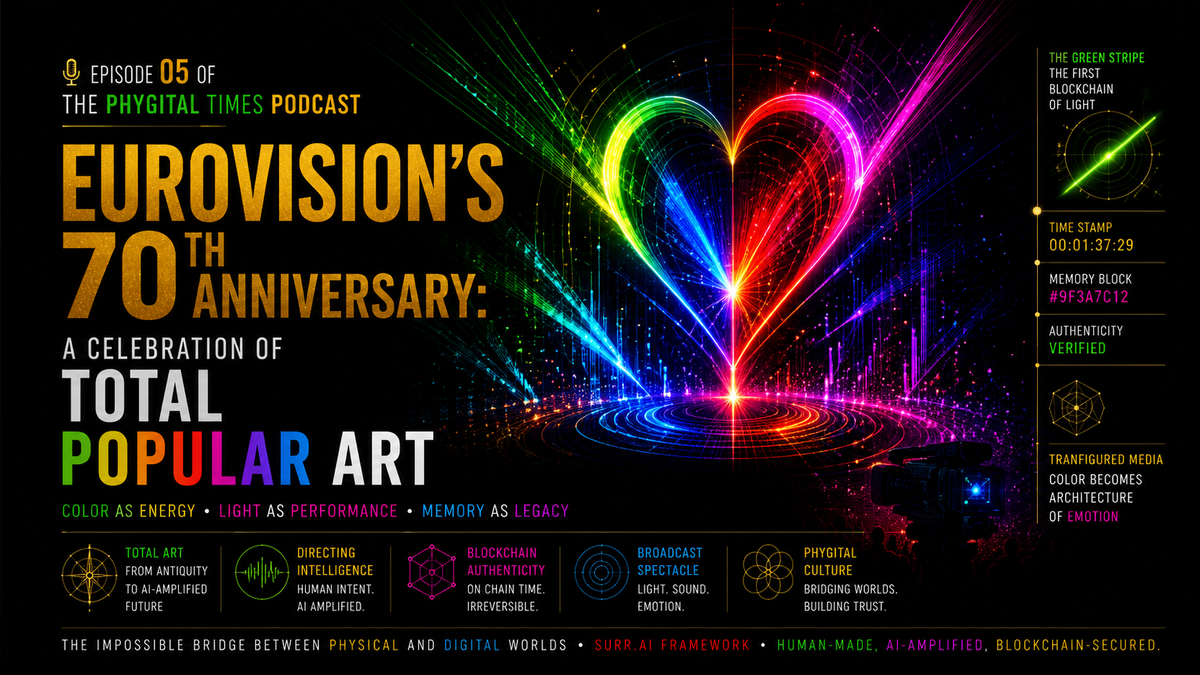
Eurovision’s 70th Anniversary: A Celebration of Total Popular Art
For its 70th Anniversary in Vienna, Eurovision is more than a song contest - it is Total Pop Art in motion: a continent-scale fusion of music, light, broadcast technology, national memory, audience consensus, and phygital culture.

How to Watch the Eurovision 2026 Grand Final Live & After the Broadcast:
The Eurovision Song Contest 2026 Grand Final will be broadcast live from Vienna on Saturday, May 16, 2026, at 21:00 CEST — which is 3:00 p.m. ET / 12:00 p.m. PT in the United States. In participating countries, viewers can watch through their national public broadcasters, often with local-language commentary. The EBU also states that the Grand Final is available to stream for free on the official Eurovision Song Contest YouTube channel where available in your region.
For U.S. viewers, Eurovision 2026 is available live on Peacock, with the Grand Final scheduled for Saturday, May 16, at 3:00 p.m. ET. For the first time in nearly a decade, U.S. viewers can also stream the live shows through the official Eurovision YouTube channel, according to Eurovision’s own 2026 viewing guide.
After the live broadcast, viewers should use the official post-show channels rather than unauthorized uploads. Eurovision notes that the shows are available through broadcasters’ websites and on-demand services, depending on country and rights availability. The official Eurovision YouTube channel is also the key digital archive for live streams, highlights, clips, artist performances, and post-show content, though replay availability may vary by region.
Voting in the Grand Final opens just before the first competing song is performed and remains open throughout the show, continuing for approximately 40 minutes after the final competing performance. Viewers may vote up to 10 times, with voting methods depending on location: phone, SMS, the official app, or esc.vote for eligible Rest of the World voters.
In The Phygital Times framework, this live-and-afterlife structure is part of Eurovision’s phygital architecture: the first experience happens in real time through broadcast, voting, and collective attention; the second experience begins after the show, when performances circulate as official clips, replays, highlights, reaction videos, rankings, memes, and cultural memory. The Grand Final is therefore not only watched once - it is replayed, archived, shared, analyzed, and transformed into the digital afterimage of a live continental ritual.
From Analog Broadcast to Phygital Memory: Why Vienna 2026 Is More Than a Song Contest
For 70 years, Europe has been making the same Total Popular Art. We just have not called it that — until now.
The Eurovision Song Contest is usually described through the language of entertainment: songs, costumes, national votes, glitter, heartbreak, surprise winners, political tension, fan culture, and televised spectacle. But the 70th edition in Vienna invites a deeper reading. When viewed through the Total Art + Tech framework of The Phygital Times Podcast and SurR.Ai, Eurovision becomes something larger than a music competition. It becomes a 70-year cultural protocol: a living broadcast system that fuses voice, body, light, architecture, camera direction, national mythology, public voting, digital circulation, and collective memory.
Vienna 2026 is scheduled for May 12, 14, and 16 at the Wiener Stadthalle, with ORF as host broadcaster and 35 participating public service broadcasters. The official Eurovision page presents the event as the 70th contest, staged in Vienna, with global viewing through participating broadcasters and YouTube access where available.
This is the central proposition of Episode 05 of The Phygital Times Podcast: Eurovision is not merely pop culture. It is Total Popular Art — the mass, broadcast-era descendant of the ancient total artwork. The transcript frames Eurovision as a massive coordinated artwork involving 35 countries, tens of millions in production resources, broadcast logistics, pyrotechnics, camera engineering, and a brutally compressed 180-second window for each artistic entry. It argues that dismissing Eurovision as camp or kitsch blinds us to one of the most sophisticated cultural machines currently operating in public view.
1. The Core Thesis: Eurovision as Total Pop Art
The phrase Total Popular Art matters because it changes the category of analysis. Eurovision is not “high art” in the museum sense, and it is not simply commercial television. It is a civic-popular ritual built from many arts at once: music, costume, choreography, lighting, architecture, graphic design, stage engineering, national storytelling, public voting, broadcast editing, social media circulation, and now global streaming.
This is why the old insult “kitsch” is not enough. Eurovision’s kitsch is not accidental weakness; it is a mass-participation technology. Bright colors, theatrical exaggeration, emotional directness, humor, glamour, and instantly readable symbols lower the barrier to entry. They allow millions of viewers, across languages and national traditions, to understand the emotional proposition of a performance in seconds.
In the podcast framework, this connects Eurovision to the oldest models of total artistic integration. Ancient Greek theater fused architecture, music, chorus, myth, masks, civic debate, and audience presence into a shared public event. Baroque stage designers expanded theatrical illusion through perspective. Wagner gave the synthesis of music, drama, architecture, and staging the name Gesamtkunstwerk. Diaghilev operationalized the total artwork as a modern production system by forcing composers, painters, choreographers, dancers, and producers into one integrated artistic machine. Later, experiments such as Nine Evenings: Theatre and Engineering pushed the artist-engineer relationship into electronic signal, documentation, and technological infrastructure. The podcast transcript presents Eurovision as the loudest contemporary continuation of that lineage: a sensory machine that compresses thousands of years of art theory into a live annual broadcast.
The crucial difference is scale. Greek theater gathered the city. Eurovision gathers the continent - and, increasingly, the world.
2. The Genesis Block: Lugano 1956
If Eurovision is read as a cultural ledger, then Lugano 1956 is its Genesis Block.
The first Eurovision Song Contest took place in Lugano, Switzerland, in May 1956, with seven participating broadcasters each submitting two songs. That modest analog beginning has now expanded into a 70-year broadcast organism. The 2025 contest reached 166 million viewers across 37 public service media markets, according to the EBU’s post-event statistics; Vienna 2026 builds on that scale as the anniversary edition.
Here, the SurR.Ai method introduces the concept of a Digital Chronotope: a cultural time-space where historical duration, media infrastructure, and collective attention become one system. From 1956 to 2026, Eurovision’s “ledger” records not financial transactions, but annual proofs of performance: each year, a new host city, a new broadcast design, new songs, new controversies, new votes, new memories.
This is where Velimir Khlebnikov’s mathematical imagination becomes useful as an interpretive lens. Khlebnikov’s Tables of Destiny related historical events through numerical patterns, including sums of powers of 3; modern scholarship has documented his effort to treat history as a field of mathematical recurrence rather than as a purely linear narrative. The Phygital Times does not need to claim that Khlebnikov “predicted” Eurovision. The stronger point is conceptual: Eurovision’s 70-year anniversary can be read as a nodal point in a rhythmic cultural system - a passage from analog broadcast dominance into a phygital age of streaming, data, participation, and on-chain memory.
3. The 180-Second Hash
The most radical feature of Eurovision is not its excess. It is its constraint.
Official Eurovision rules state that songs must not exceed three minutes and that a maximum of six artists may perform on stage. This makes every entry a compressed artistic calculation. In the language of the SurR.Ai framework, the three-minute performance becomes a 180-second hash: a small, fixed container into which a delegation must compress identity, emotion, musical structure, staging, camera grammar, and memorability.
A successful Eurovision entry is therefore not simply a song. It is a "computational diamond" formed under pressure.
The podcast calls attention to the “17 ingredients” that must be engineered inside this tiny window: composition, lyrics, language choice, vocal delivery, arrangement, choreography, costume, lighting, LED content, props, pyrotechnics, stage architecture, national symbolism, camera direction, broadcast editing, meme potential, and voting strategy. Each must operate simultaneously. The singer must reach juries through vocal and compositional credibility while reaching the public through instant emotional spectacle. A costume must communicate identity in three seconds. A lighting cue must translate musical transition into physical feeling. A single camera angle must work on television, YouTube, TikTok, Instagram, and X.
This is why Eurovision is a serious art-engineering problem. Every country receives the same maximum duration. Every country must solve the same formal constraint. The winner is not merely the best song; the winner is the performance that most effectively turns constraint into total sensory memory.
4. Vienna 2026: The Construct
Vienna is not a neutral container for the 70th contest. It is part of the artwork.
The official stage design for Vienna 2026 is built around the creative spirit of the Viennese Secession, using three leitmotifs: The Leaf, The Curved Line, and The Construct. Eurovision describes the leaf as a symbol of origin and potential, the curved line as resonance and movement, and the construct as a golden structure connecting art with functionality.
This matters historically. The Viennese Secession was itself a break from rigid academic art. By building the 70th contest around Secessionist principles, ORF turns the stage into a public-facing art-historical statement: tradition and modernity, ornament and engineering, organic form and technological control.
The physical scale confirms the point. Eurovision’s own “stage in numbers” report states that the Vienna 2026 structure is approximately 2,000 square metres and 210 tonnes, built in just under two weeks with peak assembly involving up to 300 people working on the stage and lighting system. The Green Room, meanwhile, takes on an Austrian character through the Viennese coffeehouse motif, turning the waiting area into another cultural layer of the production.
Even the cameras participate in the transformation. ARRI announced that ALEXA 35 Live camera systems and related live-production updates would be used at Eurovision 2026, marking a move toward a more cinematic live-broadcast image. The result is not simply “better video.” It is a new broadcast skin: Eurovision as radiant field, cinematic surface, and real-time digital painting.
5. Postcards: The Hidden Machinery of Total Art
Most viewers treat Eurovision postcards as pleasant interludes. In the Total Art + Tech framework, they are one of the most important parts of the machine.
A postcard is the short video segment that plays between live performances. On the surface, it introduces the next artist and often connects them to the host country’s landscape, culture, or visual identity. Functionally, however, it solves a brutal logistical problem: the stage must be reset in near darkness, with crews removing props, cleaning debris, preparing audio feeds, moving platforms, checking safety, and positioning the next act - while the television audience remains emotionally engaged.
The podcast transcript describes postcards as miniature video artworks that bridge a technical crisis with beauty. They hide the labor of the machine while keeping the viewer inside the illusion.
This is a perfect example of Total Popular Art. The backstage problem becomes an aesthetic solution. Logistics become cinema. The viewer never sees the panic; the viewer sees continuity.
6. Consensus, Televoting, and the Audience as Hash Power
Eurovision is also a system of consensus.
In the early decades, juries controlled the ledger. Then came the public vote. Eurovision voting histories show televoting appearing in 1997 with five countries, expanding in 1998, and later giving way to the modern jury/televote hybrid; from 2009, the contest used a 50/50 jury and televote model in the final.
This is where the Nakamoto analogy becomes powerful. In the Bitcoin white paper, Satoshi Nakamoto describes proof-of-work as a way of timestamping transactions into a chain that becomes increasingly difficult to alter; the longest chain represents both the sequence of witnessed events and the largest pool of computational power behind it.
Eurovision is not a blockchain, of course. But as metaphor, the comparison is productive. In Eurovision, the “hash power” is collective attention. Juries provide professional validation. Televoters provide emotional validation. The Rest of the World vote adds a global layer of distributed participation. The final score becomes a cultural consensus ledger, not because it is objectively “correct,” but because it records a structured, time-stamped act of mass agreement.
In 2026, this attention ledger expands further through YouTube. The official Eurovision watch page states that the contest is free to stream on YouTube where available, while YouTube itself is marking a double milestone: 70 years of the contest and 20 years of the Eurovision YouTube channel. For the Phygital Times framework, that is not a distribution footnote. It is a network upgrade.
7. The Hard Fork: Boycotts, Politics, and Network Stress
A living cultural protocol also experiences conflict.
Eurovision has faced rule crises before. The 1969 contest ended in a four-way tie, and the 1970 edition saw several countries boycott amid dissatisfaction with the result and voting structure. In 2026, the contest faces another major rupture: Spain, Ireland, the Netherlands, Slovenia, and Iceland withdrew or boycotted over Israel’s participation amid the Gaza war, according to Reuters and AP reporting.
This article does not take a political position on the dispute. The point here is structural. When a broadcast system built around unity encounters geopolitical fracture, the system behaves like a network under stress. Nodes withdraw. Rules are adjusted. Public trust becomes part of the performance. The “Big Five” automatic-qualifier structure is altered by Spain’s withdrawal, leaving the 2026 final with host Austria, the remaining Big Four, and 20 qualifiers from the two semi-finals. Eurovisionworld reported that the Grand Final would feature 25 participants: Austria, Germany, France, Italy, the United Kingdom, and 20 semi-final qualifiers.
In blockchain language, this is a hard fork of cultural consensus. In art-historical language, it is proof that Eurovision remains a civic ritual. It does not float above history. It absorbs history, stages it, and forces millions of viewers to confront the tension between entertainment, national representation, and public morality.
- Current Ledger State: Vienna After Both Semi-Finals
As of the completion of the second semi-final, the Grand Final lineup is now set. The first semi-final, held on Tuesday, May 12, added Moldova, Sweden, Croatia, Greece, Finland, Israel, Belgium, Lithuania, Poland, and Serbia to Saturday’s Grand Final. Eurovisionworld reported that Moldova’s “Viva, Moldova” by Satoshi, Sweden’s “My System” by Felicia, Croatia’s “Andromeda” by Lelek, Greece’s “Ferto” by Akylas, Finland’s “Liekinheitin” by Linda Lampenius & Pete Parkkonen, Israel’s “Michelle” by Noam Bettan, Belgium’s “Dancing on the Ice” by Essyla, Lithuania’s “Sólo quiero más” by Lion Ceccah, Poland’s “Pray” by Alicja, and Serbia’s “Kraj mene” by Lavina all advanced.
The second semi-final, held on Thursday, May 14, added Bulgaria, Romania, Czechia, Cyprus, Denmark, Australia, Ukraine, Albania, Malta, and Norway to the Grand Final. Eurovisionworld reported that Bulgaria’s “Bangaranga” by Dara, Romania’s “Choke Me” by Alexandra Căpitănescu, Czechia’s “Crossroads” by Daniel Žižka, Cyprus’s “Jalla” by Antigoni, Denmark’s “Før vi går hjem” by Søren Torpegaard Lund, Australia’s “Eclipse” by Delta Goodrem, Ukraine’s “Ridnym” by Leléka, Albania’s “Nân” by Alis, Malta’s “Bella” by Aidan, and Norway’s “Ya Ya Ya” by Jonas Lovv all advanced.
From the Total Art + Tech perspective, these twenty semi-final qualifiers are the contest’s newly validated cultural blocks. Each has survived the first consensus test: not only as a song, but as a complete three-minute system of voice, staging, camera grammar, costume, lighting, national identity, and emotional compression. They now join the automatic finalists — host country Austria and the Big Four of Germany, France, Italy, and the United Kingdom — creating a 25-entry Grand Final on Saturday, May 16, at the Wiener Stadthalle.
The final therefore becomes the closing ceremony of Eurovision’s 70-year cycle: 25 compressed artworks, one stage, one broadcast, millions of simultaneous interpretations. But the winner is only one layer. The deeper object is the system itself - a living ledger of Total Popular Art, renewed annually through public attention, broadcast engineering, and collective memory.
9. Blockchain Authenticity and the Future of Authorized Memory
The next evolution is not simply “Eurovision with NFTs.” That would be too shallow, and potentially legally dangerous.
The EBU’s terms state that the EBU and/or its licensors retain ownership of contributed content and that the EBU and its partners remain owners of their names, branding, logos, and trademarks. Therefore, no independent creator, fan, startup, or media project should attempt to mint, sell, or commercially exploit Eurovision footage, logos, performances, songs, or stage assets without authorization. The correct lane for independent commentary is analysis, education, criticism, original diagrams, conceptual frameworks, and cultural interpretation.
That said, the authorized future is compelling. If rights holders ever chose to develop official Web3 integrations, the strongest use would not be speculation. It would be memory.
An authorized phygital collectible could function like a digital ticket stub, a verified attendance badge, a limited-edition postcard artwork, a cryptographic proof of vote participation, or a time-stamped certificate tied to a specific performance. The podcast transcript makes this distinction clearly: the opportunity is not to pirate the content, but to develop the lens — educational diagrams, museum talks, podcast guides, and media-literacy frameworks that help audiences understand how the spectacle works.
This is where SurR.Ai’s concept of Directing Intelligence becomes crucial. AI and blockchain are not the authors. They are instruments. The human artist, curator, broadcaster, designer, director, choreographer, composer, and editor remain the directing intelligence. AI may assist with ideation, synthetic narration, visual prototyping, translation, or archival indexing. Blockchain may secure provenance, timestamp participation, and preserve memory. But the artistic authority remains human.
10. Forecast: From Viewers to Participants
The 70th anniversary also points toward a future in which the audience is no longer merely watching.
Eurovision already exists across physical and digital layers: the arena, the fan zones, the national broadcasts, the YouTube streams, the app, the online vote, the social media clips, the memes, the reaction videos, the streaming charts. The next phase is likely to be more explicitly phygital: authorized digital badges, interactive voting layers, AI-personalized viewing interfaces, augmented-reality stage extensions, verified fan participation, and eventually biometric or emotional feedback loops.
The podcast closes with a provocative possibility: what happens when the collective nervous system of the audience becomes part of the show? What happens if heart rate, movement, sound, phone interaction, or other consent-based audience signals influence lighting, LED environments, or stage atmospheres in real time?
That would complete the arc from ancient theater to phygital culture. In the Greek theater, the audience’s physical presence shaped the civic ritual. In broadcast television, the audience became remote but massive. In the social media era, the audience became reactive and distributive. In the next phygital era, the audience may become an active data layer inside the artwork itself.
The audience will not just watch the stage. The audience will help generate the stage.
Conclusion: Color as Energy, Light as Performance, Memory as Legacy
Eurovision’s 70th Anniversary is not only a nostalgic milestone. It is a live demonstration of how culture survives by becoming a system.
From Lugano’s seven-broadcaster beginning to Vienna’s 210-tonne Secessionist construct, Eurovision has repeatedly absorbed the dominant technologies of its time: radio, television, satellite exchange, color broadcast, televoting, LED staging, social media, streaming, cinematic live cameras, and now the coming tools of AI and blockchain-secured memory. It is a proof-of-work artwork in the cultural sense: seventy years of repetition, adaptation, conflict, renewal, and mass participation.
To dismiss it as kitsch is to miss the mechanism. To watch it only as a competition is to miss the architecture. Eurovision is a continent-scale Total Popular Art system - a living Gesamtkunstwerk of light, sound, nationhood, technology, emotion, and consensus.
For The Phygital Times, Vienna 2026 is therefore not just the 70th Eurovision Song Contest. It is the visible threshold between the analog broadcast century and the phygital cultural century.
Color becomes energy. Light becomes performance. Memory becomes legacy.
Transparency Note
This article is based on Episode 05 of The Phygital Times Podcast: “Eurovision’s 70th Anniversary: A Celebration of Total Popular Art,” supported by human editorial direction, podcast transcript analysis, and external source verification. The podcast episode disclosed that its synthetic audio narration was generated by Google NotebookLM, with conceptual framing, source curation, and editorial direction by Vladi Lepi / SurR.Ai.
Not Affiliated
The Phygital Times is an independent editorial and cultural-analysis platform. It is not affiliated with, endorsed by, or sponsored by the European Broadcasting Union, ORF, or the Eurovision Song Contest. “Eurovision” and “Eurovision Song Contest” are referenced for editorial commentary, cultural criticism, and nominative identification.
🚀 Sponsored by: We are grateful for the support of our sponsors, LV Agency, Inc. and SurR.Ai, who make it possible for us to deliver high-quality content to our readers.
Introducing The Phygital Times Podcast
Bridging the Physical & Digital Worlds Through Art, Intelligence, and Blockchain Culture.
A new audiovisual platform has officially entered the evolving phygital landscape.
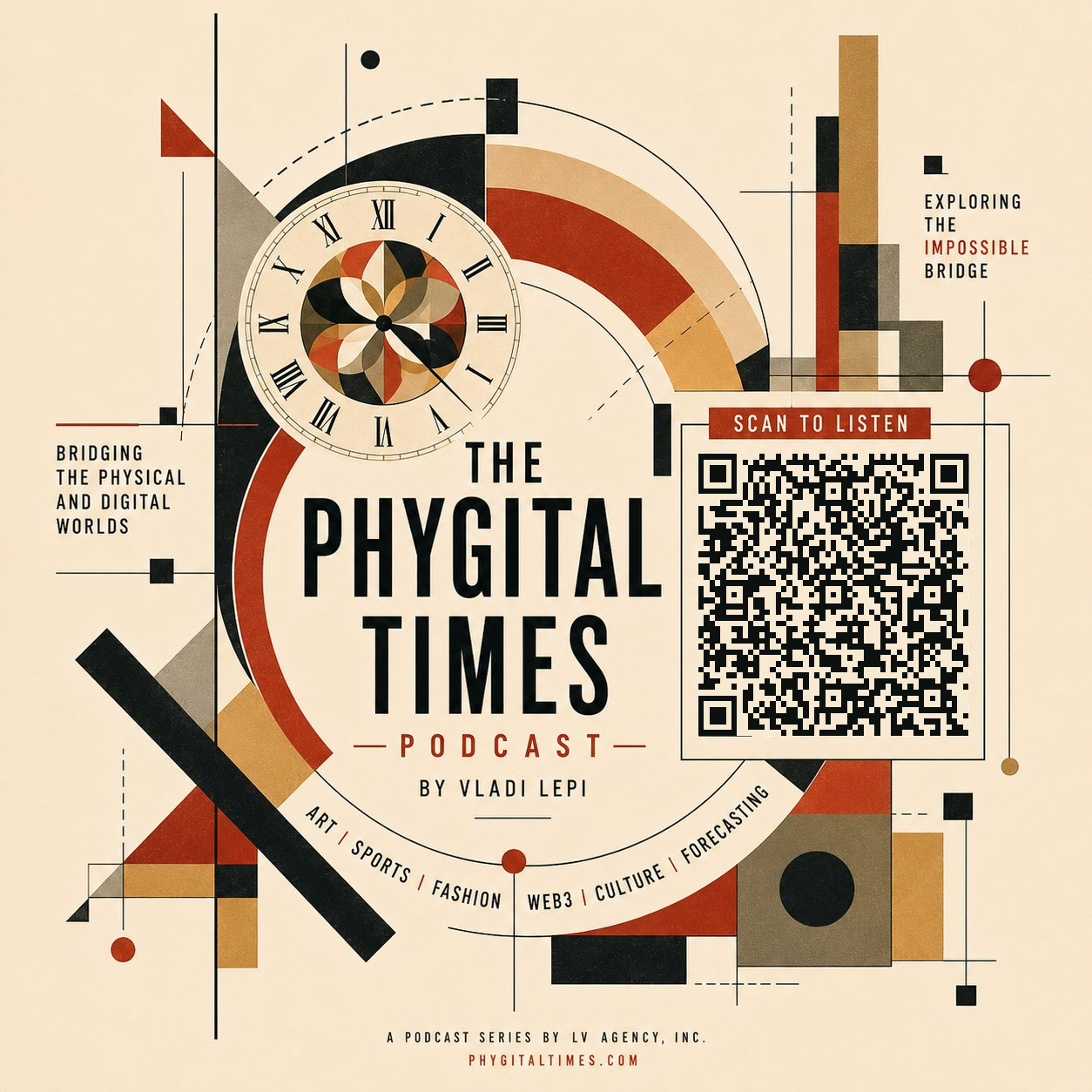
The Phygital Times Podcast, created by Vladi Lepi & managed by LV Agency, Inc., launches as the official audiovisual extension of The Phygital Times online publication - an ongoing media initiative exploring the rapidly converging worlds of fine art, artificial intelligence, blockchain systems, luxury culture, futuristic forecasting, esoteric and exoteric knowledge, and human-directed digital authorship.
At a moment when AI-generated content floods the internet and digital culture accelerates into abstraction, The Phygital Times aims to provide something increasingly rare: structure, narrative clarity, and intellectual direction.
The podcast investigates what creator Vladi Lepi describes as the “Impossible Bridge” between the physical and digital worlds - the emerging space where traditional cultural value systems collide with cryptographic permanence, AI amplification, and blockchain-secured ownership.
Through conversations, visual essays, forecasting frameworks, and deep conceptual analysis, the series explores topics including:
• The rise of the Phygital Lifestyle across art, sports, entertainment, fashion, and global marketing;
• Total Art + Tech as an interdisciplinary framework uniting performance arts, visual culture, AI systems, blockchain infrastructure, and immersive media;
• The evolving role of human authorship in the age of generative AI;
• Numeric Humanism and the emerging “System of Temporal Law” conceptual framework;
• Blockchain irreversibility as a new form of cultural memory and authorship verification;
• Hybrid art collecting and the future convergence of physical and digital assets;
• The conceptual and structural foundations behind SurR.Ai artworks, audiovisual systems, and phygital cultural production.
The podcast also expands upon the research and structural logic surrounding SurR: The System of Temporal Law - the AI-amplified audiovisual artwork submitted to the 2026 ABS Digital Art Prize under the theme SYSTEMS. By connecting the mathematical philosophy of Velimir Khlebnikov’s Tables of Destiny with the cryptographic logic introduced by Satoshi Nakamoto, the series positions authorship not merely as expression, but as a verifiable and irreversible system.
Rather than treating AI as an autonomous creator, The Phygital Times argues for a different model: human-made, AI-amplified culture directed through intentional systems, selection protocols, and blockchain-secured proof of authorship.
Designed for art collectors, strategists, technologists, media and PR professionals, high-net-worth individuals (HNWIs), upper-class audiences, new generations of business founders, and visionary creators, the platform operates at the intersection of theosophy and real-world technological infrastructure.
As the boundaries between physical and digital experience continue to dissolve, The Phygital Times Podcast seeks to document - and forecast - the deeper structures shaping the next era of culture.