The New Language of Authorship
Mathematics becomes choreography, blockchain becomes proof of intent, and AI becomes an instrument — not an author. The System of Temporal Law proposes a new language for human-made, AI-amplified phygital culture.

How “Phygital” Thinking, Numeric Humanism, and Blockchain Logic Are Reshaping the Future of Human-Made AI Art Right Now.
- a news-release feature and press briefing for journalists, reporters, media, and PR professionals covering the future of art, business, technology, authorship, and blockchain culture.
By Vladi Lepi & SurR.Ai for "The Phygital Times"
Introduction:
We Have Entered the Post-Prompt Era
Something fundamental is changing in digital culture.
For the past several years, artificial intelligence has been framed primarily as a generator of content - images, videos, music, text, simulations, and increasingly entire virtual environments. Millions of outputs are created daily. Yet behind this explosion of generative media lies a deeper unresolved question:
Who actually authored the work?
Was it the algorithm?
The prompt?
The platform?
The model trainer?
Or the human who designed the system behind the output?
This question became central during the development of SurR: The System of Temporal Law. Written in Numbers, Secured On-Chain, a 62-second AI-amplified audiovisual artwork created by New York-based art and technology practice SurR.Ai, a division of LV Agency, Inc.
The work was not conceived as “AI art” in the conventional sense. It was conceived as a human-authored protocol, a structured creative system where mathematics, history, cinematic composition, cryptographic logic, and blockchain verification merge into a single authorship framework.
At its core stands a governing equation:
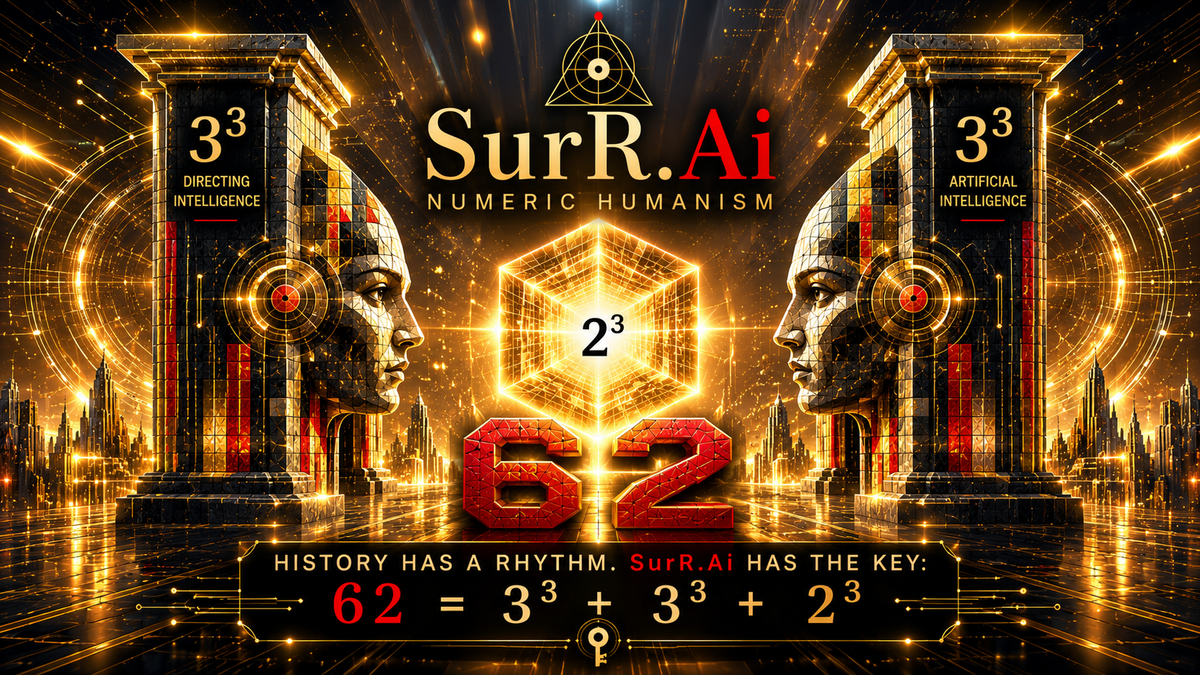
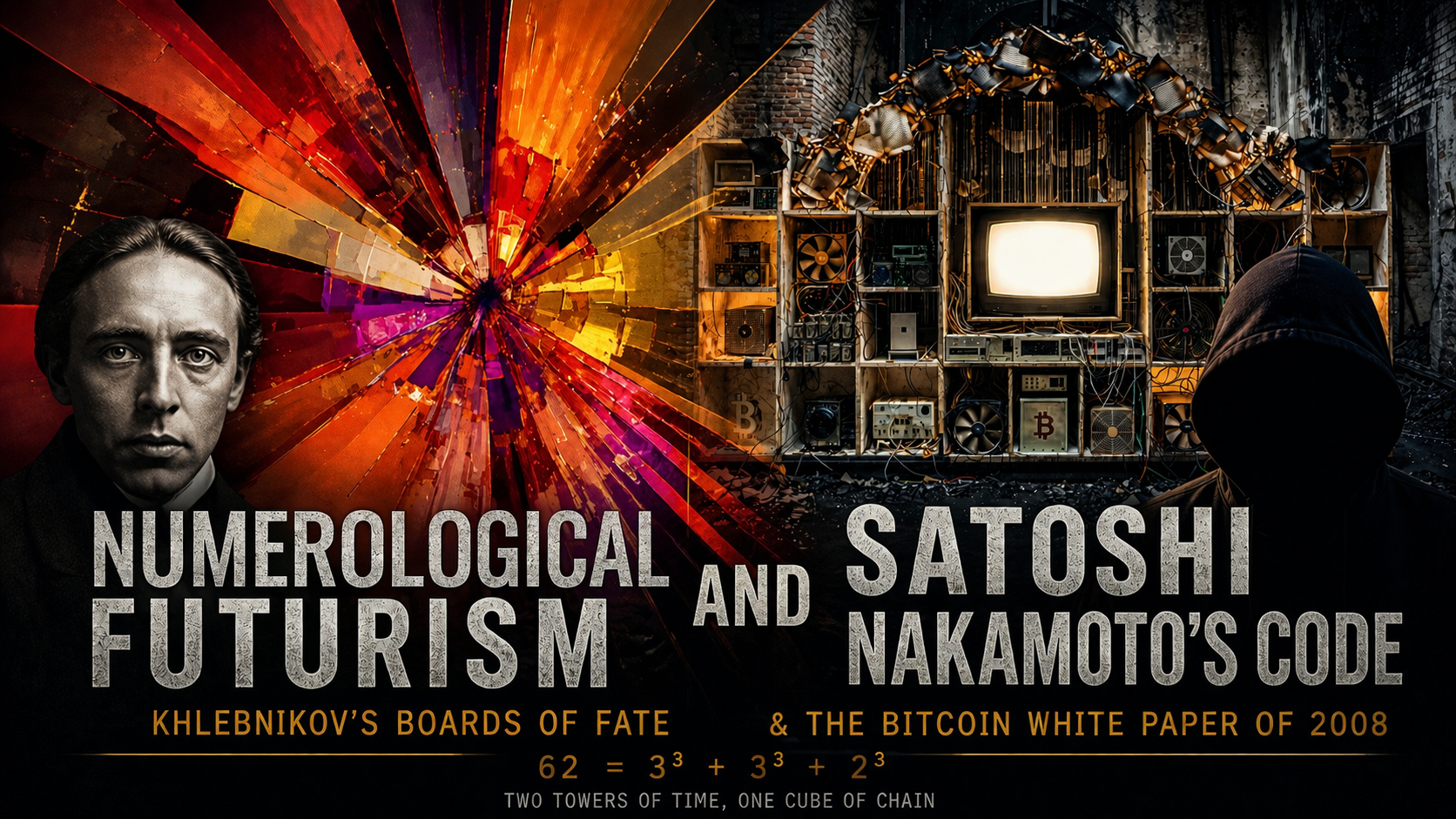
62 = 3³ + 3³ + 2³ | Two towers of time. One cube of chain.
This formula became more than a constraint. It became a language.
And from that language emerged a new glossary - one designed to help artists, collectors, technologists, and cultural institutions navigate the shift from simple generation toward systemic creation.
This article presents that evolving framework.
Based on the official SurR.Ai media documentation and development notes, The System of Temporal Law is positioned as a 62-second AI-amplified audiovisual system that uses blockchain timestamping to define authorship in digital creation. Although conceived digitally, the work remains grounded in the physical world through a range of installation formats prepared by the artist and his team, including potential screen-based displays, fine art prints, video loop presentations, and phygital exhibition environments.
Official press materials and the extended media kit are available upon request.
Part I: From Prompt Engineering to System Architecture
The early era of generative AI rewarded novelty.
A well-written prompt could produce astonishing results. But as the tools matured, prompting alone became insufficient as a marker of originality.
Why?
Because prompts can be copied.
Styles can be imitated.
Outputs can be replicated.
Models can regenerate endlessly.
What cannot be easily replicated is system design.
This realization led SurR.Ai toward the concept of System Architecture.
System Architecture
System Architecture is the structural blueprint created by the human artist before AI begins computation.
Rather than asking the machine to “make something beautiful,” the artist creates a governing framework:
- mathematical constraints
- duration rules
- symbolic references
- visual transitions
- sequence hierarchies
- edit protocols
- selection thresholds
- final verification procedures
In The System of Temporal Law, the 62-second duration was not chosen for convenience.
It was constructed mathematically. The equation defined the runtime, internal pacing, symbolic segmentation, and visual progression. The result is closer to a musical score, film script, or choreographic notation than a traditional AI prompt.
AI does not invent the system. It performs inside it.
Watch SurR: The System of Temporal Law. Written in Numbers, Secured On-Chain on YouTube
Part II: Artificial Intelligence as Instrument, Not Author
One of the most misunderstood aspects of AI-generated media is the tendency to anthropomorphize the machine.
At SurR.Ai, artificial intelligence is treated differently.
Artificial Intelligence as a Computer - Computational Instrument
In this framework, AI is not a creator. AI is computational infrastructure.
Comparable to:
- a camera in cinema
- a piano in music
- a printing press in publishing
- editing software in filmmaking
Or more precisely:
AI is the orchestra.
But an orchestra does not compose itself.
An orchestra requires direction.
This distinction is critical.
Without direction, AI produces abundance.
With direction, AI can produce authorship.
Part III: Directing Intelligence
SurR.Ai introduces one of its most important concepts:
Directing Intelligence
Directing Intelligence refers to the human-led process of guiding AI systems toward intentional outcomes.
The term draws parallels to:
- film directors
- ballet choreographers
- orchestra conductors
- architectural planners
- cryptographic system designers
In practical terms, Directing Intelligence includes:
Selection
Out of hundreds or thousands of generated outputs, which frames survive?
Elimination
What gets rejected?
Sequencing
What order creates meaning?
Compression
How much time is necessary?
Constraint
What rules define the boundaries?
Finalization
At what moment does the artist declare the work complete?
These decisions form what SurR.Ai describes as Proof of Intent.
Machines generate. Humans direct.
That difference may become one of the defining legal, philosophical, and cultural distinctions of the AI era.
Part IV: Numeric Humanism
Perhaps the most original philosophical contribution emerging from the project is:
Numeric Humanism
Numeric Humanism treats numbers not as abstract calculations, but as carriers of:
- memory
- symbolism
- culture
- rhythm
- mythology
- historical recurrence
The concept draws inspiration from:
- Velimir Khlebnikov, who believed history may follow numerical cycles
- Satoshi Nakamoto, who transformed timestamped mathematics into economic trust systems
SurR.Ai connects these two worlds:
Khlebnikov explored whether numbers govern civilization.
Nakamoto proved numbers can secure civilization.
Numeric Humanism proposes that:
Numbers can also help author culture - when guided by human direction.
In this framework, digital art is no longer simply an image.
It becomes a human-designed numerical protocol.
Watch the Multimedia NotebookLM Explainer: SurR: The System of Temporal Law on YouTube
Part V: Temporal Anchoring
Once a digital work is complete, another question emerges:
When does authorship become final?
SurR.Ai answers this through:
Temporal Anchoring
Temporal Anchoring is the act of fixing human intent into an irreversible moment of time.
For The System of Temporal Law, this occurred through minting on the Ethereum blockchain.
According to the official media documentation, the work was anchored on-chain on April 30, 2026, creating a permanent timestamp tied to its authorship.
This changes the role of blockchain.
Blockchain is no longer merely:
- marketplace infrastructure
- speculative trading rails
- ownership metadata
Instead, blockchain becomes:
Creative Infrastructure
A system that answers:
- When was the work finalized?
- Who anchored it?
- What exact version became canonical?
- Which sequence was declared authentic?
This is what SurR.Ai calls:
Temporal Law
A law defined not by institutions, but by time, structure, and verification.
Part VI: From NFT to Phygital System
The project also reflects a broader cultural transition.
Digital works no longer need to remain trapped on screens.
SurR.Ai frames this through:
Phygital Integration
The word “phygital” describes the fusion of:
- physical presence
- digital intelligence
- blockchain verification
- collectible permanence
In practice, this may include:
- NFT master editions
- fine art prints
- moving image displays
- video loop installations
- museum projections
- commissioned variants
- educational archives
This transforms digital work into an ecosystem. Not an object.
A system.
Part VII: Why This Matters Beyond Art
The implications extend far beyond Art Galleries or NFT marketplaces.
As AI-generated content expands across:
- media
- journalism
- advertising
- education
- finance
- entertainment
- government communication
The question of authorship becomes critical.
Not:
“Can AI create?”
But:
Who designed the system behind what AI created?
This may influence:
- copyright law
- intellectual property systems
- media authentication
- educational accreditation
- archival permanence
- digital trust frameworks
In that sense, The System of Temporal Law may represent more than an artwork. It may represent an early prototype for post-generative authorship systems.
The SurR.Ai Mini-Dictionary
Artificial Intelligence
A computational instrument capable of producing outputs at scale, but not inherently capable of authorship.
Directing Intelligence
The human-led orchestration of AI systems through selection, constraint, sequencing, and finalization.
Numeric Humanism
A creative philosophy where numbers become carriers of cultural memory, poetic structure, and human intention.
System Architecture
The blueprint governing how AI operates inside a defined artistic framework.
Temporal Anchoring
The act of fixing human authorship into an irreversible timestamp through blockchain infrastructure.
Temporal Law
A verified state in which human intent becomes permanently secured through time-based cryptographic proof.
Phygital Culture
A system where digital creation and physical experience coexist within a unified authorship framework.
Conclusion: The Future Belongs to Hybrid (Phygital) Systems
The age of prompt novelty is fading.
What comes next is deeper.
More structured.
More accountable.
More human.
As AI continues to generate infinite content, the value may no longer reside in output alone.
It may reside in:
Who designed the system.
Who directed the process.
Who anchored the intent...
and Who secured it in time.
That may be the true beginning of the next chapter in authorship.
And perhaps, the true beginning of Phygital Culture.
🚀 Sponsored by: We are grateful for the support of our sponsors, LV Agency, Inc. and SurR.Ai, who make it possible for us to deliver high-quality content to our readers.
Introducing The Phygital Times Podcast
Bridging the Physical & Digital Worlds Through Art, Intelligence, and Blockchain Culture.
A new audiovisual platform has officially entered the evolving phygital landscape.

The Phygital Times Podcast, created by Vladi Lepi & managed by LV Agency, Inc., launches as the official audiovisual extension of The Phygital Times online publication - an ongoing media initiative exploring the rapidly converging worlds of fine art, artificial intelligence, blockchain systems, luxury culture, futuristic forecasting, esoteric and exoteric knowledge, and human-directed digital authorship.
At a moment when AI-generated content floods the internet and digital culture accelerates into abstraction, The Phygital Times aims to provide something increasingly rare: structure, narrative clarity, and intellectual direction.
The podcast investigates what creator Vladi Lepi describes as the “Impossible Bridge” between the physical and digital worlds - the emerging space where traditional cultural value systems collide with cryptographic permanence, AI amplification, and blockchain-secured ownership.
Through conversations, visual essays, forecasting frameworks, and deep conceptual analysis, the series explores topics including:
• The rise of the Phygital Lifestyle across art, sports, entertainment, fashion, and global marketing;
• Total Art + Tech as an interdisciplinary framework uniting performance arts, visual culture, AI systems, blockchain infrastructure, and immersive media;
• The evolving role of human authorship in the age of generative AI;
• Numeric Humanism and the emerging “System of Temporal Law” conceptual framework;
• Blockchain irreversibility as a new form of cultural memory and authorship verification;
• Hybrid art collecting and the future convergence of physical and digital assets;
• The conceptual and structural foundations behind SurR.Ai artworks, audiovisual systems, and phygital cultural production.
The podcast also expands upon the research and structural logic surrounding SurR: The System of Temporal Law - the AI-amplified audiovisual artwork submitted to The 2026 Lumen Prize. By connecting the mathematical philosophy of Velimir Khlebnikov’s Tables of Destiny with the cryptographic logic introduced by Satoshi Nakamoto, the series positions authorship not merely as expression, but as a verifiable and irreversible system.
Rather than treating AI as an autonomous creator, The Phygital Times argues for a different model: human-made, AI-amplified culture directed through intentional systems, selection protocols, and blockchain-secured proof of authorship.
Designed for art collectors, strategists, technologists, media and PR professionals, high-net-worth individuals (HNWIs), upper-class audiences, new generations of business founders, and visionary creators, the platform operates at the intersection of theosophy and real-world technological infrastructure.
As the boundaries between physical and digital experience continue to dissolve, The Phygital Times Podcast seeks to document - and forecast - the deeper structures shaping the next era of culture.